
APPEALS & DONOR CHOICE
The Gift That Hasn't Happened
Follow up on an intention without counting it as money.
Record what donors say about giving again, follow up only where they’ve agreed, and report the survey without counting a gift that hasn’t happened.
Go to the messages and worksheet ↗The decision
The finding in its setting
Godin and colleagues (2014) randomly assigned 7,000 lapsed blood donors to one of six questionnaires or to a control group that received none, then counted registrations at blood drives over the next 6 and 15 months. Some questionnaire versions increased registration compared with the control group. About 23% of people with valid addresses returned a questionnaire.
The outcome was blood-drive registration, so the study cannot tell you how much money a cash-donation survey would produce. Returning a questionnaire was a choice, which is why the comparison that counts is everyone assigned against everyone in the control group. People who reply differ from people who don’t in ways no mailing caused.
How an answer turns into a number
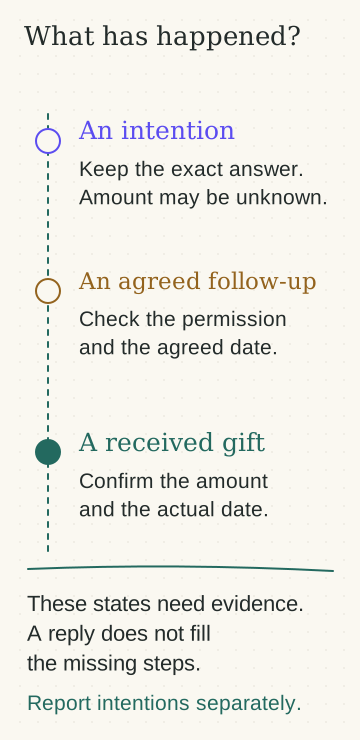
Survey answers drift as they move through a team. “I plan to give again” becomes “likely donor” in the database, then “41 expected renewals” in the board pack, then a revenue line built on the average gift. Each step seems reasonable to whoever takes it, and none of them is something the donor said.
The donor answered one question, on one date. That’s what the record should hold, with the wording of the question. Anything staff infer goes in a separate note and doesn’t change the donor’s status. Permission to follow up is a separate answer too; a donor can plan to give and still not want a call.
| Answer | What you know | What you can do | When it ends |
|---|---|---|---|
| No reply | Nothing new. Silence isn’t a no, a maybe or permission. | Carry on with the donor’s usual communications. | Nothing is recorded, so nothing needs to end. |
| Plan to give | What the donor said, on that date. | Thank them. Follow up personally only if they ticked the follow-up box. | When they give, or at the recheck date. |
| Not sure yet | What the donor said, on that date. | Follow up only with permission, and offer what they might find useful. | At the recheck date. |
| Not right now | What the donor said, on that date. | Thank them. No personal ask follows from the survey. | At the recheck date. |
| Gift received | A gift, with its amount. | Receipt and thanks as usual. Cancel any planned follow-up ask. | The answer is closed. |
| Formal pledge | A commitment made through your usual pledge process. | Finance records it under your organization’s policy. | Handled by finance, outside the survey record. |
Give every answer a recheck date
An answer describes one moment. Set a recheck date when you record it, such as the end of the period the question asked about. After that date it leaves the active list and stays in the donor’s history. Nobody should stay a “likely donor” because of a box they ticked two years ago.
To find out whether the survey changed giving, hold back a randomly chosen group that doesn’t receive it, and fix the dates before sending. Then compare the share of each whole group who gave, counting each donor once. The reply rate and the giving rate have different denominators. Keep them apart in every report.
The study
- Promoting the Return of Lapsed Blood Donors: A Seven-Arm Randomized Controlled Trial of the Question–Behavior Effect
2014. Measures blood-drive registration, not money. Compares everyone assigned to each group.
Worked case
The worked cases and templates use invented people and organizations.
Fernwood’s check-in survey
After Femi checks duplicate identities and excludes donors whose contact preferences do not permit this survey, Fernwood Community Pantry has 1,200 eligible individual donors whose last gift was 13 to 36 months before March 1. Rhea, the development manager, wants to ask them whether they’re thinking of giving again. Femi, the operations lead, wants to know whether asking makes any difference.
On March 2, Femi randomly splits the 1,200 into two groups of 600 and saves the file. One group receives the survey on March 3. The other doesn’t. Both groups get Fernwood’s usual communications. The comparison window runs from March 3 to August 31, which is also the recheck date for every answer.
The survey
Sent March 3 to the 600 donors in the survey group.
| Status | Donors | Asked for follow-up |
|---|---|---|
| Email bounced | 12 | 0 |
| Delivered, no reply | 492 | 0 |
| Replied: plan to give | 41 | 25 |
| Replied: not sure yet | 33 | 11 |
| Replied: not right now | 22 | 1 |
| All survey recipients | 600 | 37 |
96 of the 600 replied, a reply rate of 16% of everyone sent the survey. Six replies mentioned an amount in the comment box, such as “probably $50 again.” Rhea copies each comment into the donor’s record word for word and adds none of them up.
Rhea owns the follow-ups and works through the 37 by the channel each donor chose. Two donors who planned to give gave online before Rhea reached them; their follow-ups were cancelled and they received the usual receipt and thanks. Of the 35 Rhea contacted by March 31, four replied “no thanks,” and their records now say so. The 22 who said “not right now” get no personal ask; the one who asked about volunteering in their comment gets the information they requested.
Rhea’s follow-up to a donor who plans to give
Sent to donors who answered “Yes, I plan to” and ticked email.
The April report
Rhea’s first draft for the April 14 finance committee counted the 41 “plan to give” answers as expected renewals at the group’s average past gift of $85: 41 × $85 = $3,485 in the spring forecast. Femi took it out. The answers did not establish 41 gifts of $85. Some comments mentioned possible amounts, but none created a commitment through Fernwood’s pledge process. The $3,485 was Fernwood’s estimate, presented as donors’ commitments.
The report gives the survey counts in full, reconciled to all 600 recipients, and leaves revenue as gifts received. Two donors made written pledges after their follow-up; finance recorded them through its usual pledge process, and the report counts them there.
The survey section of the April report
Every recipient appears in exactly one line.
August 31: did the survey make a difference?
Femi counts, for each group of 600, the donors who made at least one gift between March 3 and August 31, from any channel, counting each donor once. Everyone stays in the group they were assigned to, including bounces and people who never replied.
| Group | Assigned | Donors who gave | Share who gave |
|---|---|---|---|
| Survey | 600 | 39 | 6.5% |
| No survey | 600 | 31 | 5.2% |
| Difference | – | 8 | 1.3 percentage points |
This comparison covers the survey and the agreed personal follow-ups it triggered. It cannot isolate the effect of asking the question. Eight more donors gave in the survey group. With 600 in each group, a gap that size could easily come from chance, so Femi reports a small difference that doesn’t settle whether the survey helped. Repeating the same design next year would add evidence.
The 39 survey-group donors who gave include 22 who said they planned to, 7 who weren’t sure, 1 who said not right now and 9 who never replied. So 22 of the 41 who planned to give did give, which is 54%. Femi doesn’t set that beside the 5.2% in the no-survey group. Those 41 chose to reply and chose that answer, and many would probably have given anyway. The 54% describes them and says nothing about what the survey did.
On August 31 every answer reached its recheck date. The 19 donors who said they planned to give and haven’t are no longer flagged, and their March answers stay in their history.
Put it to work
Your survey question
Keep the follow-up question separate from the intention question, and keep the last line.
Your follow-up messages
Send only to donors who asked to hear from you, by the channel they chose. Each version has a way to decline.
Your intention record and survey report
The record holds one donor’s answer. The report must add up to everyone sent the survey.
The donor intention follow-up kit
The survey, the three follow-up messages, the intention record and the reconciling report in one file.
Download the follow-up kitWho does what
Whoever processes replies records each answer word for word and opens a follow-up task only where the donor ticked a box. One named person owns each follow-up and its due date. Finance owns pledges, through whatever process your organization already uses; the survey doesn’t create a new kind of commitment. Whoever reports to leadership owns the reconciliation, the comparison and the recheck date.
Exceptions
- A donor gives before you follow up. Cancel the follow-up, send the receipt and thanks as usual and close the answer.
- A donor writes an amount. Copy it word for word into the comment field. It becomes a pledge only if the donor makes one through your usual process.
- A donor who said “not right now” gives anyway. Thank them as you would anyone. The earlier answer was true when they gave it.
- Someone answers for a household. Record the answer against the person who replied and note the household. Don’t copy it onto other people’s records.
- A donor asks not to be contacted at all. That overrides the follow-up and every other list.
Check whether it worked
- Every recipient appears in exactly one line of the report, and the lines add up to the number sent.
- Every follow-up task traces back to a ticked box.
- No intention appears in revenue, receivables or the forecast.
- Every answer has a recheck date, and the active list shrinks as those dates pass.
- If you compared groups, both giving rates use everyone assigned, over the same fixed dates.
Continue with the research
Gaston Godin and colleagues sent questionnaires to lapsed blood donors and counted blood-drive registrations. Everyone assigned to each questionnaire was compared with a control group that received none.
Read how the seven groups were defined and what each questionnaire asked, then the registration results at 6 and 15 months. Check which comparisons include every assigned donor, whether or not they returned the questionnaire.
Gaston Godin, Marc Germain, Mark Conner, Gilles Delage and Paschal Sheeran
Other decisions before the send
The appeal needs urgency. The facts are still being checked.The Deadline Has to Be Real
Write an urgent appeal your program and finance teams can stand behind.
We want to ask donors which program matters to them.What Does This Box Promise?
Ask donors what matters and make clear what their answer changes.
Someone wants to add a giving link to the thank-you.Thanks, Then Another Ask?
Decide whether an invitation belongs in this donor’s thank-you.
We promised fewer fundraising emails. Several teams send them.One Email Means Every Team
Make an email-frequency promise every sender can keep.