
APPEALS & DONOR CHOICE
The Deadline Has to Be Real
Write an urgent appeal your program and finance teams can stand behind.
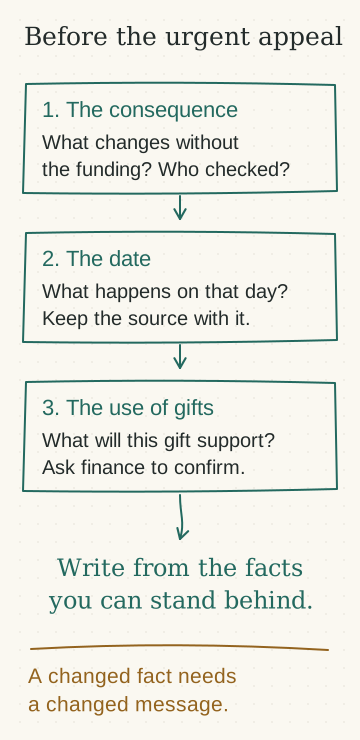
Finish an appeal claim brief: confirm what is actually at risk, set a date you can defend, say where gifts go and decide what you’ll send if the facts change.
Go to the messages and worksheet ↗The decision
The finding in its setting
Tanner (2026) compared two Charles Darwin Foundation campaigns sent to 3,983 previous donors. One reported that a species had gone extinct; the other that a species believed lost had been found. About 2.1% of donors gave to the extinction campaign and about 1.2% to the rediscovery campaign.
Both campaigns reported something that had happened, to people who already supported that conservation work. The study didn’t reword one program as a loss, and it gives no reason to describe a loss nobody has confirmed. Nor does it show that loss framing doubles giving for other organizations. It supports a narrower point, that a true account of a loss can draw a response from people who already care about the work.
Three things that get called a deadline
Appeal drafts often treat three different situations as one. A program consequence means a specific service will stop, shrink or not start on a known date unless money arrives, and someone with authority has said so. A finance shortfall means the budget is short. That’s real, but a gap in the general budget rarely means one particular service ends on one particular day; the organization may draw on reserves, cut elsewhere or finish the year in deficit. A calendar date is one the campaign chose: the end of the tax year, the last day of the appeal, the day the printer needs copy.
Each supports different words. Only a confirmed program consequence lets you say something will be lost. A shortfall lets you describe the gap and what gifts will help with. A calendar date lets you ask for a gift by that date and say why you chose it, without implying anything happens to the program afterwards.
| What you have | Who confirms it | The appeal can say | The appeal can’t say |
|---|---|---|---|
| A program consequence with a decision date | The program lead confirms what is at risk. Whoever decides, such as the director or board, confirms the date and the condition. | What will stop or not start, from when, and what the decision depends on. | That more is at risk than the confirmed service, or that one gift decides it. |
| A finance shortfall | Finance confirms the amount and the period. | The size of the gap and what gifts to this appeal support. | That a named service ends unless the gap closes, unless someone has decided that. |
| A matching gift with an end date | Finance or the funder confirms the terms in writing. | The match amount, its terms, its end date and what happens if it’s met early. | That the program depends on the match, unless that is separately confirmed. |
| A date from the campaign calendar | Nobody needs to. It’s your date. | A request to give by that date, and why you chose it. | That anything is lost after it. |
| A consequence nobody can confirm in time | Nobody, yet. | What gifts make possible, with no deadline. | Any loss, until it’s confirmed. |
Where the money goes
A second claim usually travels with the deadline: what a gift buys. “Gifts to this appeal support our after-school program” and “Your $500 gives a child a place” describe different arrangements. The second implies the gift is spent on that place, which is only true if your organization records and uses it that way. Ask finance how gifts made through this appeal will be recorded before you choose the wording.
If gifts go to a general program fund, you can still show what things cost. “A Saturday place for the spring term costs about $500” gives donors a sense of scale, provided the same paragraph says gifts support the whole program. Write the calculation into the brief and have finance check it, so whoever answers a donor’s question can show where the figure came from.
Plan for the facts to change
The facts behind an appeal keep moving after the copy is approved. A grant arrives, the board changes its plan, a building fails an inspection. Before sending, decide who will tell you if the consequence changes, what you’ll send instead and how you’ll correct anything already out. Write the replacement version at the same time as the first, while the facts are fresh, and get it approved in the same sign-off.
The study
- Lost and found: A natural field experiment on charitable donations, extinctions, and finance for conservation
Published 2026. The two campaigns reported different real events; read what each told donors before comparing the gift rates.
Worked case
The worked cases and templates use invented people and organizations.
The sentence in the draft
Millbrook After School runs a weekday program for 60 children, Monday to Thursday, funded through June by a city contract and two foundation grants. In September it added a Saturday morning session for 24 children whose schools had referred them for extra help with reading and maths. A one-off grant pays for Saturdays until December 12.
On November 4, Ama, the development director, receives the year-end email draft. Its opening line reads: “This winter, 60 children could lose their after-school place unless you give by December 31.” The appeal is scheduled for November 17. Ama opens a claim brief and checks each part of the sentence with the person who would know.
| Part of the sentence | Who Ama asked | What they confirmed | What changes |
|---|---|---|---|
| 60 children | Jonah, program director | 60 children attend on weekdays. 24 attend on Saturdays, all referred by their schools. | Use 24, and name the Saturday session. |
| could lose their after-school place | Rosa, finance director | The weekday program is funded through June 30. No weekday place is at risk. | Only the Saturday session is at risk. Say so, and say the weekday program is safe. |
| this winter | Jonah | The last funded Saturday is December 12. A spring term would run 20 Saturdays from January 9 to May 29, with no session on April 3. | Name the dates. |
| by December 31 | Dee, executive director, and the board minutes of October 22 | The board decides on December 10, using gifts and written grant commitments received by December 8. December 31 came from the campaign calendar. | The date in the appeal becomes December 8. |
| unless you give | Rosa | Gifts to the appeal go to the after-school program fund, which pays for weekdays and Saturdays. The board counts them toward the Saturday decision. If Saturdays end, or more is raised than Saturdays need, the money supports weekdays. | Explain what gifts support and what happens in each case. Don’t say a gift buys a place. |
The cost, and the condition
Jonah and Rosa cost the spring term together. The funder of the autumn grant has agreed in writing that $3,000 left unspent can be used in the spring.
| Line | Calculation | Amount |
|---|---|---|
| Tutors | 2 tutors × 4 hours × $30 × 20 sessions | $4,800 |
| Site lead | 5 hours × $40 × 20 sessions | $4,000 |
| Snacks and materials | 24 children × $3 × 20 sessions | $1,440 |
| Building opening fee | $88 × 20 sessions | $1,760 |
| Total cost | $600 per session × 20 sessions | $12,000 |
| Already confirmed | Unspent autumn grant, funder’s written approval on October 28 | $3,000 |
| Still needed by December 8 | $12,000 − $3,000 | $9,000 |
The board minute sets the condition. If $12,000 is confirmed by December 8, all 20 Saturdays run. If less is confirmed, Millbrook will run as many full sessions as the money covers, at $600 each, as long as that’s at least ten. With less than $6,000 confirmed in total, which means less than $3,000 raised, the Saturday session ends on December 12 and families hear that week.
A spring place costs $12,000 ÷ 24 = $500. The appeal can use that figure to show scale, in the same paragraph that says gifts support the whole after-school program.
Ama’s decision
The appeal goes out on November 17 about the Saturday session, with December 8 as its date and the board’s condition stated plainly. December 31 comes out of the copy, along with the 60 children. Jonah and Rosa agree to tell Ama the same day if a grant decision or anything else changes the gap. The replacement version is approved in the same sign-off, so the team can switch without another round of review.
The appeal email
Sent November 17. Every figure and date matches the claim brief.
The replacement version
Approved with the main email. Used if the spring term is fully funded before November 17, or if the board’s condition can’t be confirmed by the copy deadline. Choose one of the two middle paragraphs.
When the funding arrived
On November 30, the Pell Family Fund confirmed in writing a $4,000 grant for the spring Saturday session. With $5,350 already given to the appeal, confirmed spring funding reached $3,000 + $4,000 + $5,350 = $12,350, a week before the date in the appeal. Dee confirmed that the board’s condition had been met.
Ama followed the brief. The giving page changed on November 30 to say the spring term was funded. The December 6 reminder, which repeated the deadline, was cancelled. The update below went out on December 1 to appeal recipients who could still receive it under their contact preferences. The grants and $5,000 of the appeal gifts covered the Saturday cost. The remaining $350, and any appeal gifts received after November 30, went to the weekday program, under the terms the appeal had described. Donors still heard the board’s decision on December 11, as promised.
The December 1 update
A funding update for appeal recipients whose contact preferences permit it. It contains no further request.
Put it to work
Your appeal claim brief
Complete it before the copy is approved. Keep it with the draft, and give a copy to whoever answers donor replies.
Your appeal, in two versions
Draft both together and approve them together. Every bracket should be filled from the claim brief.
Change notice to colleagues
Send the same day a fact in the brief changes, before anyone answers another donor.
The appeal claim brief
The brief, both email versions and the change notice in one file, to share with program and finance before the copy is approved.
Download the appeal claim briefWho does what
- The development director owns the brief and approves the final copy.
- The program lead confirms what is at risk, who is affected and what isn’t at risk.
- Finance confirms the costs, the fund and what happens to gifts in each case.
- Whoever decides, usually the executive director or board chair, confirms the condition and the decision date.
- Donor care answers replies from the brief and passes anything it doesn’t cover to the brief owner.
Exceptions
- A sudden, real loss, such as a building closed after an inspection. Complete sections 3 and 4 with the people who can confirm the facts before approving the first email.
- A matching gift. State the match amount, its terms and its end date. If the match is met early, say so on the giving page and in any reminder.
- The consequence has already happened. Report it, and describe what gifts will do now. Don’t ask donors to prevent something that has already occurred.
- Identifiable people. Describe the service and the numbers. Use a child’s or family’s name, photograph or story only with the permission your organization requires for that use.
Check whether the brief helped
- Every number and date in the sent email matches the brief, and a colleague outside development can trace each one to the person who confirmed it.
- Count donor replies asking about the claim, and how many your team answered from the brief without going back to program or finance.
- The report-back went out on the date the appeal promised.
- If the facts changed, note how long it took for the giving page and reminders to change.
- Add a line to the brief for anything it didn’t cover this time.
Continue with the research
Michael Tanner analyzed two Charles Darwin Foundation campaigns sent to previous donors. One reported a species extinction and the other the rediscovery of a species thought lost. Both described real events.
Read Tanner’s description of the two campaigns, including what each told donors, before the gift rates. The events themselves differed, and that shapes what the comparison can tell you about your own appeal.
Michael K. Tanner
Other decisions before the send
We want to ask donors which program matters to them.What Does This Box Promise?
Ask donors what matters and make clear what their answer changes.
A donor said they plan to give. What do we record now?The Gift That Hasn't Happened
Follow up on an intention without counting it as money.
Someone wants to add a giving link to the thank-you.Thanks, Then Another Ask?
Decide whether an invitation belongs in this donor’s thank-you.
We promised fewer fundraising emails. Several teams send them.One Email Means Every Team
Make an email-frequency promise every sender can keep.