
FIELD GUIDE 04 / IMPACT COMMUNICATION
One Story, Ready to Send
Turn a program lead’s rough notes into an update that is accurate and worth reading.
A good update gives the donor one real result, what it probably means and a detail that makes the work visible. All three have to come from records someone can check. This guide goes from a program lead’s notes to a finished email, showing what each editorial choice adds.
This is a teaching case. The program, people, records and figures are invented.
Read the transcript
Put one real result in a donor update, and say how sure you are right beside it. Morgan asked how September went. 42 students came to the reading sessions, and 31 came to four or more. Tutors ran a one-minute reading check at the start and end of the month. Of the 36 who took both, 26 read more words correctly at the end. It's one month, tutors scored their own students, and there's no comparison group, so call it an encouraging early sign. It can't show the program caused the change, and nobody measured confidence. The sign-out sheet has 58 entries, which counts loans, not children. Use the cleared photo of the book shelf. The story about one boy stays out; nobody recorded it, and it would need his family's permission.
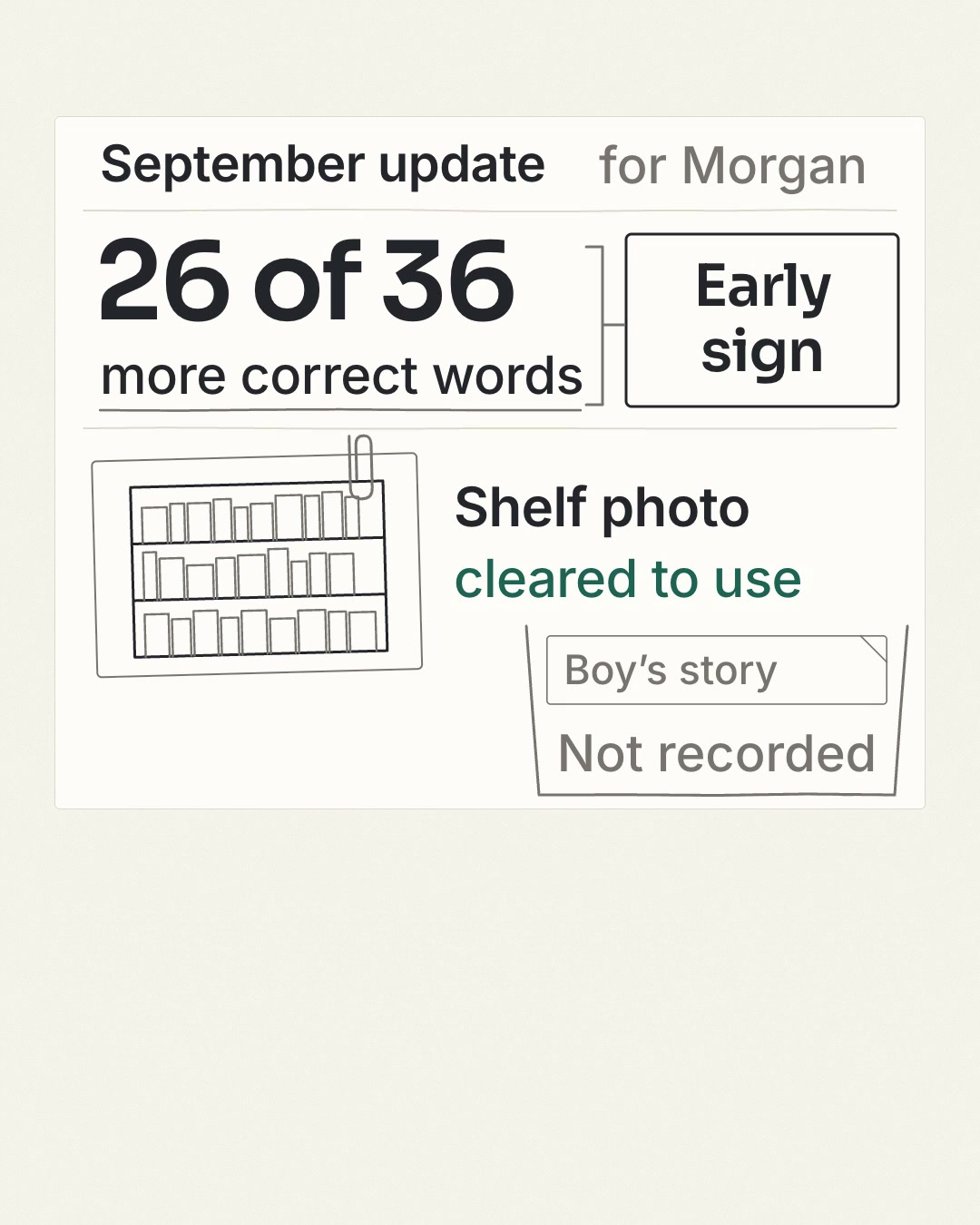
Put one real result in a donor update, and say how sure you are right beside it. Morgan asked how September went. 42 students came to the reading sessions, and 31 came to four or more. Tutors ran a one-minute reading check at the start and end of the month. Of the 36 who took both, 26 read more words correctly at the end. It's one month, tutors scored their own students, and there's no comparison group, so call it an encouraging early sign. It can't show the program caused the change, and nobody measured confidence. The sign-out sheet has 58 entries, which counts loans, not children. Use the cleared photo of the book shelf. The story about one boy stays out; nobody recorded it, and it would need his family's permission.
What the program lead sent
Morgan, who supports the reading program, asked how September went. Amina, Morgan’s contact, has this from Ben, the program lead:
- Register. 42 distinct students came to at least one of six sessions, September 2–30. 31 came to four or more.
- Reading check. In the first and last week, tutors ran the program’s one-minute check, which counts words read correctly. 36 students took both. 26 read more words correctly at the end. Tutors scored their own students.
- Session logs. From week three, students asked to take books home. Tutors started a sign-out sheet: 58 sign-outs by September 30.
- Ben’s note. “The kids loved it. Huge jump in confidence.”
- A tutor’s story, told to Ben. A boy who wouldn’t read aloud in week one read a full page to the group in week four. It isn’t in the log.
- Photos. The book shelf, with no students in frame, cleared for donor emails. Students reading in a circle, with no permission recorded for donor use.
- Next result. Ben has scheduled the same check for December and agreed to have results ready for Amina on January 12, 2027. Amina has reserved time to review them and send Morgan an update by January 16.
Choose what goes in, and why
| In the notes | Choice | What it adds, or why it stays out |
|---|---|---|
| 42 students; 31 at four or more sessions | Keep both numbers | The second shows regular attendance, which a headcount hides. |
| 26 of 36 read more words correctly | Keep, with how it was measured and one sentence on its limits | The one real result. Describing the check lets Morgan judge it. |
| 58 book sign-outs | Keep | A recorded detail that shows students asking to borrow books. It makes their interest visible without claiming we know what they read at home. |
| “Huge jump in confidence” | Leave out; ask Ben what tutors saw | Nobody measured confidence. A specific recorded behavior could go in instead. |
| The boy in week four | Leave out | It isn’t recorded, and it describes an identifiable child. It would need his family’s permission and the tutor’s confirmation. |
| Shelf photo; circle photo | Use the shelf only | The shelf is cleared and shows something real. The circle photo has no recorded permission. |
Say what the result means, and how sure you are
“26 of 36 read more words correctly at the end of the month” is what the check shows. Deciding what it means takes judgment. One month is short, tutors scored their own students, and there is no comparison group, so some of the gain might have happened anyway. Together those support “an encouraging early sign.” They don’t support “improved reading ability” in general, or a claim that the program caused the change.
Say that in one plain sentence next to the result. Morgan gets a real finding and enough context to weigh it, without a paragraph of caveats.
Draft to reject:
Your generosity transformed 42 young readers, who gained confidence and fell in love with books.
What the records support:
Of the 36 students who took both reading checks, 26 read more words correctly at the end of September than at the start. It’s one month, scored by the tutors, so we read it as an encouraging early sign.
The finished update
The findings trace to the register, reading checks and sign-out sheet. The photo is cleared, the interpretation is labeled as the team’s reading, and the next result has an agreed schedule.
Send the program lead a draft and three questions
Ben can answer in a few minutes: he has a draft to mark up, three specific questions and a date. Keep participant records and personal details where your team already controls access.
If the result isn’t ready
Suppose the second round of checks is still being scored. The update still has the attendance, the sign-out sheet and the photo. Say what is coming and when:
If you promised news about one participant, program news doesn’t fulfill it. Say so:
If someone proposes a participant’s story
Suppose the boy’s family later agrees to his story appearing in a donor update, and communications then wants it for the public appeal as well. Each new audience, version or channel is a fresh question for the family. Prepare the replacement before you ask. The update above is that replacement: approved, ready and dependent on nobody’s personal story. With it in hand, the family can say no without leaving a gap.
Give whoever publishes one record: the approved version, where it may appear, what isn’t approved and who to contact about a change. The family’s reasons stay with the staff contact. The field notes A backup makes “no” possible work through a completed record for an event film.
Write your version
Delete any line you can’t support. Attendance and one good recorded detail still make an update worth sending.
TAKE IT TO YOUR TEAMThe story briefCSV · Verified facts, interpretation and limits, exclusions and a blank briefTAKE IT TO YOUR TEAMFrom notes to updateEditable guide · Source packet, choices, finished email, request and story-use recordFinish the handoff
| Work | Person responsible | Finish condition |
|---|---|---|
| Check the figures, the check description and the photo | Ben, program lead | Draft corrected and records linked by October 9. |
| Send the update | Amina, Morgan’s contact | Final version and send date saved by October 11; delivery checked. |
| December reading check | Amina, with Ben | Check with Ben on January 12; results to Morgan by January 16. |
Sending the update answers Morgan’s September question. The December results are a new promise with their own date.
Further reading: Jenna Watanabe and Maria Bryan on storytelling and consent. The teaching case, messages and records here are original Gratona examples.
Explore the reading list ↗