
FIELD GUIDE 01 / STEWARDSHIP
Who Promised What?
Turn an overdue donor update into a clear handoff.
“Follow up with Morgan” is hard to finish. “Check the attendance count with Ben by October 9, then update Morgan by October 11” gives someone work they can do.
The people and promises in this guide are fictional.
Read the transcript
Keep the date you gave a donor, even when the figure behind it is late. On October 4, Amina told Morgan she'd send September's attendance figures by October 11. The count isn't verified yet. Ben, on the program team, is checking the register for duplicate entries by October 9. So two people hold different parts of this promise. Ben owns the checked number. Amina owns the answer to Morgan. Now suppose Ben's check runs late. Waiting quietly for him would let Morgan's date pass in silence. Amina still owes Morgan a note by October 11: what's still being checked, and a realistic day she'll write again. The record keeps the original date, with the new one beside it. Give the check and the answer separate owners and separate dates.
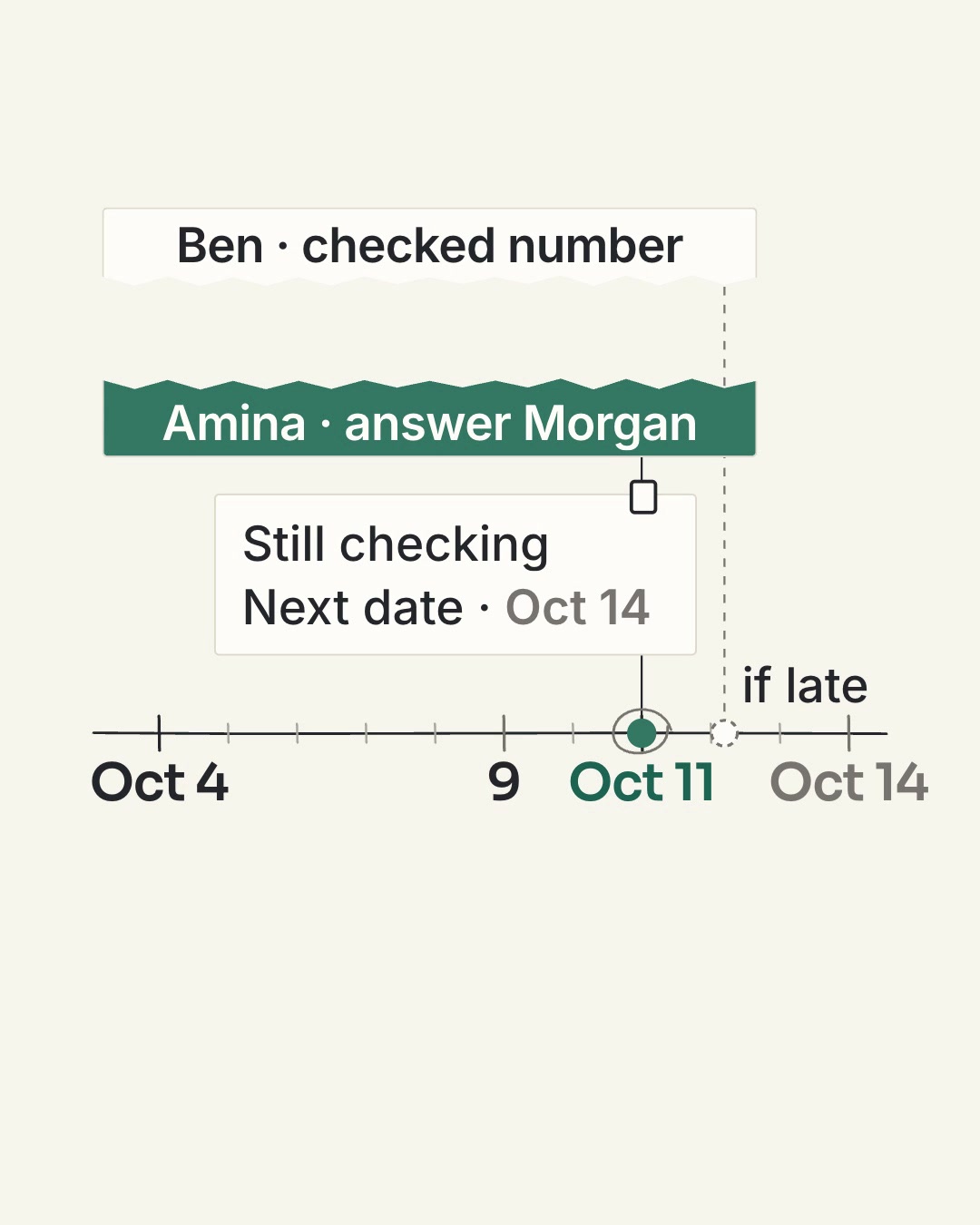
Keep the date you gave a donor, even when the figure behind it is late. On October 4, Amina told Morgan she'd send September's attendance figures by October 11. The count isn't verified yet. Ben, on the program team, is checking the register for duplicate entries by October 9. So two people hold different parts of this promise. Ben owns the checked number. Amina owns the answer to Morgan. Now suppose Ben's check runs late. Waiting quietly for him would let Morgan's date pass in silence. Amina still owes Morgan a note by October 11: what's still being checked, and a realistic day she'll write again. The record keeps the original date, with the new one beside it. Give the check and the answer separate owners and separate dates.
Find the open promises first
Most overdue promises were never written down as tasks. They sit in sent mail and call notes. Before building a handoff, set aside about twenty minutes to look.
- Choose a window, such as the last 30 days, and open your sent mail and your call or meeting notes.
- Search for the phrases people use when they commit: “I’ll send”, “I’ll get back to you”, “I’ll follow up”, “let me check”, “I’ll ask”, “by Friday”, “next week”. In call notes, try “promised”, “will send” and “asked for”. These are starting points. They will miss promises worded differently and turn up plenty that aren’t promises.
- Sort each result: an open commitment to a donor, one already kept (find the reply that kept it), or not a donor commitment.
- For each open one, copy the exact words, the date and a link to where it was made.
- At the next team meeting, ask colleagues what they have told donors they would do. Your search can’t find a promise made aloud or from someone else’s account.
Amina’s search of her last 30 days found six results:
| What it said | Where | Decision |
|---|---|---|
| “I’ll send you September’s attendance figures by October 11.” | Call note with Morgan, October 4 | Open. The worked example below. |
| “I’ll get back to you about visit dates.” | Email to a donor, September 22 | Open, with no date. Agree one and tell the donor. |
| “I’ll send the annual report as soon as it’s printed.” | Email to a donor, September 30 | Open, waiting on the printer. Record that and a check date. |
| “I’ll pass your thanks on to the tutors.” | Call note, September 25 | Open and small. Do it today and note it. |
| “I’ll send you the photos from the gala.” | Email to a donor, September 18 | Kept: sent September 19. Nothing to do. |
| “I’ll send it over this afternoon.” | Email to the caterer, September 29 | Not a donor commitment. |
Three of the four open promises go into the builder below. The message to the tutors doesn’t; sending it takes less time than recording it.
A promise someone else can pick up
| Field | Completed example |
|---|---|
| Promise as communicated | “I’ll send you September’s attendance figures by October 11.” |
| Where it was made | Amina’s October 4 call note; internal relationship record EXAMPLE-104. |
| Person responsible for answering the donor | Amina. |
| Original deadline | October 11. |
| Missing piece | The program team has not verified the count of distinct students. |
| Next action | Ben checks the register for duplicate attendance entries by October 9. |
| Next check | Amina checks with Ben on October 9. |
| If the count is still unavailable | Amina tells Morgan what is outstanding by October 11 and gives a realistic next check date. |
| Evidence of completion | Final figures linked to the source record, final email and actual send date. |
Waiting for Ben doesn’t pause Amina’s obligation to keep Morgan informed.
The answer still needs an owner.
Link the checked register by October 9.
Check with Ben October 9. Keep the original deadline visible.
Count still missing? Amina explains the delay by October 11 and gives the next check date.
Send the internal handoff
If the deadline slips
Choose the next date after checking what is realistic. Keep October 11 in the record; add the update and any revised agreement alongside it.
Make your own record
Enter each open promise from your search. The builder checks the dates you enter against the donor deadline and keeps the original commitment in the handoff. Keep sensitive notes in the controlled relationship record; a shared work list can use an internal ID and a link.
Fill in one promise. Take the handoff and any missing decisions into your next team conversation.
Use an internal ID. Keep sensitive details in your controlled relationship record. Inputs stay on this page and disappear on reload.
7 decisions to finish
- Recover the exact promise and link the conversation where it was made.
- Agree who will answer the donor, including a substitute if needed.
- Find the original donor deadline; keep it even if the plan changes.
- Agree who will provide the missing fact or decision, what they will deliver, and by when.
- Agree who will check progress with the person doing the work, and on what date.
- Decide who will tell the donor if the work is delayed and when they will write.
- Name the verified result and delivery record that will prove the promise is complete.
Use the gaps to decide what to do
| What is missing? | Next action |
|---|---|
| The actual promise | Return to the conversation record. Clarify with the relationship owner before assigning a guess. |
| Someone responsible | Agree who will answer the donor. Name a substitute if that person is away. |
| A reliable figure | Assign verification to the source owner. Keep a separate donor-update date. |
| Time to complete everything | Decide what to defer. Tell anyone affected by a changed commitment. |
| Proof it was completed | Check the final version and delivery record. “Draft written” is not “update sent.” |
Start the team review with promises due or overdue. End with decisions and named actions. An item stays open because something specific remains—not simply because its status says “waiting.”
To see this work beside a donor record, watch Gratona’s stewardship walkthrough. It follows giving history through a saved staff task and a relationship-plan draft.
Reading connection: Trevor and Tarren Bragdon’s 7-Figure Fundraising, on coordinating donor experience. This record, the search exercise and the messages are original Gratona examples.
Explore the reading list ↗