
FIELD GUIDE 03 / BOARD RELATIONSHIPS
One Introduction, Ready to Make
Three messages for a board introduction
A board member offers a name. What happens next depends on what that person has actually said, and on whether the board member trusts the experience they would be vouching for. Settle both before anyone writes.
Fictional example: Maya serves on the board of Oak Street Reading. Her colleague Sam has asked about local reading programs. Leah is the development director.
Read the transcript
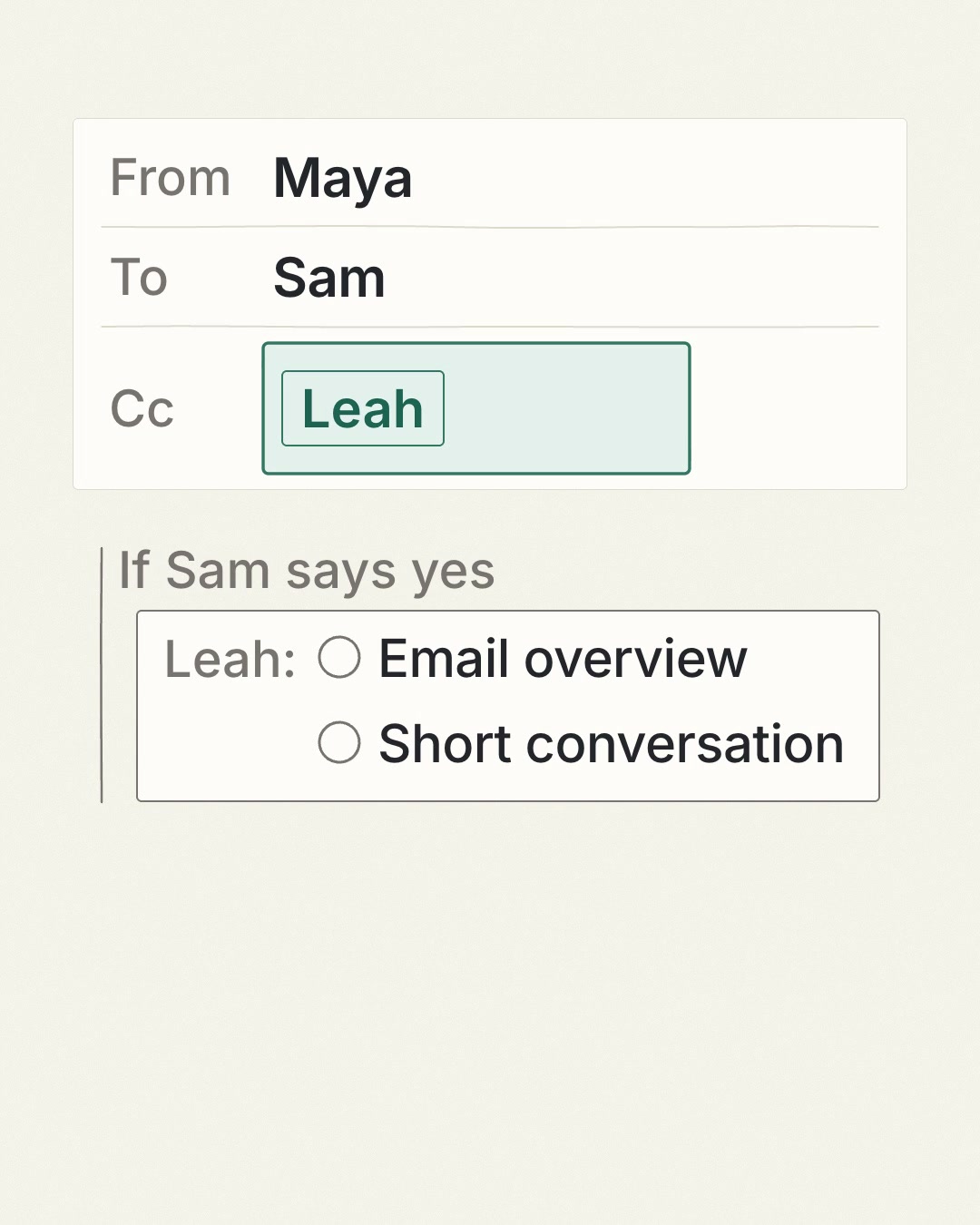
Before a board member copies you into an introduction, the person being introduced should already have said yes. Maya sits on the board of Oak Street Reading. Her colleague Sam asked her about local reading programs, so the interest is Sam's own. Leah, the development director, first tells Maya what will happen: a reply within two working days, an email overview or a short call, and no request for money. Now Maya can describe it honestly. She asks Sam whether an introduction would be welcome, or whether a link to read would suit better. If Sam doesn't reply, the status stays permission pending. Silence isn't a yes. After a clear yes, Maya makes the introduction, and Leah's first reply lets Sam choose what happens next.
Before a board member copies you into an introduction, the person being introduced should already have said yes. Maya sits on the board of Oak Street Reading. Her colleague Sam asked her about local reading programs, so the interest is Sam's own. Leah, the development director, first tells Maya what will happen: a reply within two working days, an email overview or a short call, and no request for money. Now Maya can describe it honestly. She asks Sam whether an introduction would be welcome, or whether a link to read would suit better. If Sam doesn't reply, the status stays permission pending. Silence isn't a yes. After a clear yes, Maya makes the introduction, and Leah's first reply lets Sam choose what happens next.
Start from what the board member knows
| What the board member says | What it tells you | Next step |
|---|---|---|
| “Sam asked me about local reading programs.” | Stated interest, in Sam’s own words. | Send the cover note below, then use the three messages. |
| “I think Dana would love this.” | The board member’s hunch. Dana hasn’t said anything yet. | The board member mentions the work in their own conversation with Dana, or invites her to something they have attended. Ask about an introduction only if she shows interest. |
| “He has money. He should give to us.” | Possible giving capacity. Nothing about his interest or his relationship with you. | No introduction yet. Ask what he has said about the cause. If nothing, the board member can raise the work naturally and see how he responds. Keep capacity notes out of anything he could read. |
| “I don’t want to put her in an awkward position.” | A concern about the experience the board member would be vouching for. | Describe exactly what will and won’t happen, as the cover note does. If the doubt is about the program itself, invite the board member to see it first and ask whether they’d bring a friend. |
Only the first row is ready for an introduction. The others still need a conversation that the board member owns, or a visit that tests the experience. The field notes Before you ask the board for names include a visit brief and the questions to ask a board member afterwards.
Leah → Maya, before Maya writes
The note makes Leah’s side a promise Maya can repeat. If Leah can’t reply within two working days, she should say so here, before Maya describes the timing to Sam.
1. Check whether the introduction is welcome
Maya → Sam
Wait for Sam’s yes. If Sam would rather have a link, send the link and leave Leah out of the thread.
2. Make the introduction
Maya → Sam and Leah, after Sam agrees
Sam may forward this, so it carries only the connection and who replies next. Views on wealth, giving potential or personal circumstances stay out of it.
3. Receive the introduction
Leah → Sam and Maya
Record a next step only when Sam agrees to one.
If the answer is “not now”
Maya → Sam
Tell Leah the introduction is paused, without passing on Sam’s reasons. Without a reply, the status stays “permission pending.” If Maya follows up at all, she makes declining easy.
Keep one useful record
Keep this in the team’s working record rather than the board member’s inbox.
| Field | Filled example |
|---|---|
| Connector | Maya, board member |
| Person introduced | Sam |
| Reason | Asked Maya about local reading programs |
| Starting point | Stated interest |
| Cover note | Leah to Maya, September 7 |
| Permission | Sam agreed by email, September 8 |
| Staff owner | Leah |
| Introduction | Sent September 9 |
| Latest action | Leah offered an email overview or conversation, September 9 |
| Status | Awaiting Sam’s reply |
| Next internal check | Leah checks for a reply September 16; no automatic outreach |
| Agreed next step | None yet |
Make your version
Replace each bracketed field, and delete options your team can’t offer.
Reading connection: Terry Axelrod on board involvement, and Trevor and Tarren Bragdon’s 7-Figure Fundraising on coordinating introductions. These messages are original Gratona examples.
Explore the reading list ↗