
APPEALS & DONOR CHOICE
Thanks, Then Another Ask?
Decide whether an invitation belongs in this donor’s thank-you.
Decide which donors can receive an invitation to give inside your annual thank-you, and leave with a clean thank-you, an invitation paragraph and a decision for each donor group.
Go to the messages and worksheet ↗The decision
The finding in its setting
Sudhir, Fong and Roy (2019) varied HelpAge India’s annual thank-you letter to about 200,000 previous donors. Across everyone, adding an explicit request for another donation had no statistically significant effect on giving. Split by giving history, the response differed. Donors who had given recently, often or in larger amounts responded less well to the request, while lapsed, infrequent and smaller donors responded better. The authors estimate that sending the request only to the groups that responded well could raise donations by about 6–11%, a back-of-envelope calculation from their results rather than a separate test.
The letter was a once-a-year thank-you. The study shows that giving history can change how a request inside one is received. It doesn’t give you a permanent rule about whom to ask.
Four messages that all start with thank you
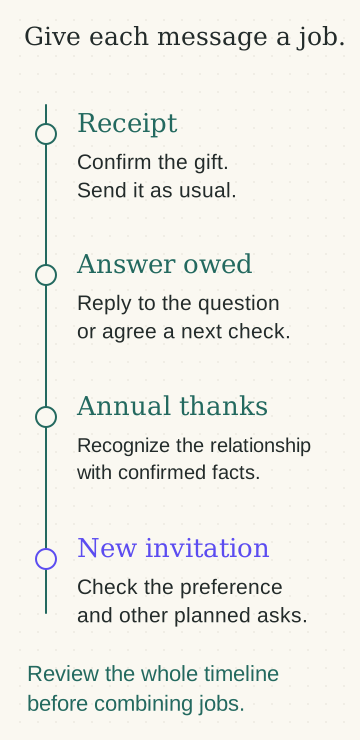
Most teams send several kinds of message that open with thanks. They have different triggers and owe the donor different things. This guide considers an invitation inside the annual thank-you; decisions about welcome messages belong with the welcome series.
| Message | What triggers it | What it owes the donor | Room for an invitation? |
|---|---|---|---|
| Gift receipt | A gift is processed. | An accurate record of the gift, promptly. | No. Send it on time and unchanged, and never hold it back for a test. |
| Reply to a donor’s question | The donor asked something. | The answer, or a date for it. | No. Answer first. |
| Welcome after a first gift | A donor’s first gift. | What happens next and how to reach you. | Decide this with your welcome series, separately. |
| Annual thank-you | Your calendar. | Thanks and an honest account of the year. | Possibly, for donors who pass the eligibility checks. |
Eligibility comes before assignment
Two questions get mixed together in a thank-you test. Eligibility asks whether this donor should receive an invitation at all, given everything else going on with them. Assignment asks which eligible donors get which version, and it should be random if you want to learn anything.
Decide eligibility from facts in the record: the donor’s preferences, how and when they give, whether a payment is failing or a pledge instalment is due, whether someone owes them a reply or a report, and what else is scheduled to reach them in the next few weeks. Don’t decide it from who you think will give.
Then define your comparison groups by date, with a reference date, before anyone is assigned. People who unsubscribe or ask for fewer emails after assignment leave every later send at once and stay in the analysis under the version they were assigned. Dropping them from the count would hide the reaction you most need to see.
The study
- Greedy or Grateful? Asking for More when Thanking Donors
2019 working paper. Results are reported by recency, frequency and gift size. The targeting estimate is a calculation, not a separate test.
Worked case
The worked cases and templates use invented people and organizations.
Linden’s November letter
Linden Neighbors pairs volunteers with older people who live alone and runs a shopping minibus for them. Each November it emails donors an annual thank-you with a short account of the year. Its year-end appeal on November 24 and Giving Tuesday email on December 1 use the donor list frozen on October 31: donors who gave between November 1, 2024 and October 31, 2026.
This year Tomás, the development director, proposes adding a paragraph to the November 10 thank-you inviting a gift toward a second minibus. On November 2, before any talk of a test, Tomás asks Aisha in donor care for the contact timeline of every donor with open activity. The first one Aisha brings back belongs to Irene Kowalski.
| Date | What | Owner | Status |
|---|---|---|---|
| October 6 | Online gift of $150, with automatic receipt | Payments system | Sent October 6 |
| October 9 | Irene asks whether the gift can go to the shopping service, and asks for the annual report | Aisha, donor care | Acknowledged; answer promised by October 20 |
| October 20 | Answer to Irene’s question | Aisha, with finance | Overdue. Finance hasn’t yet confirmed how to answer. |
| November 10 | Annual thank-you, possibly with invitation | Tomás | Planned |
| November 24 | Year-end appeal | Tomás | Planned |
| December 1 | Giving Tuesday email | Communications | Planned |
Irene has three messages planned in three weeks, at least two of them requests for money, and an answer that is almost two weeks late. The proposed invitation is about the shopping service, the very thing Irene asked about. Sending it before the answer would tell Irene the organization had time to ask but not to reply.
Tomás pauses the invitation for Irene. Aisha gets the answer from finance and sends it with the annual report by November 6. Irene receives the plain thank-you on November 10. The November 24 appeal goes ahead, because Irene’s preferences allow appeal emails.
From one record to the whole list
Aisha applies the same checks to all 2,400 donors who gave between November 1, 2023 and October 31, 2026. Each donor goes into the first row that applies, so nobody is counted twice.
| Check, in order | Donors | What they receive on November 10 |
|---|---|---|
| No email consent, or asked not to be emailed | 310 | Nothing by email. Postal thanks where their preferences allow. |
| Asked not to receive fundraising requests | 140 | The plain thank-you |
| Monthly donors | 180 | The monthly donors’ own thank-you |
| Managed personally by a relationship manager | 60 | A letter from their relationship manager |
| Open issue: unanswered question, overdue promise, failed payment or pledge instalment due | 45 | The plain thank-you, once the issue is resolved |
| Last gift on or after October 11, 2026 | 165 | The plain thank-you. They had a receipt and thanks within the past month. |
| Eligible for the invitation | 1,500 | Decided by group, below |
| All donors | 2,400 | – |
A decision for each group
Tomás defines the groups before anyone is assigned. Current donors made their last gift between November 1, 2024 and October 10, 2026; lapsed donors made theirs between November 1, 2023 and October 31, 2024. Of the 1,500 eligible, 1,100 are current and 400 are lapsed.
| Group | Eligible | Decision | Reason |
|---|---|---|---|
| Current: last gift November 1, 2024 to October 10, 2026 | 1,100 | Plain thank-you for all 1,100 | All are on the November 24 appeal list, so an invitation on November 10 would put two requests 14 days apart. Tomás will reconsider with next year’s calendar. |
| Lapsed: last gift November 1, 2023 to October 31, 2024 | 400 | Test: 200 plain thank-you and 200 with the invitation, assigned at random | They aren’t on the year-end lists, so the annual thank-you is the only fundraising campaign planned for them this winter. Receipts and replies continue as usual. With 200 in each half, the result can point to something worth checking. It won’t settle it. |
Aisha assigns the lapsed donors on November 3 and saves the file read-only. Gifts from November 10 to December 8 will be matched to the version each donor was assigned, and the team will review on December 15. Tomás uses the completed appeal test linked below to show colleagues how to read the result group by group, against everyone originally assigned.
The annual thank-you
Sent November 10 to every donor receiving the plain version. Program figures confirmed by the program director on November 4.
The invitation paragraph
Added after the program paragraph for the 200 lapsed donors assigned to it. Nothing else changes. Finance confirmed the fund wording on November 4.
Tomás’s note to colleagues
Sent November 3, after assignment.
Read a completed appeal test
- Before You Borrow the Winning Email
The worked test includes revenue, contact outcomes and the effect of a large gift, counted against the original assignment.
Put it to work
Your annual thank-you
Adapt for donors who will receive the annual thank-you without an invitation. Confirm each figure with the program team.
Your invitation paragraph
Placed after the program paragraph, for eligible donors only. Agree the fund wording with finance.
Your pre-send decision sheet
Complete it before anyone is assigned. Each donor goes in the first eligibility row that applies.
Your note to colleagues
Send after the eligibility and assignment files are checked. Give each open task one person and a date.
The thank-you decision sheet
The pre-send sheet, both message versions and the note to colleagues in one file.
Download the decision sheetExceptions
- A donor gives between assignment and the send. The receipt goes out as usual, and the donor stays in the assigned group.
- An open issue isn’t resolved by the send date. Send the thank-you later, after the answer.
- Two donors in one household fall into different groups. Decide before assignment whether you assign people or households, and send one version per unit.
- A relationship manager wants a managed donor included. Managed donors get their manager’s letter. Keep them out of the test.
- A donor in the test asks for no fundraising email. Honor it in every queue at once. The donor stays in the count under the original version.
Check before you press send
Ask a colleague who wasn’t in the planning to pick five eligible donors at random and read each one’s contact calendar for the next six weeks. If any would receive a request before an answer they’re owed, or two requests close together, fix the list before sending.
After the window, confirm that every receipt went out on its normal timing and every reply was answered within the agreed time, in both versions. Development owns the decision sheet, donor care owns open issues and replies, and finance owns receipts.
Continue with the research
K. Sudhir, Hortense Fong and Subroto Roy worked with HelpAge India to vary the annual thank-you letter sent to previous donors, including a version with an explicit request for another gift.
Read the description of the letter versions, then the results by recency, frequency and gift size. The section on targeting shows how the 6–11% estimate was calculated and what it assumes.
Greedy or Grateful? Asking for More when Thanking Donors ↗
K. Sudhir, Hortense Fong and Subroto Roy
Other decisions before the send
The appeal needs urgency. The facts are still being checked.The Deadline Has to Be Real
Write an urgent appeal your program and finance teams can stand behind.
We want to ask donors which program matters to them.What Does This Box Promise?
Ask donors what matters and make clear what their answer changes.
A donor said they plan to give. What do we record now?The Gift That Hasn't Happened
Follow up on an intention without counting it as money.
We promised fewer fundraising emails. Several teams send them.One Email Means Every Team
Make an email-frequency promise every sender can keep.