
APPEALS & DONOR CHOICE
What Does This Box Promise?
Ask donors what matters and make clear what their answer changes.
Write a donor priority question, the sentence that says what the answer does, and the handoff that makes sure your team does it.
Go to the messages and worksheet ↗The decision
Suppose a donor gives $250 with “Family reading workshops” ticked on the reply card. Six months later, they ask how many workshops the gift paid for. If the form never said what the tick did, there’s no good answer. The gift went into the general fund, the tick sits in a field nobody reports on, and the donor had reason to assume otherwise.
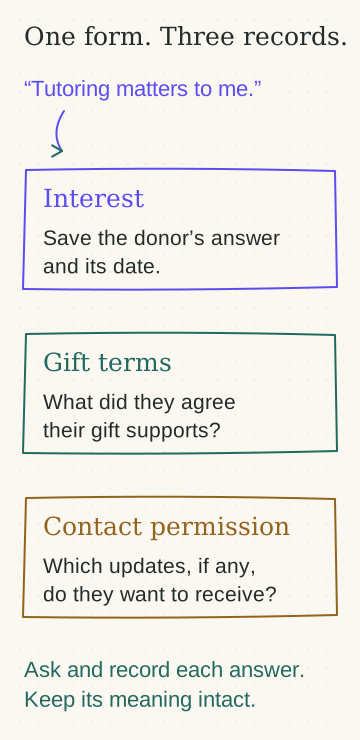
A priority box can do three different things. Each needs its own sentence on the form and its own person behind it.
| What the answer does | Sentence on the form | Where it’s recorded | Who acts on it |
|---|---|---|---|
| Chooses which updates the donor receives | “If you’ve asked for program updates, we’ll use your answer to choose what we tell you about.” | A donor-stated interest field, dated, with its source. | Whoever sends program updates, using content the program team supplies. |
| Informs planning | “We share the totals, without names, with our program team each year.” | The same interest field, reported as counts. | The program director, who receives the totals. The form shouldn’t promise any change to programs. |
| Restricts the gift | “Your gift will be used only for [program].” | A fund or restriction code, set by finance under your gift acceptance policy. | Finance, who records the restriction and confirms the gift is used that way. |
The finding in its setting
Kessler, Milkman and Zhang (2019) randomly assigned 32,174 previous donors, alumni of a university, to receive the standard reply card or one that also invited them to mark which of four priorities mattered most. Gifts stayed unrestricted whatever they marked. Among those in the highest-income census tracts who gave, gifts were about 2.4 times as large with the choice card; the study found no statistically significant increase in the likelihood of giving. A census tract describes a neighborhood, so it’s only a rough guide to any one person’s wealth. The authors note that some alumni may have believed their choice directed their gift.
The experiment doesn’t establish what every donor understood. If you offer a choice, say plainly what it does.
Rules that keep the box honest
- Offer only options you can report on. If the program team can’t supply an update about an area on the schedule you promise, leave it off.
- Keep interest, permission and restriction in separate fields. Ticking an interest doesn’t opt anyone into email, change their appeal schedule or move the gift to another fund.
- Don’t fill in an answer for the donor. A blank stays blank. A large gift or a seat at an event isn’t a stated interest.
- Use the latest answer, and keep earlier ones with their dates.
- Read every handwritten note. “For books only” is a request about the gift, and it needs a person to respond.
- Promise no more than you’ll do. If the totals go to the program team, say that, and don’t suggest every answer changes the program.
The study
- Getting the Rich and Powerful to Give
2019. Compare the two reply cards before the results. The headline effect is for one group of alumni, identified by neighborhood income.
Worked case
The worked cases and templates use invented people and organizations.
Kestrel’s new reply card
Kestrel Reading Project runs three things: one-to-one tutoring for children in grades 1 to 4, books children take home to keep, and evening reading workshops for families. Gifts go to the general literacy fund, which pays for all three. Kestrel has never offered a restricted option on its standard forms.
Marisol, the development director, wants to add a priority question to the spring reply card and the online form. Before drafting, Marisol meets Ben, the program director, and Yusuf in finance with three questions: what will the answer do, who will do it, and what must the form not imply.
They agree that the answer will decide which program stories go to donors who have asked for updates, and that Ben will receive the totals each June. It won’t change where any gift goes. Ben commits to one short update per program area every six months, so each option has something behind it. Yusuf asks to see any note requesting a restriction before anything is recorded, because Kestrel’s gift acceptance policy requires finance approval for a restricted gift.
The question on the card
Printed on the reply card and repeated on the online form, directly above the gift amount.
| On the card | Field | Values | What it changes | What it doesn’t change |
|---|---|---|---|---|
| Priority ticks | Program interest (donor-stated), with date and source | Tutoring, Books, Workshops, in any combination. Blank if nothing ticked. | Which program stories go to donors with update permission. The June totals. | The gift’s fund, email permission or appeal schedule. |
| Updates checkbox | Email permission: program updates, with date and source | Yes. A blank box leaves any existing permission as it was. | Whether the donor receives program updates. | Permission for appeals or any other email. |
| Gift | Fund | General literacy fund, unless finance approves a restriction. | Where the money is recorded. | The donor’s recorded interests. |
| Handwritten note | Note, copied word for word, with a review flag if it mentions how the gift should be used | Text. Flag open or closed. | Starts a review by Marisol and Yusuf. | The fund, until Yusuf approves a change. |
| Nothing on the card | Staff notes, kept separate | Text, with author and date. | Nothing automatically. | The donor-stated interest field. |
Five replies from the first week
The spring appeal goes out on March 2. Marisol picks five of the first week’s replies that show the decisions the team now has to make the same way every time.
| Reply | What Kestrel recorded | What happened next |
|---|---|---|
| Carla Ortiz ticks Workshops and Updates, and gives $60. | Interest: Workshops (March 5, reply card). Update permission: yes (March 5). | Standard acknowledgment. The April update about family workshops goes to Carla. |
| Hugh Marsh ticks Tutoring, leaves Updates blank and gives $100. There is no update permission on file. | Interest: Tutoring. Permission unchanged: none. | Acknowledgment only. No program updates. The answer is counted in June. |
| Priya Shah ticks all three and Updates, and gives $40. | Interest: Tutoring, Books, Workshops. Update permission: yes. | Updates rotate across all three areas. Nobody picks a favorite on the donor’s behalf. |
| Joan Abbott ticks Books, gives $500 and writes “for books only please.” | Interest: Books. Note copied word for word. Review flag opened March 6. | Yusuf holds the gift’s allocation for review and preserves Joan’s instruction. Marisol calls on March 9. The gift is not spent as unrestricted while the terms are unresolved. |
| Noor Kim leaves every box blank and gives $25. | No interest recorded. Nothing inferred from earlier gifts or event attendance. | Acknowledgment. If Noor already receives updates, they stay general. |
Carla’s acknowledgment
Sent within two working days to donors who ticked a priority and asked for updates.
Joan’s gift
On the call, Marisol explains that Kestrel gifts normally support all of its reading work, and asks what Joan would prefer. Joan wants the $500 used only for books children keep at home. Yusuf had confirmed on March 6 that Kestrel can accept a gift restricted to home books under its policy, so Marisol agrees, and sends the handoff below the same day.
Marisol’s handoff to finance and program
Written after the call, so each person knows what they now owe the donor.
What Kestrel left out
Marisol’s first draft of the card said “Choose where your gift makes the biggest difference.” Read on its own, that tells the donor the gift will go where they choose, which wasn’t true for any of the options. It came out.
The team also kept the interest field away from the appeal schedule. A donor who ticks Tutoring hasn’t asked for the tutoring appeal and no other, and hasn’t agreed to more email.
Put it to work
Your priority question
Keep only the sentences that are true for your organization, and agree them with program and finance before printing.
Your field and handoff sheet
Fill it in at the meeting with program and finance, before the form goes live.
Your acknowledgment
Use after checking the gift record and the donor’s update permission. Include the update sentence only when they have asked for those updates.
If a donor wanted a restricted gift
Use while finance reviews the donor’s instruction. Agree option 2’s wording, any offer to return the gift and the review date with finance first.
The donor priority choice kit
The question, the field and handoff sheet, the acknowledgment and the restriction reply in one file, for the meeting with program and finance.
Download the priority choice kitWhen the answer changes or doesn’t fit
If a donor ticks something different next year, the new answer is current. Keep the old one with its date; the donor may mention the change, and it helps to know.
If a program area pauses, tell the donors who chose it and asked for updates, and ask whether they’d like a different focus. If a donor asks how “their” program used the gift, answer truthfully: the gift went to the whole program, and here is what that program did.
If the donor doesn’t answer a restriction query by the agreed date, finance decides the next step under the gift acceptance policy. Keep the original instruction, assign a person and a next review date, and record any contact the donor’s preferences allow. Silence doesn’t turn the gift into an unrestricted one. Recording the money and settling its use are separate tasks; follow finance’s policy for both.
The development director owns the form and the six-month check. The program director owns update content and receives the totals. Finance owns every restriction decision. Whoever processes gifts owns the fields and the review flags.
Check after six months
Count the notes that asked for a restriction and how quickly each was resolved, and read every donor question about where a gift went. If several donors thought they had chosen where their money went, rewrite the sentence on the form.
A higher average gift after adding the question doesn’t show the question caused it. To find out, send the two cards to randomly assigned halves of the same mailing and compare everyone assigned, including people who didn’t give.
Continue with the research
Judd Kessler, Katherine Milkman and Yiwei Zhang tested two reply cards in a university annual fund. One invited alumni to mark which university priorities mattered most to them. Every gift stayed unrestricted.
Compare the two reply-card designs, shown early in the paper, then read how the authors grouped alumni by census tract. Their discussion of whether some alumni thought their choice directed their gift explains why your form should say exactly what the answer does.
Getting the Rich and Powerful to Give ↗
Judd B. Kessler, Katherine L. Milkman and C. Yiwei Zhang
Other decisions before the send
The appeal needs urgency. The facts are still being checked.The Deadline Has to Be Real
Write an urgent appeal your program and finance teams can stand behind.
A donor said they plan to give. What do we record now?The Gift That Hasn't Happened
Follow up on an intention without counting it as money.
Someone wants to add a giving link to the thank-you.Thanks, Then Another Ask?
Decide whether an invitation belongs in this donor’s thank-you.
We promised fewer fundraising emails. Several teams send them.One Email Means Every Team
Make an email-frequency promise every sender can keep.