
READING & LISTENING
The Development Shelf.
Books and conversations, with field notes you can put to work.
Explore the sources
- Book StewardshipExplore the book resources ↗
7-Figure Fundraising
Trevor Bragdon and Tarren Bragdon
Open field notes - Podcast Donor welcomeListen to the episode ↗
Episode 233: Creating Second Time Repeat Donors: Needing Speed and Personalization to Succeed
Randall Hallett
Open field notes - Webinar Board introductionsWatch the conversation ↗
Engaging Your Board as Champions, not Just Fundraisers
Terry Axelrod
Open field notes - Podcast StorytellingListen to the episode ↗
Trauma-Informed Storytelling on the Fundraising Stage with Jenna Watanabe
Jenna Watanabe with Maria Bryan
Open field notes - Reference RetentionRead the definitions ↗
Terminology
Fundraising Effectiveness Project
Open field notes - Reference Donor trustRead the source ↗
The Donor Bill of Rights
AFP, AHP, CASE and the Giving Institute
Open field notes - Research Appeal testingRead the thank-you experiment ↗
Five studies on donor appeals and behavior
Open field notes - Research Appeal testingRead the research ↗
Lost and found: A natural field experiment on charitable donations, extinctions, and finance for conservation
Open field notes - Research Appeal testingRead the research ↗
Getting the Rich and Powerful to Give
Open field notes - Research Appeal testingRead the research ↗
Promoting the Return of Lapsed Blood Donors: A Seven-Arm Randomized Controlled Trial of the Question–Behavior Effect
Open field notes - Research Appeal testingRead the research ↗
Greedy or Grateful? Asking for More when Thanking Donors
Open field notes - Research Appeal testingRead the research ↗
The hidden costs of nudging: Experimental evidence from reminders in fundraising
Open field notes
The thank-you is stuck in the CEO’s inbox
Find out what the CEO’s review actually changes, then propose a standing rule for the rest.
7-Figure Fundraising · Trevor Bragdon and Tarren Bragdon
The Bragdons argue that an ordinary, forgettable donor experience happens because no single person is in charge of it. They give that job to a dedicated coordinator, a role they call the conductor, who handles details, follow-through and the personal touches that show donors they were noticed. For major donors they recommend several thank-yous in different forms, partly because a single note can go astray without anyone knowing. They say the thank-you letter can come from someone other than the executive director when speed would otherwise create a bottleneck, and they present the whole sequence as a major-donor practice, to be scaled back for smaller donors and adapted to what a team can sustain.
The worked cases and templates use invented people and organizations.
The lesson
Twelve thank-yous are drafted and waiting. The executive director, who usually signs them, is traveling until Friday. Holding the queue feels careful, but every donor now waits, including those whose messages never needed an executive’s eye.
An executive who reviews every thank-you is usually protecting several things at once: the right name and amount, wording the organization stands behind, relationships they hold personally, promises they made and exceptions only they can settle. Someone else can own the accuracy check. Standard wording can be approved once for an agreed set of routine messages. Relationships and promises need the executive personally, but the note or call can follow the thank-you. Under that agreed rule, exceptions get a fresh decision before sending.
If you are not sure what the review protects, ask what it has caught in the past. The answer tells you which check to build.
| What the review protects | How to protect it without holding the queue | What still needs the executive |
|---|---|---|
| The right name, amount and purpose | The coordinator checks each draft against the verified gift record before it goes for approval. | Nothing, once the record is verified. |
| Wording the organization stands behind | The executive approves standard wording once. Program details come from language the program lead has checked. | New claims, or changes to the approved wording. |
| Relationships the executive holds personally | Keep a short list of those donors. Each gets the prompt thank-you now and a personal note or call from the executive afterwards. | The note or call, in the executive’s own words. |
| Promises the executive made | Each promise stays open as a task in the executive’s name. The thank-you mentions only what has been confirmed. | Keeping the promise. |
| Exceptions | A gift condition, complaint or disputed amount leaves the routine queue with the specific decision attached. | The decision. |
The third row takes the executive’s personal touch out of the approval path. The book’s major-donor sequence already works this way, with several thank-yous in different forms from more than one person. At any scale, the same idea lets an accurate thank-you go out promptly from the person coordinating support while the executive’s note follows where the relationship calls for it, and neither waits for the other. The coordinator, who sees every record, is also well placed to tell the executive what that note could mention.
Sign each message with the name of the person who wrote it. A standard letter can carry the executive’s signature when the executive has approved both the wording and that use of their signature. A message that reads as personally written implies the signer wrote or read it. If someone else prepares it, make sure the signer sees the message and knows where replies will go.
The book also argues for more than one thank-you on practical grounds: a single message can be misdelivered or filtered, and nobody finds out. A sent email is not yet a delivered thank-you. Check bounce reports and returned mail, and for the gifts where a lost thank-you would matter most, send a second message by another route.
When the executive knows most of your donors
In a small organization the executive may know most donors personally, so the third row covers most of the file. The change is smaller but still worth making: approve the wording once, send the prompt thank-you under the fundraiser’s or coordinator’s name, and spend the executive’s review time on personal notes instead of proofreading.
If you are the only fundraiser, you hold both the coordinating and the relationship work. Give them separate blocks of time so the checks don’t wait for the notes. Any gift acceptance rule that requires executive sign-off stays where it is, in the last row.
Worked case
Twelve gifts, three things for the executive
Riverbend received twelve gifts on September 14. Maya coordinates donor support, Luis leads programs and Leah, the development director, is authorized to approve routine acknowledgement copy. Anika, the executive director, is away until September 18.
Leah sorts the queue by what each record needs rather than by who usually signs.
| Records | Route | What still needs a person’s judgment |
|---|---|---|
| Seven routine gifts | Maya checks each draft against the gift record, Leah approves it and Maya sends it under her own name on September 16. | Nothing more, unless a reply raises something. |
| A gift from Ruth, a former board member who knows Anika well | The same prompt thank-you from Maya. A personal note goes on Anika’s list for her return. | Anika’s note, in her own words. |
| Two gifts from donors Anika promised to call | Maya sends each an accurate thank-you that offers no call time. Both calls stay open in Anika’s name. | Anika confirms the dates. A thank-you email doesn’t complete either promise. |
| Two gifts finance can’t yet match to a donor | Finance resolves attribution before anyone is thanked by name. | Identity and gift matching. No one guesses from a similar name. |
Anika is needed for three things, one note and two calls, and none of them has to hold an acknowledgement. Ten thank-yous go out on September 16. Only the two unmatched gifts wait, and they wait for finance.
Routing all twelve through Anika would have held ten messages until her return. Marking every record complete after an email would have hidden the promised calls; sending before finance finished matching would have risked thanking the wrong people. Official receipts follow the team’s existing process; delegating these personal messages changes neither the rules for financial documents nor who may approve an exception.
Change one fact and the route changes. If Anika had told Ruth she would call, Ruth’s gift would join the promised calls. If finance matches an unknown gift to a donor Anika knows, that gift takes Ruth’s route: a prompt thank-you from Maya, then Anika’s note.
Team kit
The queue decision
Leah sends this to Maya and finance on the morning of September 16.
Subject: September 16 thank-you queue, routes and owners

Maya, please check the eight ready drafts against the gift records and send them to me by noon. Once I’ve approved them, send them from your account and save the final messages and send times. Ruth’s is one of the eight; please also add her to Anika’s list for a personal note.

Please thank the two donors Anika promised to call, without offering a time. Send Anika the details today so she can confirm dates, and keep both calls open in her name.

Finance, please confirm the donors behind the two unmatched gifts, or tell us what’s unresolved, by 3 p.m. Maya will check then and record the next step for anything still uncertain.

Keep concerns, unusual gift conditions and new program claims out of the routine queue. Bring them to me with the specific decision needed.

Maya and I will review the queue at 4 p.m.: what was sent, what bounced, what remains open and who acts next.

Leah
Development director
A thank-you from the person coordinating support
Maya writes in her own voice and makes herself the contact for replies.
Hi Omar,

Thank you for your $150 gift to Riverbend’s after-school reading program, which arrived on September 14. Your receipt was sent separately; if it hasn’t reached you, reply here and I’ll help.

I look after donor support at Riverbend, so I’m the person to contact with any question about your gift or the program. The program gives students time to read with a tutor after school, and your gift helps keep those sessions going.

Thank you,

Maya
Donor support, Riverbend Reading Project
Check the gift, designation and any request against the record before sending. Add a colleague’s personal note only after they have written or reviewed it.
What’s waiting for the executive
Leah’s note for Anika’s return, with a proposal for the next batch.
Subject: Three thank-you items for you, and a proposal

Anika,

Welcome back. Ten of the twelve gifts from September 14 have been thanked, and nothing that needed your judgment went out without you. Three things are waiting for you personally:

1. Ruth: a personal note. She gave $500 to the reading program, her first gift since leaving the board. Maya thanked her on September 16.
2. The Okafors: the call you offered at the spring open house. They know a call is coming but not when.
3. Frances Hale: the call you promised about the new site. Same status.

Finance is still matching the other two gifts; nothing is needed from you there.

I also looked back at the ten thank-yous you approved in August. Five went out unchanged after waiting four to seven days. Your other changes were a corrected purpose, a removed claim, two personal touches and one message you rightly held because of a complaint. I think each of those can be protected before drafting or after sending, without holding the routine messages. The review and a proposed six-week trial are attached. Could we go through them at Thursday’s one-to-one?

Nothing changes until you’ve agreed to it.

Leah
Send a report like this only if your authority to approve routine messages was agreed beforehand. If it wasn’t, ask before the queue goes out. Silence isn’t delegation.
Review what the approvals actually changed
- Take the last ten to twenty thank-yous that went to the executive for approval, from the approval queue, sent folder or shared drafts. Include some you think were routine.
- For each one, compare the draft sent for approval with the version the donor received. Record the change exactly, or “nothing.”
- Name what the change protected, using the lesson’s five rows: accuracy, approved wording, a relationship the executive holds, a promise the executive made or an exception. If none fits, say what it did, such as a style preference.
- Record the date the draft was ready and the date it was approved.
- If earlier drafts weren’t kept, don’t reconstruct edits from memory. Log the next four weeks instead, using the approval log below.
| Thank-you | Days waiting | What Anika changed | What it protected | Where that check could happen instead |
|---|---|---|---|---|
| $100, reading program | 6 | Nothing | — | Maya’s record check and the approved wording |
| $250 from Robert Lin | 5 | “Dear Robert” to “Dear Bob” | A relationship she holds | Preferred name kept in the donor record; her own note after sending |
| $75, reading program | 4 | Nothing | — | Maya’s record check and the approved wording |
| $500 from the Okafors | 2 | Added a handwritten line about the open house | A relationship she holds | Her personal note, sent after the prompt thank-you |
| $50, reading program | 8 | “Summer program” corrected to “after-school reading program” | The right purpose | Maya’s check against the gift record |
| $150, reading program | 7 | Nothing | — | Maya’s record check and the approved wording |
| $1,000, reading program | 2 | Removed “your gift will fund a new tutor” | Wording the organization stands behind | Standard wording approved once; new claims still go to her |
| $40, reading program | 6 | Nothing | — | Maya’s record check and the approved wording |
| $300, reading program | 7 | Held until she had called about the donor’s July complaint | An exception | Flag the complaint on the record so the draft goes to her first |
| $60, reading program | 4 | Nothing | — | Maya’s record check and the approved wording |
Ten messages can’t give you a reliable rate, but they show what kind of review Anika is doing. Every change here has somewhere else to happen. The purpose error belongs in Maya’s record check, and the claim in the approved wording. The two personal touches can follow a prompt thank-you as Anika’s own note. The one message she held was a real exception, and the proposed rule would still send it to her first.
Your review may point somewhere else. If most of the executive’s edits add facts nobody else could know, or correct relationships the record gets wrong, fix the information that reaches the draft, or agree a fixed review time. Delegation is only one possible answer.
The standing rule to propose
Leah attaches this to her note. It names the exceptions, a trial period and what the review will look at.
PROPOSED STANDING RULE: ROUTINE THANK-YOUS

Covers: one-time gifts and first monthly gifts to existing programs, thanked with the standard wording Anika has approved.

Before sending: Maya checks name, amount, purpose and preferences against the gift record. Leah approves.
Sent: under Maya’s name, within three working days of the gift.

Still goes to Anika before sending:
- gift conditions or restrictions not already on file
- complaints, concerns or disputed amounts on the record
- new program claims, or any change to the standard wording
- donors Anika has promised something personally

Goes to Anika after sending: each Friday, the week’s list of who was thanked, with anything worth mentioning, so she can add a note or call where she knows someone.

Trial: six weeks, October 1 to November 12. Maya logs every routine message in the approval log.
Review on November 13: every message sent under the rule, any exception that reached the routine queue, any correction a donor raised and how long messages waited. Anika decides whether to keep, change or end the rule.

Either of us can pause the trial at any point.
If Anika wants to keep approving
A reply that offers a fixed review window or a narrower trial, and asks her to choose.
Subject: Re: Thank-you approvals

Anika,

Thanks for going through this. If you’d rather keep reading every thank-you before it goes, could we set regular times for it? I’d suggest Tuesday and Friday mornings. Maya will have the drafts checked and in one folder the evening before, and anything you don’t reach waits for the next window. When you’re traveling, tell us whether to hold the queue or who should approve in your place.

If you’d like to test the rule on a smaller scale first, we could limit it to routine gifts under $250 with the standard wording, for four weeks. Everything else would come to you as it does now.

Which would you prefer? I’d like to agree on it before the October batch.

Leah
Record what Anika chose and when. If she doesn’t reply, the current process continues; raise it again at your next one-to-one. Silence isn’t acceptance of the rule or of the fallback.
The approval log
One row per thank-you: when the draft was ready and approved, what changed, what the change protected and where that check could happen instead. Includes Leah’s ten August rows and a blank row.
Download approval-log.csvThe next check
At the 4 p.m. review, match each of the twelve records to a sent message or a named open task, and check for bounces. Keep the two calls and Ruth’s note visible until Anika has done them. If she agrees to a trial, bring the approval log to the review date and let her decide what happens next from what it shows.
Continue with the source
In the book, read The Conductor and Conductors Need a System, including the four-part thank-you and the authors’ note that it is meant for major donors. The Typical Donor Experience shows, month by month, the difference the role is meant to make.
Explore the book resources ↗Build one complete handoff
Record a promise the executive made personally, such as a call, with the person answering the donor, the work needed first and the next check. Copy the handoff for the colleague helping you.
Open the Atlas toolWhat the first gift can’t tell you
Decide who gets a personal follow-up and what it should be about.
Episode 233: Creating Second Time Repeat Donors: Needing Speed and Personalization to Succeed · Randall Hallett
Hallett describes many first gifts as a test of whether an organization does what it says, and argues for re-engaging new donors well within their first year without turning those contacts into another ask. In the episode, a large group of new donors is narrowed, using screening data and judgment, to the few who get individual attention. For those donors, Hallett suggests learning what inspired the gift, looking at how it was structured and noting how they think about recognition, then connecting the project they funded to the wider program. The closing advice is to start with a manageable group and track who gives a second, third and fourth time.
The worked cases and templates use invented people and organizations.
The lesson
A first gift arrives with more information than most teams read. The record shows what the donor chose to fund, how the gift reached you, whether it was one-time, monthly or in someone’s honor, and any question or preference they left. What it rarely shows is why they gave.
Hallett notes that some of what you want to know, such as how a gift was structured, can be looked up rather than asked. Most of the record works that way. Read it first, then ask the donor only what the record can’t tell you. The question becomes shorter and more specific, and nobody asks the donor to repeat what they already told you.
| In the record | What it can tell you | What it can’t tell you |
|---|---|---|
| What they funded | A subject for a useful next conversation: how that project fits the wider program. | Why it mattered to them. |
| How the gift arrived | Whose invitation, event or appeal prompted it, and who should hear that it arrived. | Whether they have a connection of their own to your work yet. |
| Gift structure | The practical care it needs. A monthly gift needs its payments to succeed; a pledge needs a schedule. | Whether they would welcome a request for more. |
| A tribute or memorial | That the gift may be about the person named. The tribute acknowledgement and any family notification come first. | Whether they have an interest of their own. Don’t assume either way. |
| A question or note | What they want to know, in their own words. A question is a commitment to answer. | Their reasons beyond what they wrote. |
| Preferences and recognition choice | How and how often to contact them, and whether to list their name. | Permission for anything beyond what they chose. |
Most teams can’t follow up personally with every new donor, so someone has to choose. Put obligations first. A donor who asked a question is owed an answer whatever the gift size. That answer takes someone’s time, so count it before anything else; the hours left over decide how many personal conversations you can offer. Next come donors who told you what interests them. Hallett’s move from project to program gives that conversation a subject without an ask.
Among the rest, gift size, screening and a colleague’s judgment can reasonably decide who gets your time; Hallett uses all three. They are weak evidence of what the donor wants next. Let potential decide where your time goes, and let the donor’s own words, or your question, decide what the contact is about.
Everyone else still gets a useful welcome, and it can carry one easy question. If you ask at scale, someone has to read the answers. Before sending, write down what you hope to learn and how each likely answer would change the plan. If every answer leads to the same scheduled message, drop the question.
The order holds at any size. A sole fundraiser might answer what’s owed, hold one or two conversations a week and send the general welcome to everyone else. A larger team can read source, structure and tribute fields in bulk and save individual reading for the gifts that stand out.
Worked case
Six new donors, two conversations
Riverbend’s recent first-time donors include the six below. Each has received an accurate acknowledgement. Leah, the development director, has time for two personal conversations this week, so she reads each record before choosing.
| What the record says | What Leah takes from it | Next step |
|---|---|---|
| Priya gave $75 and asked how tutors are trained. Maya has promised her a reply. | An answer is owed. Maya owns it, with facts from Luis. | Maya replies by the date she gave. It takes about 45 minutes of her week. |
| Leon gave $2,500 after a program briefing, where he asked how the reading sessions connect to the program’s next stage. | A stated interest, with a natural move from project to program. | Conversation one. Leah offers an overview and asks which part he wants to explore. No request. |
| Marcus gave $1,000 online after the September email. No note, no contact preference and no other connection on record. | A large first gift with no stated reason. Potential justifies the time; the content has to be a question. | Conversation two. Leah calls to thank him and asks what prompted the gift. |
| Noor gave $50 in memory of a friend and asked that the friend’s family be told. | The gift may be about the friend. The family notification is the obligation. | Confirm the family was notified. Leave Noor’s broader interest unknown. |
| Grace gave $40 through board member Tom’s birthday fundraiser and asked that Tom be told. | The invitation came from Tom, and her connection may be to him more than to Riverbend. | Thank Grace, let Tom know the gift arrived and include her in the general welcome. No individual plan from this gift alone. |
| Ada started a $25 monthly gift in August. | Her next gift is scheduled, so it isn’t a new decision to give. | Check that September’s payment went through and send the welcome for monthly donors. |
Leon and Marcus get the two conversations, for different reasons. Leon has said what he wants to understand, so the subject is set. Marcus has said nothing, so the conversation’s job is to ask. Priya’s answer comes out of Maya’s week and was counted first; if Maya had no time left, the answer would still come before either call. The Second Gift Starts Here works through a full week of this, including a question that arrives midweek.
Different facts would change the plan. If Marcus says his granddaughter’s school uses the program, Leah can offer an overview like Leon’s. If he would rather not be called, she records that and stops. If Noor asks to visit, respond to the request and let what she says next shape anything further.
Team kit
A first-gift reading
Fill one in before choosing a donor’s next step. This one is for Marcus.
FIRST-GIFT READING

Donor and record: Marcus, EXAMPLE-311
Gift: $1,000 on September 14 to the reading program; one-time
How it arrived: online, after the September email; no personal connection on record
Their own words: none
Preferences and recognition: no contact preference stated; chose to be listed by name
Already owed: thank-you sent September 16; nothing else promised
What we don’t know: what prompted the gift; whether he wants more contact
Next step and owner: Leah calls to thank him and ask what prompted the gift, by September 25. No request.
If he doesn’t answer: one voicemail and a short email with the same question; no second call
What would change the plan: a stated interest leads to an offer of information about that part of the program. A preference for less contact is recorded and applied. No reply keeps him in the general welcome.
A thank-you call with one question
Leah’s opening for Marcus. It thanks him, says nothing is being asked and poses one question.
Hi Marcus, this is Leah from Riverbend Reading Project. I’m calling to thank you for your gift to the reading program. I’m not calling to ask for anything.

If you have a moment, I’d love to know what prompted it. It helps us understand what people want to hear about.

[If he answers, listen, and ask one follow-up about whatever he mentions. If he’d like information, agree on how and when you’ll send it.]

Voicemail: Hi Marcus, it’s Leah from Riverbend. I wanted to thank you for your gift to the reading program. There’s no need to call back. I’ll send a short email too, in case that’s easier.
An email with a specific purpose
Leah offers Leon the information he asked about at the briefing.
Subject: How the reading sessions fit the wider program

Hi Leon,

Thank you again for supporting Riverbend. At the briefing, you asked how the reading sessions connect to the program’s next stage.

Luis, who leads the program, can put together a short overview of how students join, what happens in a session and how the team checks progress. I can send it by email, or we can talk it through if that’s more useful.

Is there a part you’d most like explained? We’ll start there. There’s no request attached; I want to make sure you get the answer you were after.

Leah
Offer the overview only once Luis has agreed to prepare it on workable timing. Otherwise, acknowledge the question now and give a date you can keep for checking back. When Leon replies, record what he asked for, how he wants it and when it will be sent. His reply narrows the work; it doesn’t establish interest in a meeting or another gift.
Leon may answer, “I only wanted the receipt. Please don’t turn this into a fundraising conversation.” Respond to that without defending the plan:
Respond to a request to stop
Update the preference before saying that you have.
Thanks for telling me, Leon. I’m sorry I misread what would be useful. I’ve recorded that you’d like receipts only, and these follow-ups will stop. You can contact me if you need anything about your gift.Apply the preference to every list and sequence before marking the work complete. A polite response alone does not fix an unchanged mailing list.
Check the work separately from the next gift
At the next review, check that Priya got her answer, Leon got the explanation he chose and Marcus’s call was made or closed. Keep unanswered questions and changed preferences visible. Answering Priya shows that you kept a commitment; it can’t tell you whether she will give again.
Later, look at who gave again over an observation period you chose in advance. Record what you knew at the first gift and what you did, so that patterns in your own donors can emerge, as Hallett suggests. Donors chosen for conversations may have given again anyway. Compare donors with similar starting circumstances, including those you couldn’t reach because time ran out. That can reveal a pattern to investigate, but it still won’t isolate the effect of the conversation. Count monthly donors separately; a scheduled payment says little about a decision to give again.
Continue with the source
In the episode, listen for the three questions about a new donor and the move from the project a donor funded to the program around it. The closing suggestions cover choosing a manageable group and tracking later gifts.
Listen to the episode ↗Plan a week of first-gift follow-up
Count what you owe, then give the remaining hours to the conversations that matter. The guide includes a completed allocation, the welcome everyone gets and a blank planning sheet.
Open the Atlas toolBefore you ask the board for names
Prepare the experience before asking for names.
Engaging Your Board as Champions, not Just Fundraisers · Terry Axelrod
Axelrod argues that many board members experience fundraising as something they were talked into, and recommends treating them with the care you would give your most valued donors. The board roles in the webinar involve no asking: inviting people to see the mission, thanking recent donors and giving personally. No one is asked to invite others before experiencing an introductory event themselves, and staff handle the follow-up with each guest, starting from what interested them. The full Benevon model behind these ideas runs over nine to twelve months; this note applies a few of them to one visit.
The worked cases and templates use invented people and organizations.
The lesson
A board member who invites a friend is vouching for the experience. If the hour is dull, or turns into a surprise appeal, the friend will remember who invited them. Reluctance to “bring names” is often a reasonable reading of that risk.
Axelrod’s own sister, an early guest, said plainly that she would not give. She came anyway, and afterwards brought her own circle of friends, because the hour had been good enough that she trusted they wouldn’t resent being invited.
That confidence is what a board member needs before inviting anyone, so their own first visit does two jobs. It gives them the firsthand understanding Axelrod asks for before anyone invites others, and it tests whether the experience is ready for guests. Axelrod asked that same sister for an honest verdict on the tour. Ask your board member whether they would be comfortable bringing a friend and, if not, what would need to change. Fix that before anyone sends an invitation.
| What you hear | A role that fits | What staff handle |
|---|---|---|
| “I don’t want to ask friends for money.” | Invite someone who has shown interest to an existing program event that includes no request. | Arrangements, the guest’s questions and any later conversation about support. |
| “I can’t think of anyone.” | Thank a few recent donors by phone or note, using facts staff provide. | Choosing the donors, checking their preferences and answering questions the calls raise. |
| “I’ll come, but I won’t invite anyone.” | Attend and report honestly on whether the experience works. | Acting on that feedback before guests arrive. |
| “I’m happy to ask.” | Hold any request until a guest has shown interest and staff agree on the timing. Axelrod asks confident askers to wait until guests are ready. | Knowing what the guest has said and when a request would be welcome. |
| “I don’t have time this quarter.” | Nothing new. Existing board commitments stand. | Keeping them informed without adding a task. |
Before anyone invites a guest, settle three things the guest will be told: what they will see, whether any request for money or time will be made, and who will contact them afterwards. Axelrod’s hosts told guests in advance that a staff member would call. That openness is what lets a board member invite without worrying about an ambush.
Use something you already run, such as an orientation, open class or program showcase. If your program can’t safely host visitors because of confidential services or young participants, offer a staff-led briefing with aggregate information instead. The same three things still need settling.
Keep this apart from commitments already made. Axelrod advises against reworking an imminent event on the strength of a new idea, and the full model takes most of a year. Try one visit alongside existing plans, and don’t rewrite anyone’s board agreement through an invitation.
Worked case
The orientation gets tested first
Oak Street Reading runs a monthly orientation for prospective adult volunteer tutors. It uses program materials and aggregate information; guests don’t observe children or see participant records.
Leah, the development director, talks to four board members about introducing people to the program. Two agree to attend the September orientation first. One would rather thank recent donors by phone. One has no time this quarter, and Leah leaves it there.
Elise, one of the two, hasn’t attended since the program changed. Afterwards she says the explanation of tutor preparation finally made the work clear to her. She also says the session ended abruptly, and she wasn’t sure what a guest would be expected to do next. Leah asks the volunteer coordinator to close future sessions by explaining how to apply and who will be in touch.
Elise thinks of Sam, who asked her about volunteering last spring. Leah confirms that the October session has space and the coordinator can receive a guest. Only then does Elise send the invitation.
If Elise had said she wouldn’t bring a friend, Leah’s next question would have been why, and the session would have been fixed before anyone else was asked. If Sam declines, the invitation ends there. Sam doesn’t become a prospect because Elise suggested the name.
Team kit
Ask after the board member’s visit
- Would you be comfortable bringing a friend to this? If not, what would need to change?
- Was anything unclear, or anything missing that a guest would want to see?
- Did anyone come to mind? What have they said that makes you think of them?
The board member’s visit brief
Give the board member enough to explain the visit and their part in it.
October volunteer orientation: a brief for board members

What you are offering: a 45-minute introduction to how Oak Street’s volunteer tutors prepare for sessions. The volunteer coordinator explains the role, shows sample learning materials and answers questions.

Who it may suit: someone who has told you they’re interested in reading programs or volunteering. They can come to learn before deciding whether to apply.

What will and won’t happen: there is no request for money. It is an orientation, not a classroom visit, so guests won’t meet children or see participant records. The session ends with how to apply and who will be in touch.

Your part: ask whether your friend would welcome the invitation. If yes, introduce them to Leah by email so she can confirm the date, any access needs and a place. You don’t need to persuade them to volunteer or give.

Our part: Leah handles arrangements and the coordinator runs the session. Afterwards, Leah contacts your friend once, asks what they thought and agrees on any next step with them.

Before you invite: check with Leah that there is space. Please don’t promise a date or a volunteer role before it’s confirmed.

After the visit: pass on any question your friend asked you to relay, and tell us if the session differed from this description.
Invite someone to explore the visit
Elise connects Sam’s interest in volunteering to a visit she has experienced.
Hi Sam,

Last spring you asked me about volunteering with a reading program. I recently went to Oak Street’s tutor orientation, and the explanation of how volunteers prepare made the work much clearer to me.

Would you like an introduction to Leah, who can find you a place at the October session? It takes 45 minutes and there’s no request for money. Leah will check in with you once afterwards, and you can decide from there whether to apply.

No problem if the timing or the idea doesn’t fit.

Elise
If Sam attends and asks about evening roles, Leah answers that question instead of sending a general appeal:
Answer the guest’s question
Name what you are checking and when the guest will hear back.
Hi Sam,

Thanks for coming to the orientation. You asked whether there are evening tutor roles. I’m checking current openings with our volunteer coordinator and will reply by October 13 with the answer and the application steps, so you can decide whether to go ahead.

Leah
A question about volunteering hasn’t established interest in giving. Record the question and the reply date, and carry both through the handoff.
A thank-you call card
For the board member who would rather thank donors. Staff prepare one card per donor.
THANK-YOU CALL CARD

Donor: Carmen Diaz
Phone: [from the donor record]
Gift: to the reading program on September 3; her second gift
Why you’re calling: to thank her, as a board member, for supporting the reading program. That is the whole purpose of the call.
Please don’t: ask for anything, or discuss other donors.
If she asks a question: say Leah will answer it, and note it below.
If you reach voicemail: leave a short thank-you and your name. No call back needed.
Already checked by staff: Carmen hasn’t asked to avoid calls, didn’t give anonymously and has no open concern.
After the call: reached / voicemail / no answer, plus any question or comment. Return the card to Leah.
The card gives the board member what a short call needs and nothing more. Staff choose the donors, check preferences first and collect the cards afterwards.
Offer another way to help
If a board member would rather not invite anyone.
That’s fine; you don’t need to bring anyone. Would you like to come to an orientation and tell us honestly whether it works, or make a few thank-you calls to recent donors? Or we can leave it for now.What completion looks like
The guest got the experience described, any question they asked has an owner and a reply date, and the board member knows where their part ended. Count those before counting names gathered or invitations sent. A guest who doesn’t reply has left the invitation unanswered; that doesn’t authorize adding them to a campaign.
Continue with the source
Look for the three board roles that involve no asking, the ambassador job description, the use of existing mission events and the development director’s follow-up call after a visit. The questions at the end explain why the full model shouldn’t be squeezed into an event already on the calendar.
Watch the conversation ↗Prepare the introduction
Check what the board member actually knows about the person, send them a cover note describing what will happen, then use the permission request, introduction and receiving reply.
Open the Atlas toolA backup makes “no” possible
Decide which changes need the story owner’s agreement, and prepare the replacement first.
Trauma-Informed Storytelling on the Fundraising Stage with Jenna Watanabe · Jenna Watanabe with Maria Bryan
Jenna Watanabe starts from experience as a speaker. Agreement to tell a personal story in some settings turned, when everyone was moving fast, into an expectation to tell it anywhere, including once within earshot of someone who wasn’t meant to hear it. In conversation with Maria Bryan, Watanabe treats consent as something to confirm at every step: speakers review their video and decide what stays, can have someone else read their words, and have a backup in place in case it becomes too much. Bryan adds that people sometimes say more in an interview than they would choose to publish, which is one reason the review matters.
The worked cases and templates use invented people and organizations.
The lesson
A right to withdraw works only if withdrawing is affordable. Someone who knows their film is the centerpiece of the dinner program may feel they can’t say no without leaving a hole, and agree to what they would rather refuse. A replacement that is approved and ready removes that pressure. It also makes a yes easier to trust.
Watanabe’s experience shows that audience means particular people as well as numbers. A guest list can help someone judge an event’s audience; public distribution is much harder to bound. Explain any recording or livestream too. Ask whether there is anyone they wouldn’t want to see or hear the story, without requiring them to name anyone. The production team needs the decision, and any personal reason can stay with the staff contact.
Agreeing to an interview isn’t agreeing to every sentence in it. Show the person the actual cut, with its captions, thumbnail and the appeal around it, and take out anything they ask to remove without asking why.
| What changed | For example | What to show the story owner |
|---|---|---|
| Audience | A dinner film is proposed for a public campaign page. | Who will be able to see it, including people they may know, and that online copies can travel beyond your control. |
| Version | A two-minute film is cut into short social clips. | The actual clips, with captions, thumbnails and surrounding text. Shortening can change the meaning. |
| Channel | In-room playback becomes an email to donors or a download. | Where it will live, who can forward it and how long it will stay up. |
| Time | Last year’s approved film is proposed for this year’s event. | The same film, with the question asked again. Work, safety or family circumstances may have changed. |
| Their part in the event | After the film, the emcee plans to invite the person to stand. | That separate request. Appearing in a film isn’t agreement to be pointed out in the room. |
A broad release form may cover uses the person never pictured when they signed it. Ask about the specific use anyway.
A backup is ready when it is approved for this audience, the file is in the show folder, it fits the same slot and the emcee has words to introduce it. Build it around what the segment was meant to tell people rather than around a substitute speaker. Watanabe advises choosing two things you want guests to know before they leave, and the backup should still deliver one of them. It might be a staff member describing the program, an approved anonymous story, or a clearly labeled composite built from material you have permission to use. A small team without a video budget can use a short paragraph read by the executive director, with a photograph of the space and no participants in it.
Name who can remove the original from every scheduled use: the playback queue, the website, the social calendar and any email. If something has already gone out, tell the person what can be stopped or taken down and what can’t be recalled. Don’t promise that every copy will disappear.
Worked case
The request that changes the job
Nia, an adult participant in Harbor Skills’ training program, has approved a two-minute film for the October 22 dinner. Her approval names that event and the final cut, which she reviewed on October 17. On October 18, Theo in communications asks to add the film to the public campaign page and make three social clips. “Her release covers all media,” he adds.
Lena, the development director, checks the request against the record. The release is broad, but Nia agreed to one dinner. The campaign page would reach people nobody can predict, the clips would cut her words down, and public copies can circulate beyond Harbor Skills’ control. Lena keeps the dinner plan and pauses the online uses.
She shows Nia the draft page and the three clips, and asks whether there is anyone Nia wouldn’t want to see them. Nia is comfortable with the invited dinner audience and its agreed no-recording arrangements, but she hasn’t told her current employer about her time in the program. She declines online use. Lena records the decision for the production team and keeps the reason to herself.
The dinner already has a replacement. The program director describes the training, using verified activities and an approved photograph of the workshop with no participants in it, and the segment carries the evening’s first message, that the program trains adults for skilled work. Nia could withdraw from the dinner film too without leaving an empty slot.
The production handoff
Keep the approved version, permitted uses and replacement with the production files. Reasons stay with the staff contact.
STORY USE RECORD

Story owner: Nia
Staff contact: Lena
Final version: Nia-dinner-film-v3, reviewed by Nia on October 17
Approved use: play once at the October 22 dinner
Not approved: campaign page, social clips, email, later events
In the room: do not invite Nia to stand or speak without a separate agreement
Change requests: Nia contacts Lena; Lena tells every production owner
Production owner: Devon, audiovisual lead
Before the event: Devon confirms the playback file and removes earlier cuts from the show folder
Replacement: program director’s workshop segment, approved October 16 for the dinner and online use; same slot length
After the event: Lena records where the film was shown and confirms nothing was uploaded
Team kit
Ask about the new use
Show the exact content and destinations. The existing agreement stands while you wait.
Hi Nia,

We have your agreement to show version three at the October 22 dinner, and that stays as it is. A colleague has asked about putting the film on our public campaign page and making three short clips for social media. Those would reach people well beyond the dinner, including people neither of us can predict.

I’ve attached the draft page and the clips so you can see exactly what’s proposed. Is there anyone you wouldn’t want to see them? You can say no to any or all of it, and you don’t need to give a reason. Nothing will be published while we wait for your answer.

You can also change your mind about the dinner. We have another segment ready, so you wouldn’t need to replace anything or explain.

Lena
Reply to the colleague who asked
Lena answers Theo without passing on Nia’s reasons, and offers what the campaign page can use instead.
Hi Theo,

Nia has agreed to the dinner showing only, so the film won’t go on the campaign page or into social clips. The release doesn’t change that; we asked about this use and she said no. Please take it off the content calendar.

For the page, the program director’s workshop segment and the workshop photograph are both approved for online use. If you’d like a participant story as well, I can ask the program team to find someone who is comfortable with online publication and has time to review the edit.

Lena
If Nia withdraws on the day
Lena replies, then gets Devon’s confirmation and updates the emcee’s script.
Thank you for telling me. I’ll ask Devon to take the film out of tonight’s playback and let you know when it’s done. We’ll use the other segment. You don’t need to explain, or speak in its place.Tell Nia it’s done only after Devon confirms the film is out of the playback queue, then give the emcee the words for the replacement segment.
The handoff is complete when
- A colleague who wasn’t in the conversation can identify the exact version, its permitted uses and who to contact about a change.
- Someone has checked the actual playback, publishing and email queues against those decisions.
- The replacement is approved, in the show folder and scripted, and using it asks nothing of the story owner.
Continue with the source
In the published transcript, read Watanabe’s account of being a speaker, then the exchange that begins with Bryan’s question about practices that protect the story owner. It covers support during recording, video review, speaking options and a backup if someone withdraws. The later discussion of anonymous storytelling suggests ways to tell a story without identifying anyone.
Listen to the episode ↗Prepare the replacement and the story-use record
The story guide shows an update that works without anyone’s personal story, and a blank story-use record for whoever publishes.
Open the Atlas toolGrowth can hide a leak
Reconcile two retention figures and decide which count answers the board’s question.
Terminology · Fundraising Effectiveness Project
The Fundraising Effectiveness Project defines donor retention as the share of a prior period’s donors who gave again in the current period. Its glossary defines a new donor as someone with no earlier recorded gift, allows a donor to be an individual, household or organization, and distinguishes several kinds of return after a gap. It defines database donor retention separately from this period-to-period rate.
The worked cases and templates use invented people and organizations.
The lesson
Retention starts from last year’s donors and asks which of those same people gave again. A common shortcut starts from this year’s donors and subtracts the new ones. Subtraction works if you remove everyone who didn’t give last year. Under FEP’s definition, a new donor has no earlier recorded gift, so subtracting only new donors also leaves people who gave in an earlier year, skipped last year and came back. They are real donors, but they were never in last year’s group.
The shortcut overstates retention by exactly the number of returning donors divided by last year’s total. The error grows with every lapsed donor you win back, so a good reactivation year can make retention look healthier than it is.
Report returning donors as a result of their own. Inside the shortcut they inflate one number and get no credit.
| Question | Count | What it can’t tell you |
|---|---|---|
| Are more people giving? | Donor growth: the change in total donors between comparable periods. | Whether last year’s donors stayed. New and returning donors can outnumber losses. |
| Are we keeping last year’s donors? | Retention: last year’s donors who gave again, divided by last year’s donors. | Why anyone stopped, or whether a particular message brought someone back. |
| Are we reaching new people? | First-ever donors: no earlier recorded gift. | Whether they will give again. That is next year’s retention question. |
| Are lapsed donors coming back? | Returning donors: gave before the prior period, skipped it, then gave again. | How long each was away. That needs older history. |
When two reports disagree, ask their owners for the donor lists behind each figure, the period boundaries and how much history they checked. They may be answering different questions. Keep both counts if both questions matter; don’t settle the disagreement by picking the larger percentage or relabeling a database measure as annual retention.
With a small cohort, report the count beside the rate. In a fixed cohort of 80, each additional prior-year donor who gives again moves retention by 1.25 percentage points. A five-point change is four people.
Calendar boundaries create absences of their own. A donor who gave on December 20, 2024 and again on January 5, 2026 gave about a year apart but counts as absent from 2025. Check for gifts received just after a period closed before calling anyone lapsed.
Worked case
Two reports, two different questions
Harbor Skills had 96 donors in 2025, up from 80 in 2024. Its finance pack reports 80% retention; the development dashboard reports 50%. Before recommending another campaign, operations lead Jules asks both owners for the donor IDs and counting rules behind each figure.
The finance pack took the 96 current donors, subtracted 32 first-ever donors and divided the remaining 64 by 80. Its “new” meant first-ever, which is right for counting new donors and wrong for this subtraction. The 64 included 24 people who gave before 2024, skipped that year and returned in 2025.
The dashboard matched the previous year’s people: 40 of the 80 gave again. After confirming that both exports used the same identity, date and gift rules, Jules reports retention of 40 ÷ 80 = 50% and donor growth of 16 ÷ 80 = 20%. The gap of 30 percentage points between the reports is the 24 returning donors divided by 80.
| Group | Donors |
|---|---|
| Gave in both 2024 and 2025 | 40 |
| Gave in 2024; no qualifying 2025 gift | 40 |
| First-ever donors in 2025 | 32 |
| Returned in 2025 after skipping 2024 | 24 |
| All 2024 donors: 40 + 40 | 80 |
| All 2025 donors: 40 + 32 + 24 | 96 |
The export had several gift rows per person. Jules removed duplicates only after settling the donor identity rule. Deduplicating by name would have been unsafe: two people can share a name, and one person can hold more than one account.
The 40 prior-year donors without a 2025 gift make a review list. Jules’s first pass, using the export from January 9, 2026:
| Finding | Donors | Next step |
|---|---|---|
| Gave in the first week of January 2026 | 4 | Still absent for 2025, but not candidates for lapsed-donor outreach. |
| Monthly gift ended with a failed payment in late 2024 | 2 | The person who handles recurring gifts checks the payment status and the right support response. |
| Asked for no further contact | 1 | The preference stands. No outreach. |
| Nothing in the record explains the absence yet | 33 | Relationship owners review each history before anyone chooses a message. |
| Total | 40 | Matches the reconciled count. |
The calculation shows which records need attention. It can’t say why anyone is absent, or make another contact appropriate.
Team kit
Four questions to ask about annual retention
- Of how many donors? The denominator should be the prior period’s donors, and the report should say whether it counts individuals, households or organizations.
- Can you show me the ones who gave again? Ask for the matched donor IDs; subtracting totals alone doesn’t show who returned.
- What does “new” mean in this report? If it means first-ever, subtracting new donors counts returning donors as retained.
- Are both periods complete and cut off the same way? A year-to-date figure needs the same cutoff in the comparison year.
Give both report owners the same definition
Agree on the periods, donor identity and qualifying gifts before comparing the reports.
RETENTION REPORT DEFINITION

Measure: Annual donor retention
Prior period: January 1–December 31, 2024
Current period: January 1–December 31, 2025
Identity: One resolved individual donor ID per person in both exports
Qualifying gifts: Received direct gifts; unpaid pledges excluded
Corrections: Refunds and reversals reconciled before the lists are produced
Credit: Soft-credit records do not create an additional donor in this report
Date field: Received-gift date, applied to both periods
Source: Finance-confirmed gift exports and the resolved donor-ID map
History: Earlier records checked before separating first-ever and returning donors
Export date: January 9, 2026
Owner: Jules
Harbor Skills counts individuals. FEP’s definitions also allow households or organizations; whichever you choose, apply it to both periods and say so in the report.
Explain the gap to the other report’s owner
Jules writes to the finance lead. The arithmetic in both reports is right; only one measures retention.
Subject: Two retention figures in the 2025 board pack

Hi Owen,

Our reports show 80% and 50% retention for 2025, and I’ve worked out why they differ.

Your figure takes the 96 donors of 2025, removes the 32 who gave for the first time and divides the remaining 64 by the 80 donors of 2024. Those 64 include 24 people who gave before 2024, skipped 2024 and came back in 2025. They are good news, but they weren’t 2024 donors, so they can’t have been retained.

Counting from the 2024 list, 40 of the 80 gave again, which is 50%. I suggest the board sees three results: 50% retention, 20% growth in donors and 24 donors who returned after a gap.

I’ve attached a shared definition so our exports match next time. Could we go through it on Thursday?

Jules
Explain growth and retention together
Use this structure with your own verified periods, definitions and counts.
Harbor Skills had 96 qualifying donors in calendar year 2025, up 20% from 80 in 2024. Of those 80 prior-year donors, 40 gave again in 2025: annual donor retention was 50%. The 2025 total comprises 40 retained donors, 32 first-ever donors and 24 who returned after a gap. An earlier figure of 80% counted the returning donors as retained, although they had not given in 2024. We are reviewing the 40 absent prior-year records for payment problems, identity changes, giving schedules and stated preferences before choosing any outreach.If earlier history is incomplete
Use this only when the two comparison lists and identities are verified; the uncertainty concerns older history.
The 2025 total includes 56 donors who did not give in 2024. Earlier history is still being reconciled, so we can’t yet say how many are first-ever donors and how many returned after a gap. This does not change the verified 40-of-80 retention calculation.If identities remain unresolved, withhold the rate and name who is checking the mapping. If the prior cohort is empty, report “No eligible prior cohort”; a 0% rate would mean something different. For an unfinished year, name the year-to-date periods and use the same cutoff in both; don’t label the result completed annual retention.
The report is ready when
- A colleague can use the saved lists to find the donors who gave in both periods and reconcile both totals.
- The counting rules cover identity, qualifying gifts, credit and dates; no exclusion lives only in someone’s memory.
- The board paragraph keeps its periods and denominator when copied, and the absent-donor list has an owner.
Continue with the source
Compare “Donor retention rate” with “Database donor retention rate,” then read “New donor,” “Reactivated donors” and “Reacquired donors.” They answer different questions about the same giving history. The glossary’s definition of a donor explains why a report has to say whether it counts individuals, households or organizations.
Read the definitions ↗Compare the lists and draft the report
Enter comparable periods, a counting rule and anonymous donor IDs, with earlier history if you have it. Copy the board explanation and the method note separately, and download the records that need review.
Open the Atlas toolThe answer behind the thank-you
Decide what evidence you need to answer the donor’s question.
The Donor Bill of Rights · AFP, AHP, CASE and the Giving Institute
The Donor Bill of Rights, developed by AFP, AHP, CASE and the Giving Institute, sets out what donors can expect: to be told the organization’s mission and how it intends to use gifts, to see its most recent financial statements, to have gifts used for the purposes given, to be appropriately acknowledged, to have information about their giving handled with respect and confidentiality, and to get prompt, truthful and direct answers to their questions.
The worked cases and templates use invented people and organizations.
The lesson
Questions about money often arrive inside a thank-you exchange, so they tend to get thank-you answers: prompt, warm and vague. Treat each one as a request for a specific record. The reply can only be as precise as the record behind it.
One person owns the reply even when others supply the facts. When finance provides the figures, name the colleague who will check the attachment and write to the donor. Answer the confirmed parts, and keep an unfinished part open with a date.
| Donor question | Evidence to obtain | What the answer can say |
|---|---|---|
| How will my gift be used? | The recorded designation, and a verified program budget or spending report. | The intended use, as specifically as your records allow. A budget shows plans, not spending. |
| Can I see your financial statements? | The most recent completed statements, their period and the actual file. | Send the statements and name their period. An annual report or receipt is a different document; if you send one, say what it is. |
| How much goes to overhead? | The breakdown of expenses by program, administration and fundraising in the latest statements, if they report one. | The figures, their period and what each category includes. Don’t promise that a set share of this gift went to programs unless your accounting tracks it that way. |
| Please keep my name private. | What the donor means, and every place the name appears or is due to appear. | The specific changes made, and anything already published that can’t be recalled. |
For the first question, how specific you can be depends on what your records show:
| What your records show | What you can truthfully say |
|---|---|
| The gift is recorded for a program | That it supports that program. |
| The program has an approved budget | What the budget pays for, described as intended use. |
| Program spending is reported for a period | The actual figures, with their period and source. |
| The gift is tracked to a specific purchase | The purchase. Pooled program accounting rarely supports this, so check first. |
| An appeal used an example cost, such as “$50 buys ten books” | That the figure showed what books cost. Don’t imply this gift bought them unless your records show it. |
“Please keep my name private” needs a scope before anyone can honor it. The donor may mean off published donor lists, not named at events, hidden on online giving pages, not shared with other organizations, or all of these. Ask if it’s unclear. Record each choice separately from contact preferences; someone can choose public anonymity and still want receipts and program updates.
Then find every place the name appears or is due to appear: printed and online donor lists, event programs and signage, donor walls, social posts and the donor feed on an online giving or peer-to-peer page. Some may already be live. Confirm each change with the person who owns that list, and describe only what was actually done.
Worked case
Three requests inside one email
Rosa gave $500 to Northbank Reading on September 8 through the online giving page, after the September appeal. On September 9 she asks three things: what her gift pays for, whether she can see the latest financial statements and whether her name can be left off the public thank-you list.
Hana, the donor support lead, separates the work and keeps the reply. Eli in finance checks the gift’s designation and which statements are the latest completed set. Communications checks where Rosa’s name appears. Hana will answer Rosa by September 12.
The gift form and receipt record the reading program. Eli checks the September appeal too: it used $50 for ten books as an example cost and said that gifts support the whole program, including tutors. The budget includes tutor time and reading materials, and the records don’t trace any single gift to a particular purchase. Rosa could still picture her $500 as a hundred books. Hana explains what the example cost meant and what the records show.
Communications finds Rosa’s first name and initial in the giving page’s public donor feed, and her full name on the draft list for the annual report, which hasn’t been printed. Both are removed. Rosa’s existing request for program updates stays as it is.
An answer the donor can check
Hana sends this after checking the designation, the attachment and both places Rosa’s name appeared.
Subject: Your reading-program gift and the information you asked for

Hi Rosa,

Thank you for asking. I’ve checked your September 8 gift with Eli, who leads our finance team.

Your $500 gift is recorded for Northbank’s reading program, whose budget pays for tutor time and reading materials. Our September appeal said $50 could buy a set of ten books; that figure was there to show what books cost. Your gift supports the whole program, tutors included, and our records don’t assign it to particular books or students, so I can’t honestly describe it that way.

I’ve attached Northbank’s financial statements for the year ended December 31, 2025. Eli has confirmed they are our most recent completed statements. If you’d like a figure explained, reply here and I’ll arrange the answer.

Your name has been removed from the donor feed on our giving page and from the draft list for our annual report, which hasn’t been printed. We’ve recorded that you’d prefer not to appear on public thank-you lists. This doesn’t change the program updates you asked to receive.

I’ll remain your contact if any part of your question is still unanswered.

Hana
Team kit
Check what the appeal promised
Use the pooled-program explanation only if it matches the appeal and the gift record. If the appeal promised a narrower use, don’t describe that promise as an example cost. Ask finance and the responsible fundraising lead to reconcile what was promised, recorded and spent before answering.
Check the next appeal before it goes out
Read each example cost the way a donor might take it literally, then write only what your records could support.
APPEAL SENTENCE CHECK

Sentence: “$50 buys ten books for a young reader.”
Read literally: my $50 bought ten books for one child.
What our records could show: gifts are pooled across the reading program; books are tracked as a total purchase, not by gift or by child.
Rewrite: “It costs about $50 to put ten new books on the shelf. Gifts to the reading program pay for books, tutors and sessions.”
Check with: Eli in finance, for the current cost of ten books.

Sentence: “Sponsor a student’s term for $300.”
Read literally: my gift is linked to one student.
What our records could show: no link between gifts and students; the program is funded as a whole.
Rewrite: “A term of sessions costs about $300 per student. Your gift supports the whole program.”
Check with: the program lead, for the per-student cost and how it was worked out.

Sentence:
Read literally:
What our records could show:
Rewrite:
Check with:
Do this while the appeal is still a draft. Every example cost you keep needs a current figure and a line saying what gifts actually support, unless your accounting really does link gifts to purchases. Had the September appeal been checked this way, Hana’s reply to Rosa would have confirmed what the appeal said instead of correcting it.
Keep the work visible to a colleague
Record what Rosa asked, who will answer and what remains open.
DONOR QUESTION RECORD

Request and source: Rosa’s September 9 email; gift record EXAMPLE-208
Questions: what the gift pays for; latest financial statements; public recognition
Reply owner: Hana
Verifier: Eli, for the designation, budget categories and statements
Recognition check: communications, for every place the name appears
Internal check: September 11
Reply owed by: September 12
Evidence: gift-form designation, receipt, Eli’s confirmation, appeal wording, communications’ list of changes
Final response: approved email, statements attached, actual send time
Still open: anything the reply could not resolve
Preferences: no public name listing, recorded September 9; program updates continue as requested
If finance has not verified the answer
Send the confirmed part. Keep September 12 as the original deadline and record the new commitment.
Your name has been removed from the donor feed on our giving page and from the draft annual report list. I’m still confirming the gift-use details and which financial statements are the latest completed set. I’ll write again by September 15 with those records or a clear explanation of what remains outstanding. I’m sorry I couldn’t complete that part today.Ask what “private” means
For a donor who asks for privacy without saying how far it should go.
Thank you for letting me know. So that I get this right, which of these would you like?

- Leave your name off published donor lists
- Don’t name you at events or on signage
- Hide your name on our online giving pages
- Leave your details off mailing lists shared with other organizations

Whichever you choose, we’ll still send your receipts and anything you’ve asked to receive.
If Rosa had asked for identifying details about the students, Hana would offer approved program-level information and explain the boundary. Answering one person’s question shouldn’t disclose someone else’s story.
If one person handles both the finance records and the reply, the separation still helps: check the record before you write the sentence it supports.
The response is ready when
- Every request has a verified answer, or stays open with a named owner and a next response date.
- The message includes the attachment it promises, and every claim in it matches a record. Asking a colleague to check something is not the same as their having checked it.
- The preference has reached every list that uses it, and the record keeps the donor’s own words without guessing at motives.
Continue with the source
Read provisions I, III, IV, V, VI and X, which cover intended gift use, financial statements, acknowledgement and recognition, confidentiality and questions. Use the original wording when you review your own policies.
Read the source ↗Assign the answer and the next check
Use the promise record to capture the donor’s question, the person responsible for replying and the information still needed.
Open the Atlas toolBefore You Borrow the Winning Email
Decide what a published appeal result lets you test, and read your own result group by group.
Five field experiments examined appeals, priority choices, questionnaires, thank-you letters and contact promises. They studied different audiences and measured different outcomes. Each finding below links to its original paper.
The worked cases and templates use invented people and organizations.
The lesson
Every published result has a setting: one organization, one group of people, one change and one response counted over a set period. Headline figures tend to travel without it. In the five field experiments below, the average sometimes hid how differently groups of donors responded, and in one the response counted wasn’t money.
Before you borrow a message, find out who received it, what changed and what was counted, for how long. Then decide what you’d test, and what you’d keep doing whatever the answer.
Describe a loss only when it’s real
Tanner (2026) compared two campaigns to about 4,000 previous donors of the Charles Darwin Foundation. One reported an extinction, the other the rediscovery of a species. Roughly 2.1% gave to the extinction appeal and roughly 1.2% to the rediscovery appeal. The campaigns described different real events, so this compares two true stories rather than one story reworded as a loss, and at this list size each rate rests on few gifts.
If a service will really end on a date, say so and keep the evidence with the draft: who confirmed it, and when. If nothing will be lost, describe what a gift makes possible. Don’t make donors responsible for a loss nobody has confirmed.
Say what a priority choice does
Kessler, Milkman and Zhang (2019) mailed about 32,000 previous donors to a university annual fund. Reply cards for a randomly chosen group invited alumni to mark which of four priorities mattered most; every gift stayed unrestricted whatever they marked. Among alumni in the highest-income census tracts, those who gave gave about 2.4 times as much as similar donors with the standard card, with no statistically significant increase in the likelihood of giving. That’s one subgroup, identified by neighborhood income, at one university.
If you invite a choice, say what it does: restricts the gift, informs planning or shapes what you report back. For example: “Tell us which part of our work matters most to you. Your gift supports all of it, and your answer decides which program updates we send you.” Use that only if finance and the program team have agreed it’s true.
Treat a survey answer as an intention
Godin and colleagues (2014) assigned 7,000 lapsed blood donors to six questionnaire versions or a control group, then counted blood-drive registrations over 6 and 15 months. Some questionnaire versions increased registration frequency. About 23% of recipients with valid addresses returned one. The researchers compared everyone originally assigned to each group, including nonrespondents. Returning the questionnaire was a choice, so a comparison of respondents alone would mix the effect of the mailing with who chose to reply.
This is evidence about giving blood; it can’t forecast cash gifts. When a donor replies “I plan to give again this year,” record a stated intention, keep it apart from pledges and leave it out of revenue forecasts. If you test a survey, compare giving from everyone assigned to receive it with everyone who wasn’t, never respondents alone.
Test an ask inside a thank-you by giving history
Sudhir, Fong and Roy (2019) varied HelpAge India’s annual thank-you letter to roughly 200,000 previous donors. Across everyone, adding an explicit request for another gift had no statistically significant effect. Split by history, recent, frequent and higher-value donors gave less when asked, while lapsed, infrequent and lower-value donors gave more. Their estimate that targeting the request could raise donations by 6–11% is a back-of-envelope calculation, not a measured result.
Leave receipts out of any test like this; they go promptly and unchanged. Don’t turn the lapsed-donor result into a rule to ask every lapsed donor. Define your groups before sending, and read results within each group as well as overall.
Make a contact promise you can keep
Damgaard and Gravert (2018) emailed about 43,500 donors on DanChurchAid’s list. One version added a line promising a single email in the next three months, where the usual was monthly. Within three days, unsubscribes were 0.30% in that group against 0.49% for the usual message: 0.19 percentage points lower, or about 39% in relative terms. Giving didn’t differ significantly. Monthly direct-debit donors weren’t included.
That’s evidence about three days of unsubscribes. It doesn’t make quarterly contact right for everyone or show that fewer emails raise more. First check every sending queue: newsletters, events, renewals and automated reminders. Make the promise precise: “We’ll send you one fundraising email between [start date] and [end date]. Receipts and replies to your questions will come as usual.” Use dates your team can keep.
Turn a finding into a local test
Choose one change and donor groups defined before you send. Count one primary measure for everyone you assigned, including people who never opened or replied. Fix the window and decide in advance what you’ll do if the result is unclear. On a small list, a difference of a few gifts is a reason to look closer; don’t call it a winner.
The five studies
- Lost and found: A natural field experiment on charitable donations, extinctions, and finance for conservation
Read what each campaign reported before comparing the gift rates.
- Getting the Rich and Powerful to Give
The two reply-card designs are shown side by side early in the paper.
- Promoting the Return of Lapsed Blood Donors: A Seven-Arm Randomized Controlled Trial of the Question–Behavior Effect
Measures blood-drive registration. Check which comparisons include every assigned donor.
- Greedy or Grateful? Asking for More when Thanking Donors
2019 working paper. Results are reported separately by recency, frequency and gift size.
- The hidden costs of nudging: Experimental evidence from reminders in fundraising
The contact-frequency comparison is one of three versions in the second experiment.
Work through each decision
- The Deadline Has to Be Real
Write an urgent appeal your program and finance teams can stand behind.
- What Does This Box Promise?
Ask donors what matters and make clear what their answer changes.
- The Gift That Hasn't Happened
Follow up on an intention without counting it as money.
- Thanks, Then Another Ask?
Decide whether an invitation belongs in this donor’s thank-you.
- One Email Means Every Team
Make an email-frequency promise every sender can keep.
Worked case
Riverbend’s thank-you test
Riverbend Literacy sends donors an annual thank-you email in November. This year Leila, the development director, wants to find out whether adding an invitation to give helps or hurts, and whether the answer differs between donors who gave recently and donors who haven’t given for a while.
She writes the plan before anyone is assigned. Recent donors gave in the 12 months before October 26; older donors last gave more than 12 months and up to 36 months before that date. Sam checks contact preferences and duplicate identities. This test uses individual donors; joint households, monthly donors and relationships managed personally receive their usual separate letters. Anyone who asked not to be emailed or solicited is excluded. Their preferences still govern any stewardship.
That leaves 1,000 recent and 1,000 older donors. Sam randomly splits each group in half, so each version goes to 500 recent and 500 older donors: 1,000 people. Version A is the usual thank-you. Version B is identical except for one added paragraph inviting a gift toward a new Saturday reading session. Both go out at the same time from the same sender. Receipts for any new gift go out as they always do, and Omar in donor care answers every reply within two working days, whichever version the donor received.
Version A: the thank-you
Riverbend’s usual annual thank-you. Confirm the gift details and program figures before sending.
Subject: Thank you from Riverbend Literacy

Hi [first name],

Thank you for your [gift of $amount in month] to Riverbend Literacy.

Since January, volunteer tutors have run [number] Saturday reading sessions at [number] library branches, and [number] children have joined a reading group for the first time.

If you have a question about your gift, or you’d like to hear from us more or less often, reply to this email or call me on [direct number].

With thanks,
Leila [surname]
Development Director, Riverbend Literacy
Version B: the added paragraph
Version B is version A with this paragraph after the program sentence. Nothing else changes. Fill each placeholder with a fact someone has confirmed.
In February, [library name] will host a new Saturday reading session for [number] children. If you’d like to support it, you can give at [giving page link]. Gifts made through this email support all of Riverbend’s literacy programs, including the new session. If now isn’t the right time, there’s no need to reply.
The first count
The observation window closes on November 23. Sam matches every gift received in the window, from any channel, to the version each donor was originally assigned. For the giving rate below, he counts each donor once, even if they made several gifts.
| Group | A: thank-you only | B: thank-you and invitation |
|---|---|---|
| Recent donors | 40 of 500 (8%) | 25 of 500 (5%) |
| Older donors | 10 of 500 (2%) | 30 of 500 (6%) |
| All donors | 50 of 1,000 (5.0%) | 55 of 1,000 (5.5%) |
Overall, version B looks 10% better: a giving rate of 5.5% against 5.0%, half a percentage point, which is five more donors out of a thousand. Among recent donors, 25 gave after B and 40 after A. Among older donors, 30 gave after B and 10 after A. The overall result combines two groups moving in opposite directions.
These are counts from a single send. Five extra donors overall doesn’t establish a winner, and 15 fewer recent donors giving doesn’t prove the invitation put them off; a gap can come from chance. The split resembles what Sudhir, Fong and Roy (2019) reported, which makes it worth checking. It doesn’t confirm a rule for Riverbend.
| Step | What Leila does |
|---|---|
| Keep | The usual thank-you as the default for every donor while the checks are in. The assignment file stays exactly as it was when the email went out. |
| Check | Net donation revenue per assigned donor, by group and version, because gift sizes can reverse a count. Unsubscribes, complaints and new no-contact requests by group and version. The replies Omar logged, by version. |
| Next | Review net revenue per assigned donor and its uncertainty on December 3. Contact harm can block a rollout even if revenue is higher. If revenue cannot support a decision, record the test as inconclusive. Consider a second test with older donors only after reviewing their replies and opt-outs. |
Leila’s note to the executive director
Sent the day the first count arrives, before revenue and opt-outs are in.
Subject: Thank-you email test, first count

Hi Grace,

The first count from the November thank-you test is in. Of the 1,000 donors assigned to the invitation, 55 gave. Of the 1,000 assigned to the usual thank-you, 50 gave. We counted each donor once. That five-donor difference isn’t enough to pick a winner.

Net revenue per assigned donor is our main measure. These counts are a first look.

The two groups went opposite ways. Among recent donors, 40 gave after the usual thank-you and 25 after the invitation. Among older donors, 30 gave after the invitation and 10 after the usual thank-you.

Sam is now working out net revenue per donor, and pulling unsubscribes and complaints with Omar, all by group and by the version each donor was originally assigned. I’ll bring them to our December 3 review. Until then the usual thank-you stays our default. If the figures don’t settle the question, I’ll record the test as inconclusive and suggest what, if anything, we test next year.

Leila| Group | A: net revenue per assigned donor | B: net revenue per assigned donor |
|---|---|---|
| Recent donors | $4,000 ÷ 500 = $8.00 | $3,125 ÷ 500 = $6.25 |
| Older donors | $1,000 ÷ 500 = $2.00 | $2,250 ÷ 500 = $4.50 |
| All donors | $5,000 ÷ 1,000 = $5.00 | $5,375 ÷ 1,000 ≈ $5.38 |
| Group | A: unsubscribes | B: unsubscribes |
|---|---|---|
| Recent donors | 2 of 500 (0.4%) | 6 of 500 (1.2%) |
| Older donors | 2 of 500 (0.4%) | 3 of 500 (0.6%) |
| All donors | 4 of 1,000 (0.4%) | 9 of 1,000 (0.9%) |
Leila’s decision
Version B brought in $375 more net revenue overall. One donor in its older group gave $750 net, twice that margin. Keeping that gift in the primary result, Sam also shows the comparison without it: $5,375 − $750 = $4,625, or $375 less than A’s $5,000. The reversal shows how much one gift influences this result. It is not a reason to discard the gift, and it does not measure the uncertainty of the test.
All 13 unsubscribes arrived in the first three days. One recent donor assigned B included a complaint with their request; no other complaints or separate no-contact requests were recorded by November 23. Omar honored every request and confirmed that no further messages went to those donors. The contact figures merit attention, but they do not establish a lasting effect on donor relationships.
Leila records the test as inconclusive and keeps the usual thank-you. Before considering an older-donor test next year, she reviews the opt-outs and complaint with Omar. She does not turn either group’s result into a permanent rule.
Team kit
Riverbend’s test plan
Written before assignment and not edited afterwards. Later changes go in a dated log.
APPEAL TEST PLAN

Test: Annual thank-you email, with and without an invitation to give
Owner: Leila, development director
Test type: Exploratory. The result shows where to look next; one send won’t set a rule.

Audience and eligibility: Donors with at least one gift in the 36 months before October 26, 2026 and a valid email address
Groups, defined before assignment: Recent (last gift within 12 months); Older (last gift more than 12 months and up to 36 months ago)
Checked before assignment: Email and solicitation preferences; duplicate identities consolidated in the assignment list without deleting source records. Excluded: anyone who asked not to be emailed or solicited; joint households, monthly donors and personally managed relationships (separate letters). Their preferences still govern stewardship.
Assignment unit: One individual donor, identified once in the assignment list
Assignment: Random within each group; 500 recent and 500 older donors per version
Assignment record: Exported by Sam on October 27, saved read-only. Donor ID, group and version are fixed from that point.

What’s true behind the invitation: Eastside Library confirmed a Saturday room from February 6, 2027 (branch manager’s email, October 14). Program director confirmed tutors and books for 24 children (October 16). Finance confirmed that gifts made through this email go to the general literacy fund (October 19).
The one change: Version B adds one paragraph and a giving link. Subject line, sender and all other text are identical.
Timing: Both versions sent Tuesday, November 3, 2026, 10:00, from Leila’s address
Not changed for the test: Gift receipts go out as usual. Every reply is answered, whatever the version.

Primary outcome: Net donation revenue per originally assigned eligible donor, by group and version. Gifts received in the window minus refunds, reversals and payment fees, divided by donors assigned.
Reported separately: Giving rate (donors with at least one gift ÷ originally assigned donors); number of gifts. Count each donor once in the rate, even if they make several gifts.
Guardrails, by group and version: Unsubscribes and complaints in the first 3 days and across the window; new no-contact or no-solicitation requests
Replies: Omar, donor care; answered within two working days; themes logged by version

Observation window: Gifts received November 3–23, 2026, from any channel, matched by donor ID. The year-end appeal starts November 24.
Review date: December 3, 2026
If the result is unclear: Record “inconclusive,” keep the usual thank-you and decide whether to test again with next year’s letter.
Rollout decision: Net revenue per assigned donor is the primary measure; assess uncertainty before wider use. Contact harm can block a rollout even if revenue is higher. Leila reviews all opt-outs and complaints before authorizing another send.
Contact changes after assignment: Honor them immediately in every send. The donor stays in the report under their original version.
Escalation: If anyone is emailed against a recorded preference, or a statement in the email turns out to be wrong, stop follow-ups and tell Leila and Grace the same day. Omar fixes every sending queue and records the correction. Any acknowledgement must use a channel the donor’s preference permits.
Your test plan
Fill it in and share it before anyone is assigned.
APPEAL TEST PLAN

Test:
Owner:
Test type:

Audience and eligibility:
Groups, defined before assignment:
Checked before assignment:
Assignment unit:
Assignment:
Assignment record (saved by, date, where):

What’s true behind each claim (source, who confirmed, date):
The one change:
Timing:
Not changed for the test:

Primary outcome: Net donation revenue per originally assigned eligible [donor / household]
Reported separately: Giving rate (assigned units with at least one qualifying gift ÷ originally assigned eligible units; count each unit once); number of gifts
Guardrails:
Replies (owner, response time):

Observation window:
Review date:
If the result is unclear:
Contact changes after assignment:
Escalation:
The test plan
A fuller planning and review sheet, with a results table, to share with the colleague who runs the send. Use the .txt button above to download your edited on-page plan.
Download the test planReading the result
Report every result against the version each donor was originally assigned, including people who never opened the email, unsubscribed later or gave by post. A comparison of respondents alone describes who chose to respond.
If someone asks not to be contacted after assignment, remove them from every remaining send straight away and keep them in the report under their original version. Dropping them from the count would hide exactly the reaction a guardrail is there to catch.
If a send normally produces only a few gifts, treat the test as exploratory. Set the window and review date before sending, report the counts beside every rate, and don’t call an early count a winner.
If someone was contacted against their preference
Send only if the preference permits an administrative reply on this channel, after correcting every sending list. If the donor asked for no contact, record the fix without sending another message.
Hi [first name],

On [date] you asked us not to [send you fundraising emails], and on [date] we sent you one anyway. I’m sorry; that was our mistake. Your preference now applies to every list we send from, including [email platform and event invitations].

You don’t need to do anything. If you have a question, reply here or call me on [direct number].

[Name]
[Role], [Organization]
The plan is ready when
- A colleague who wasn’t in the planning can tell from it who is eligible, what differs between the versions and which measure decides.
- Every factual statement in the added message has a named person who confirmed it, and a date.
- The assignment file is saved, and receipts and replies run exactly as they would without a test.
- The window, the review date and what happens if the result is inconclusive were settled before the send.
Continue with the source
In each paper, read the description of what every group received before the results, then any analysis by donor group. Sudhir, Fong and Roy show how they calculated their targeting estimate. Damgaard and Gravert explain in a footnote why they counted unsubscribes over three days.
Read the thank-you experiment ↗Prepare one appeal test
Download the worksheet to choose the audience, check the claim, draft both messages and agree what you will measure before sending.
Download the worksheetThe Deadline Has to Be Real
Finish an appeal claim brief: confirm what is actually at risk, set a date you can defend, say where gifts go and decide what you’ll send if the facts change.
Michael Tanner analyzed two Charles Darwin Foundation campaigns sent to previous donors. One reported a species extinction and the other the rediscovery of a species thought lost. Both described real events.
The worked cases and templates use invented people and organizations.
The lesson
The finding in its setting
Tanner (2026) compared two Charles Darwin Foundation campaigns sent to 3,983 previous donors. One reported that a species had gone extinct; the other that a species believed lost had been found. About 2.1% of donors gave to the extinction campaign and about 1.2% to the rediscovery campaign.
Both campaigns reported something that had happened, to people who already supported that conservation work. The study didn’t reword one program as a loss, and it gives no reason to describe a loss nobody has confirmed. Nor does it show that loss framing doubles giving for other organizations. It supports a narrower point, that a true account of a loss can draw a response from people who already care about the work.
Three things that get called a deadline
Appeal drafts often treat three different situations as one. A program consequence means a specific service will stop, shrink or not start on a known date unless money arrives, and someone with authority has said so. A finance shortfall means the budget is short. That’s real, but a gap in the general budget rarely means one particular service ends on one particular day; the organization may draw on reserves, cut elsewhere or finish the year in deficit. A calendar date is one the campaign chose: the end of the tax year, the last day of the appeal, the day the printer needs copy.
Each supports different words. Only a confirmed program consequence lets you say something will be lost. A shortfall lets you describe the gap and what gifts will help with. A calendar date lets you ask for a gift by that date and say why you chose it, without implying anything happens to the program afterwards.
| What you have | Who confirms it | The appeal can say | The appeal can’t say |
|---|---|---|---|
| A program consequence with a decision date | The program lead confirms what is at risk. Whoever decides, such as the director or board, confirms the date and the condition. | What will stop or not start, from when, and what the decision depends on. | That more is at risk than the confirmed service, or that one gift decides it. |
| A finance shortfall | Finance confirms the amount and the period. | The size of the gap and what gifts to this appeal support. | That a named service ends unless the gap closes, unless someone has decided that. |
| A matching gift with an end date | Finance or the funder confirms the terms in writing. | The match amount, its terms, its end date and what happens if it’s met early. | That the program depends on the match, unless that is separately confirmed. |
| A date from the campaign calendar | Nobody needs to. It’s your date. | A request to give by that date, and why you chose it. | That anything is lost after it. |
| A consequence nobody can confirm in time | Nobody, yet. | What gifts make possible, with no deadline. | Any loss, until it’s confirmed. |
Where the money goes
A second claim usually travels with the deadline: what a gift buys. “Gifts to this appeal support our after-school program” and “Your $500 gives a child a place” describe different arrangements. The second implies the gift is spent on that place, which is only true if your organization records and uses it that way. Ask finance how gifts made through this appeal will be recorded before you choose the wording.
If gifts go to a general program fund, you can still show what things cost. “A Saturday place for the spring term costs about $500” gives donors a sense of scale, provided the same paragraph says gifts support the whole program. Write the calculation into the brief and have finance check it, so whoever answers a donor’s question can show where the figure came from.
Plan for the facts to change
The facts behind an appeal keep moving after the copy is approved. A grant arrives, the board changes its plan, a building fails an inspection. Before sending, decide who will tell you if the consequence changes, what you’ll send instead and how you’ll correct anything already out. Write the replacement version at the same time as the first, while the facts are fresh, and get it approved in the same sign-off.
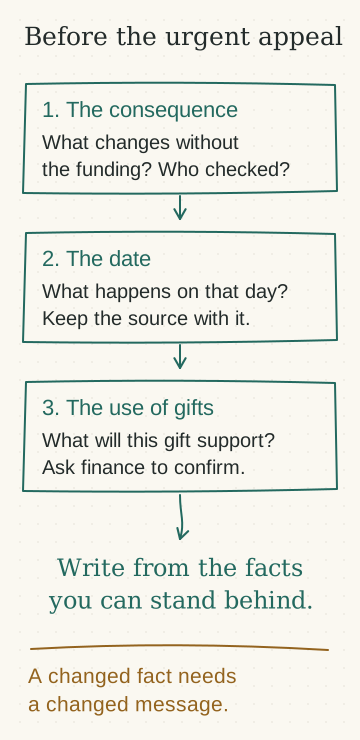
The study
- Lost and found: A natural field experiment on charitable donations, extinctions, and finance for conservation
Published 2026. The two campaigns reported different real events; read what each told donors before comparing the gift rates.
Worked case
The sentence in the draft
Millbrook After School runs a weekday program for 60 children, Monday to Thursday, funded through June by a city contract and two foundation grants. In September it added a Saturday morning session for 24 children whose schools had referred them for extra help with reading and maths. A one-off grant pays for Saturdays until December 12.
On November 4, Ama, the development director, receives the year-end email draft. Its opening line reads: “This winter, 60 children could lose their after-school place unless you give by December 31.” The appeal is scheduled for November 17. Ama opens a claim brief and checks each part of the sentence with the person who would know.
| Part of the sentence | Who Ama asked | What they confirmed | What changes |
|---|---|---|---|
| 60 children | Jonah, program director | 60 children attend on weekdays. 24 attend on Saturdays, all referred by their schools. | Use 24, and name the Saturday session. |
| could lose their after-school place | Rosa, finance director | The weekday program is funded through June 30. No weekday place is at risk. | Only the Saturday session is at risk. Say so, and say the weekday program is safe. |
| this winter | Jonah | The last funded Saturday is December 12. A spring term would run 20 Saturdays from January 9 to May 29, with no session on April 3. | Name the dates. |
| by December 31 | Dee, executive director, and the board minutes of October 22 | The board decides on December 10, using gifts and written grant commitments received by December 8. December 31 came from the campaign calendar. | The date in the appeal becomes December 8. |
| unless you give | Rosa | Gifts to the appeal go to the after-school program fund, which pays for weekdays and Saturdays. The board counts them toward the Saturday decision. If Saturdays end, or more is raised than Saturdays need, the money supports weekdays. | Explain what gifts support and what happens in each case. Don’t say a gift buys a place. |
The cost, and the condition
Jonah and Rosa cost the spring term together. The funder of the autumn grant has agreed in writing that $3,000 left unspent can be used in the spring.
| Line | Calculation | Amount |
|---|---|---|
| Tutors | 2 tutors × 4 hours × $30 × 20 sessions | $4,800 |
| Site lead | 5 hours × $40 × 20 sessions | $4,000 |
| Snacks and materials | 24 children × $3 × 20 sessions | $1,440 |
| Building opening fee | $88 × 20 sessions | $1,760 |
| Total cost | $600 per session × 20 sessions | $12,000 |
| Already confirmed | Unspent autumn grant, funder’s written approval on October 28 | $3,000 |
| Still needed by December 8 | $12,000 − $3,000 | $9,000 |
The board minute sets the condition. If $12,000 is confirmed by December 8, all 20 Saturdays run. If less is confirmed, Millbrook will run as many full sessions as the money covers, at $600 each, as long as that’s at least ten. With less than $6,000 confirmed in total, which means less than $3,000 raised, the Saturday session ends on December 12 and families hear that week.
A spring place costs $12,000 ÷ 24 = $500. The appeal can use that figure to show scale, in the same paragraph that says gifts support the whole after-school program.
Ama’s decision
The appeal goes out on November 17 about the Saturday session, with December 8 as its date and the board’s condition stated plainly. December 31 comes out of the copy, along with the 60 children. Jonah and Rosa agree to tell Ama the same day if a grant decision or anything else changes the gap. The replacement version is approved in the same sign-off, so the team can switch without another round of review.
The appeal email
Sent November 17. Every figure and date matches the claim brief.
Subject: Saturday mornings at Millbrook, after December 12

Hi [first name],

Since September, 24 children have spent Saturday mornings at Millbrook working on reading and maths with two tutors. Their schools referred them because they needed extra help.

The grant that started the session pays for Saturdays until December 12. Our board will decide on December 10 whether the session continues in the spring, and that decision depends on what we raise by December 8.

The spring term is 20 Saturdays, from January 9 to May 29, and costs $12,000. We already have $3,000. If we raise the other $9,000 by December 8, every Saturday goes ahead. If we raise less, we’ll run as many Saturdays as the money covers, as long as that’s at least ten. If we can’t cover ten, the session ends on December 12.

Our weekday program isn’t affected. It’s funded through June, and all 60 children who come Monday to Thursday keep their places.

Gifts to this appeal go to Millbrook’s after-school program, which pays for weekdays and Saturdays. A spring Saturday place costs about $500 per child. Every gift received by December 8 counts toward the board’s decision. If the session can’t continue, or we raise more than Saturdays need, your gift will support the weekday program.

Give by December 8: [link]
If you’re giving by post, please send your gift by December 3 so it arrives in time.

I’ll write on December 11 to tell you what the board decided.

Ama [surname]
Development Director, Millbrook After School
[direct phone]
The replacement version
Approved with the main email. Used if the spring term is fully funded before November 17, or if the board’s condition can’t be confirmed by the copy deadline. Choose one of the two middle paragraphs.
Subject: Saturday mornings at Millbrook

Hi [first name],

Since September, 24 children referred by their schools have spent Saturday mornings at Millbrook working on reading and maths with two tutors. Our weekday program, Monday to Thursday, serves 60 children.

[If spring is funded] The Saturday session will continue from January 9 to May 29, thanks to [funder].
[If the decision isn’t confirmed] We’re still settling plans for Saturdays in the spring, and I’ll write again when they’re confirmed.

Gifts to this appeal go to Millbrook’s after-school program: tutors, snacks, books and the building, on weekdays and Saturdays. A term of Saturday mornings costs about $500 for each child.

Give: [link]

Ama [surname]
Development Director, Millbrook After School
[direct phone]
When the funding arrived
On November 30, the Pell Family Fund confirmed in writing a $4,000 grant for the spring Saturday session. With $5,350 already given to the appeal, confirmed spring funding reached $3,000 + $4,000 + $5,350 = $12,350, a week before the date in the appeal. Dee confirmed that the board’s condition had been met.
Ama followed the brief. The giving page changed on November 30 to say the spring term was funded. The December 6 reminder, which repeated the deadline, was cancelled. The update below went out on December 1 to appeal recipients who could still receive it under their contact preferences. The grants and $5,000 of the appeal gifts covered the Saturday cost. The remaining $350, and any appeal gifts received after November 30, went to the weekday program, under the terms the appeal had described. Donors still heard the board’s decision on December 11, as promised.
The December 1 update
A funding update for appeal recipients whose contact preferences permit it. It contains no further request.
Subject: Saturdays at Millbrook will continue

Hi [first name],

On November 17 I wrote that $9,000 would fund all 20 spring Saturdays, and that the session would end on December 12 if we couldn’t fund at least ten. Gifts to the appeal, together with a $4,000 grant from the Pell Family Fund, now mean all 20 spring Saturdays, from January 9 to May 29, are paid for. The funding condition was met a week early.

If you gave, thank you. Any gift beyond what Saturdays need, including gifts that arrive from now on, will go to our weekday program, as the appeal said.

The December 8 deadline no longer applies. I’ll write on December 11 to confirm the board’s decision, as promised.

Ama
Team kit
Your appeal claim brief
Complete it before the copy is approved. Keep it with the draft, and give a copy to whoever answers donor replies.
APPEAL CLAIM BRIEF

Appeal:
Send date:
Brief owner:

1. THE CLAIM
Sentence in the draft, word for word:
What it tells donors will happen, and when:

2. WHAT KIND OF DATE IS THIS?
☐ Program consequence: a named service stops, shrinks or doesn’t start
☐ Finance shortfall: a budget gap, with no decision about a specific service
☐ Matching gift: terms and end date confirmed in writing
☐ Campaign calendar date
☐ Not confirmed yet

3. THE CONSEQUENCE (program consequence only)
Service at risk:
People affected (number, and who they are):
Services not at risk, and why:
Last funded date:
Who decides:
Decision date:
Condition (amount, by what date, what counts toward it):
What happens with partial funding:
Confirmed by (name, role, date, where recorded):

4. THE MONEY
Total cost, line by line, with calculations:
Already confirmed (source, date):
Still needed:
How gifts to this appeal are recorded (fund):
Confirmed by finance (name, date):
What happens to gifts if the consequence goes ahead anyway:
What happens to gifts beyond the amount needed:
Cost figure the appeal may use, and its exact wording:

5. WORDS
The appeal may say:
The appeal must not say:

6. IF THINGS CHANGE
Who tells the brief owner, and how quickly:
Version for a gap that closes before sending (approved: yes / no):
Version for a condition that can’t be confirmed by the copy deadline (approved: yes / no):
After sending: giving page, reminders, update to recipients (owner, timing):
Report-back to donors (date, owner):

7. SIGN-OFF
Program (name, date):
Finance (name, date):
Decision-maker (name, date):
Development (name, date):
Your appeal, in two versions
Draft both together and approve them together. Every bracket should be filled from the claim brief.
VERSION A: A CONFIRMED CONSEQUENCE

Subject: [Service] after [last funded date]

Hi [first name],

[What the service is, who it’s for and what has happened since it started, in two or three sentences.]

[Funding source] pays for [service] until [last funded date]. [Who decides] will decide on [decision date] whether it continues, based on what we raise by [deadline].

[Next period] costs [total]. We already have [amount confirmed]. If we raise the other [amount needed] by [deadline], [what happens]. If we raise less, [what partial funding does]. [What happens if the minimum isn’t reached.]

[What isn’t affected, and why.]

Gifts to this appeal go to [fund, in words a donor understands]. [Cost figure, worded to show scale.] [What happens to gifts if the service ends anyway, or if more is raised than it needs.]

Give by [deadline]: [link]

I’ll write on [report-back date] to tell you what was decided.

[Name]
[Role, organization, direct contact]


VERSION B: NO CONFIRMED DEADLINE

Subject: [What gifts make possible]

Hi [first name],

[What the service is and who it’s for.]

[Choose one:]
[The next period is funded: what happens next, and who made it possible.]
[We’re still settling plans for [period], and I’ll write again when they’re confirmed.]

Gifts to this appeal go to [fund]. [Cost figure from the brief, worded to show scale.]

Give: [link]

[Name]
[Role, organization, direct contact]
Change notice to colleagues
Send the same day a fact in the brief changes, before anyone answers another donor.
Subject: Appeal change: [appeal name]

[What changed], confirmed by [name] on [date].

From now:
Giving page: [new wording], updated by [owner] by [time]
Scheduled reminders: [cancelled / replaced with], by [owner]
Donor replies: answer with [wording], [owner]
Donors who already gave: [what they’ll hear, and when]
Board or leadership report: [what changes]

The original claim brief and this notice are saved at [location].
The appeal claim brief
The brief, both email versions and the change notice in one file, to share with program and finance before the copy is approved.
Download the appeal claim briefWho does what
- The development director owns the brief and approves the final copy.
- The program lead confirms what is at risk, who is affected and what isn’t at risk.
- Finance confirms the costs, the fund and what happens to gifts in each case.
- Whoever decides, usually the executive director or board chair, confirms the condition and the decision date.
- Donor care answers replies from the brief and passes anything it doesn’t cover to the brief owner.
Exceptions
- A sudden, real loss, such as a building closed after an inspection. Complete sections 3 and 4 with the people who can confirm the facts before approving the first email.
- A matching gift. State the match amount, its terms and its end date. If the match is met early, say so on the giving page and in any reminder.
- The consequence has already happened. Report it, and describe what gifts will do now. Don’t ask donors to prevent something that has already occurred.
- Identifiable people. Describe the service and the numbers. Use a child’s or family’s name, photograph or story only with the permission your organization requires for that use.
Check whether the brief helped
- Every number and date in the sent email matches the brief, and a colleague outside development can trace each one to the person who confirmed it.
- Count donor replies asking about the claim, and how many your team answered from the brief without going back to program or finance.
- The report-back went out on the date the appeal promised.
- If the facts changed, note how long it took for the giving page and reminders to change.
- Add a line to the brief for anything it didn’t cover this time.
Continue with the source
Read Tanner’s description of the two campaigns, including what each told donors, before the gift rates. The events themselves differed, and that shapes what the comparison can tell you about your own appeal.
Read the research ↗Complete the appeal claim brief
Keep the verified facts, funding terms, review and replacement message together before the appeal goes out.
Download the worksheetWhat Does This Box Promise?
Write a donor priority question, the sentence that says what the answer does, and the handoff that makes sure your team does it.
Judd Kessler, Katherine Milkman and Yiwei Zhang tested two reply cards in a university annual fund. One invited alumni to mark which university priorities mattered most to them. Every gift stayed unrestricted.
The worked cases and templates use invented people and organizations.
The lesson
Suppose a donor gives $250 with “Family reading workshops” ticked on the reply card. Six months later, they ask how many workshops the gift paid for. If the form never said what the tick did, there’s no good answer. The gift went into the general fund, the tick sits in a field nobody reports on, and the donor had reason to assume otherwise.
A priority box can do three different things. Each needs its own sentence on the form and its own person behind it.
| What the answer does | Sentence on the form | Where it’s recorded | Who acts on it |
|---|---|---|---|
| Chooses which updates the donor receives | “If you’ve asked for program updates, we’ll use your answer to choose what we tell you about.” | A donor-stated interest field, dated, with its source. | Whoever sends program updates, using content the program team supplies. |
| Informs planning | “We share the totals, without names, with our program team each year.” | The same interest field, reported as counts. | The program director, who receives the totals. The form shouldn’t promise any change to programs. |
| Restricts the gift | “Your gift will be used only for [program].” | A fund or restriction code, set by finance under your gift acceptance policy. | Finance, who records the restriction and confirms the gift is used that way. |
The finding in its setting
Kessler, Milkman and Zhang (2019) randomly assigned 32,174 previous donors, alumni of a university, to receive the standard reply card or one that also invited them to mark which of four priorities mattered most. Gifts stayed unrestricted whatever they marked. Among those in the highest-income census tracts who gave, gifts were about 2.4 times as large with the choice card; the study found no statistically significant increase in the likelihood of giving. A census tract describes a neighborhood, so it’s only a rough guide to any one person’s wealth. The authors note that some alumni may have believed their choice directed their gift.
The experiment doesn’t establish what every donor understood. If you offer a choice, say plainly what it does.
Rules that keep the box honest
- Offer only options you can report on. If the program team can’t supply an update about an area on the schedule you promise, leave it off.
- Keep interest, permission and restriction in separate fields. Ticking an interest doesn’t opt anyone into email, change their appeal schedule or move the gift to another fund.
- Don’t fill in an answer for the donor. A blank stays blank. A large gift or a seat at an event isn’t a stated interest.
- Use the latest answer, and keep earlier ones with their dates.
- Read every handwritten note. “For books only” is a request about the gift, and it needs a person to respond.
- Promise no more than you’ll do. If the totals go to the program team, say that, and don’t suggest every answer changes the program.
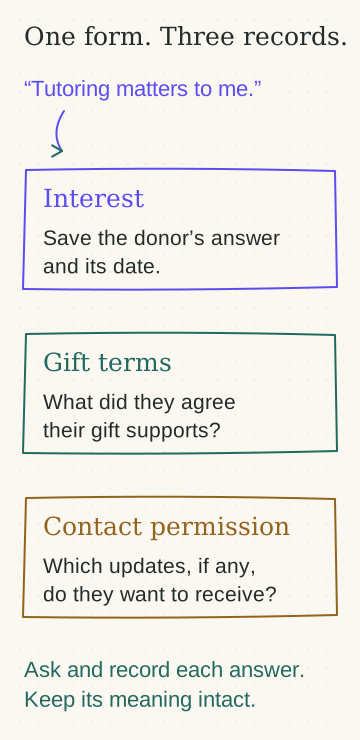
The study
- Getting the Rich and Powerful to Give
2019. Compare the two reply cards before the results. The headline effect is for one group of alumni, identified by neighborhood income.
Worked case
Kestrel’s new reply card
Kestrel Reading Project runs three things: one-to-one tutoring for children in grades 1 to 4, books children take home to keep, and evening reading workshops for families. Gifts go to the general literacy fund, which pays for all three. Kestrel has never offered a restricted option on its standard forms.
Marisol, the development director, wants to add a priority question to the spring reply card and the online form. Before drafting, Marisol meets Ben, the program director, and Yusuf in finance with three questions: what will the answer do, who will do it, and what must the form not imply.
They agree that the answer will decide which program stories go to donors who have asked for updates, and that Ben will receive the totals each June. It won’t change where any gift goes. Ben commits to one short update per program area every six months, so each option has something behind it. Yusuf asks to see any note requesting a restriction before anything is recorded, because Kestrel’s gift acceptance policy requires finance approval for a restricted gift.
The question on the card
Printed on the reply card and repeated on the online form, directly above the gift amount.
WHICH PART OF OUR WORK MATTERS MOST TO YOU?
Tick any that apply.

☐ One-to-one tutoring
☐ Books children keep at home
☐ Family reading workshops

Your gift supports all three, whatever you tick. If you’ve asked for program updates, we’ll use your answer to choose what we tell you about. We also share the totals, without names, with our program team each June.

WOULD YOU LIKE PROGRAM UPDATES?
☐ Yes, email me a short update about twice a year.
Leaving this blank keeps your current preferences. To change them, contact Marisol at [email] or [phone].

If you want your gift used for one program only, please contact Marisol before you give: [phone] or [email].| On the card | Field | Values | What it changes | What it doesn’t change |
|---|---|---|---|---|
| Priority ticks | Program interest (donor-stated), with date and source | Tutoring, Books, Workshops, in any combination. Blank if nothing ticked. | Which program stories go to donors with update permission. The June totals. | The gift’s fund, email permission or appeal schedule. |
| Updates checkbox | Email permission: program updates, with date and source | Yes. A blank box leaves any existing permission as it was. | Whether the donor receives program updates. | Permission for appeals or any other email. |
| Gift | Fund | General literacy fund, unless finance approves a restriction. | Where the money is recorded. | The donor’s recorded interests. |
| Handwritten note | Note, copied word for word, with a review flag if it mentions how the gift should be used | Text. Flag open or closed. | Starts a review by Marisol and Yusuf. | The fund, until Yusuf approves a change. |
| Nothing on the card | Staff notes, kept separate | Text, with author and date. | Nothing automatically. | The donor-stated interest field. |
Five replies from the first week
The spring appeal goes out on March 2. Marisol picks five of the first week’s replies that show the decisions the team now has to make the same way every time.
| Reply | What Kestrel recorded | What happened next |
|---|---|---|
| Carla Ortiz ticks Workshops and Updates, and gives $60. | Interest: Workshops (March 5, reply card). Update permission: yes (March 5). | Standard acknowledgment. The April update about family workshops goes to Carla. |
| Hugh Marsh ticks Tutoring, leaves Updates blank and gives $100. There is no update permission on file. | Interest: Tutoring. Permission unchanged: none. | Acknowledgment only. No program updates. The answer is counted in June. |
| Priya Shah ticks all three and Updates, and gives $40. | Interest: Tutoring, Books, Workshops. Update permission: yes. | Updates rotate across all three areas. Nobody picks a favorite on the donor’s behalf. |
| Joan Abbott ticks Books, gives $500 and writes “for books only please.” | Interest: Books. Note copied word for word. Review flag opened March 6. | Yusuf holds the gift’s allocation for review and preserves Joan’s instruction. Marisol calls on March 9. The gift is not spent as unrestricted while the terms are unresolved. |
| Noor Kim leaves every box blank and gives $25. | No interest recorded. Nothing inferred from earlier gifts or event attendance. | Acknowledgment. If Noor already receives updates, they stay general. |
Carla’s acknowledgment
Sent within two working days to donors who ticked a priority and asked for updates.
Subject: Thank you, Carla

Hi Carla,

Thank you for your gift of $60 to Kestrel Reading Project, received on March 5. Your receipt is attached.

You told us family reading workshops matter most to you, so the program updates you asked for will focus on them. The first one comes in April. Your gift supports all of our reading work: tutoring, books children keep at home and the workshops.

If you’d like to hear about something else, or stop the updates, reply to this email.

Marisol [surname]
Development Director, Kestrel Reading Project
Joan’s gift
On the call, Marisol explains that Kestrel gifts normally support all of its reading work, and asks what Joan would prefer. Joan wants the $500 used only for books children keep at home. Yusuf had confirmed on March 6 that Kestrel can accept a gift restricted to home books under its policy, so Marisol agrees, and sends the handoff below the same day.
Marisol’s handoff to finance and program
Written after the call, so each person knows what they now owe the donor.
Subject: Joan Abbott’s gift, restricted to home books

Yusuf, Ben,

I spoke to Joan Abbott on March 9 about the note on the reply card (“for books only please”). I explained that our gifts normally support all of our reading work. Joan would like the $500 used only for books children keep at home.

Yusuf: please record the gift as restricted to home books, as you approved on March 6 under the gift acceptance policy.

Ben: by June 30, please send me what we spent on home books between March and June, so I can tell Joan how the gift was used.

I’ll send Joan a letter confirming the restriction today, and a short report in July. Joan’s interest is recorded as Books. Joan hasn’t asked for program updates, so none will be sent.

Marisol
What Kestrel left out
Marisol’s first draft of the card said “Choose where your gift makes the biggest difference.” Read on its own, that tells the donor the gift will go where they choose, which wasn’t true for any of the options. It came out.
The team also kept the interest field away from the appeal schedule. A donor who ticks Tutoring hasn’t asked for the tutoring appeal and no other, and hasn’t agreed to more email.
Team kit
Your priority question
Keep only the sentences that are true for your organization, and agree them with program and finance before printing.
WHICH PART OF OUR WORK MATTERS MOST TO YOU?
Tick any that apply.

☐ [Program area you can report on]
☐ [Program area you can report on]
☐ [Program area you can report on]

Your gift supports [what the general fund pays for], whatever you tick.
[Keep only the true sentences:]
If you’ve asked for program updates, we’ll use your answer to choose what we tell you about.
We share the totals, without names, with our program team each [month].

WOULD YOU LIKE PROGRAM UPDATES?
☐ Yes, email me a short update about [how often].
Leaving this blank keeps your current preferences. To change them, contact [name] at [email] or [phone].

If you want your gift used for one program only, please contact [name] before you give: [phone] or [email].
Your field and handoff sheet
Fill it in at the meeting with program and finance, before the form goes live.
DONOR PRIORITY QUESTION: FIELDS AND HANDOFFS

Form or card:
Owner:
Agreed with program (name, date):
Agreed with finance (name, date):

WHAT THE ANSWER DOES
☐ Chooses program updates, for donors who opted in
☐ Counted and shared with [who], [when]
☐ Restricts the gift (only if finance has approved a restricted option)
Sentence on the form, word for word:
What the form must not imply:

OPTIONS
Option | Who supplies update content | Updates per year
1.
2.
3.

FIELDS
Priority answer goes to field:              Dated: ☐   Source recorded: ☐
Update permission goes to field:            A blank box means:
Gift fund:                                  Set by:
Notes copied word for word to:              Review flag if a note mentions how the gift is used: ☐
Staff observations kept in:

HANDLING
A note asks for a restriction (who calls, within how many days, who approves, what is recorded meanwhile):
No reply by [date] (finance’s policy for the gift, person responsible, next review and any permitted contact):
Several options ticked:
No option ticked:
Donor changes their answer (latest is current; earlier answers kept with dates):
Interest ticked, but no update permission:
A program area pauses or ends:
Donor asks how “their” program used the gift:

HANDOFFS
Acknowledgment sent by, within:
Totals to program (who, when, format):
Restriction requests to finance (who, within how long):
Update content due from program (dates):

SIX-MONTH CHECK (date):
Forms returned:
Forms with at least one priority ticked:
Notes asking for a restriction:
Resolved within the agreed time:
Donors with permission who received an update matching their interest:
Donor questions showing the form was misunderstood:
Changes for the next version:
Your acknowledgment
Use after checking the gift record and the donor’s update permission. Include the update sentence only when they have asked for those updates.
Subject: Thank you, [first name]

Hi [first name],

Thank you for your gift of [amount] to [organization], received on [date]. [Receipt sentence, if applicable.]

You told us [program area] matters most to you. Your gift supports [the general fund’s work, in wording agreed with finance].

[If they asked for updates: The program updates you asked for will focus on [area]. The first comes in [month]. To change your interests or stop the updates, reply here or contact [name] at [email] or [phone].]

With thanks,
[Name]
[Role], [Organization]
If a donor wanted a restricted gift
Use while finance reviews the donor’s instruction. Agree option 2’s wording, any offer to return the gift and the review date with finance first.
Hi [first name],

Thank you for your gift of [amount], and for the note on your reply card asking that it go to [program].

Gifts to [organization] normally support all of our [work], including [program]. Before we settle how yours will be used, I wanted to check what you’d prefer:

1. Keep it as a general gift. We’ll note that [program] matters most to you[, and the updates you’ve asked for will focus on it].
2. Use it only for [program]. We can do that, and we’ll tell you by [date] how it was spent.

[If your organization can’t accept a restriction for this program, replace option 2 with: “We aren’t able to set gifts aside for [program] alone. If you’d rather not give on that basis, tell me and we’ll return your gift.”]

Reply here or call me on [number]. We’ll keep your instruction with the gift while finance reviews it, and check again on [date] if we haven’t heard from you.

[Name]
[Role], [Organization]
The donor priority choice kit
The question, the field and handoff sheet, the acknowledgment and the restriction reply in one file, for the meeting with program and finance.
Download the priority choice kitWhen the answer changes or doesn’t fit
If a donor ticks something different next year, the new answer is current. Keep the old one with its date; the donor may mention the change, and it helps to know.
If a program area pauses, tell the donors who chose it and asked for updates, and ask whether they’d like a different focus. If a donor asks how “their” program used the gift, answer truthfully: the gift went to the whole program, and here is what that program did.
If the donor doesn’t answer a restriction query by the agreed date, finance decides the next step under the gift acceptance policy. Keep the original instruction, assign a person and a next review date, and record any contact the donor’s preferences allow. Silence doesn’t turn the gift into an unrestricted one. Recording the money and settling its use are separate tasks; follow finance’s policy for both.
The development director owns the form and the six-month check. The program director owns update content and receives the totals. Finance owns every restriction decision. Whoever processes gifts owns the fields and the review flags.
Check after six months
Count the notes that asked for a restriction and how quickly each was resolved, and read every donor question about where a gift went. If several donors thought they had chosen where their money went, rewrite the sentence on the form.
A higher average gift after adding the question doesn’t show the question caused it. To find out, send the two cards to randomly assigned halves of the same mailing and compare everyone assigned, including people who didn’t give.
Continue with the source
Compare the two reply-card designs, shown early in the paper, then read how the authors grouped alumni by census tract. Their discussion of whether some alumni thought their choice directed their gift explains why your form should say exactly what the answer does.
Read the research ↗Design the priority question and its handoff
Write the choice, its meaning, the reply and the record each colleague needs to honor it.
Download the worksheetThe Gift That Hasn't Happened
Record what donors say about giving again, follow up only where they’ve agreed, and report the survey without counting a gift that hasn’t happened.
Gaston Godin and colleagues sent questionnaires to lapsed blood donors and counted blood-drive registrations. Everyone assigned to each questionnaire was compared with a control group that received none.
The worked cases and templates use invented people and organizations.
The lesson
The finding in its setting
Godin and colleagues (2014) randomly assigned 7,000 lapsed blood donors to one of six questionnaires or to a control group that received none, then counted registrations at blood drives over the next 6 and 15 months. Some questionnaire versions increased registration compared with the control group. About 23% of people with valid addresses returned a questionnaire.
The outcome was blood-drive registration, so the study cannot tell you how much money a cash-donation survey would produce. Returning a questionnaire was a choice, which is why the comparison that counts is everyone assigned against everyone in the control group. People who reply differ from people who don’t in ways no mailing caused.
How an answer turns into a number
Survey answers drift as they move through a team. “I plan to give again” becomes “likely donor” in the database, then “41 expected renewals” in the board pack, then a revenue line built on the average gift. Each step seems reasonable to whoever takes it, and none of them is something the donor said.
The donor answered one question, on one date. That’s what the record should hold, with the wording of the question. Anything staff infer goes in a separate note and doesn’t change the donor’s status. Permission to follow up is a separate answer too; a donor can plan to give and still not want a call.
| Answer | What you know | What you can do | When it ends |
|---|---|---|---|
| No reply | Nothing new. Silence isn’t a no, a maybe or permission. | Carry on with the donor’s usual communications. | Nothing is recorded, so nothing needs to end. |
| Plan to give | What the donor said, on that date. | Thank them. Follow up personally only if they ticked the follow-up box. | When they give, or at the recheck date. |
| Not sure yet | What the donor said, on that date. | Follow up only with permission, and offer what they might find useful. | At the recheck date. |
| Not right now | What the donor said, on that date. | Thank them. No personal ask follows from the survey. | At the recheck date. |
| Gift received | A gift, with its amount. | Receipt and thanks as usual. Cancel any planned follow-up ask. | The answer is closed. |
| Formal pledge | A commitment made through your usual pledge process. | Finance records it under your organization’s policy. | Handled by finance, outside the survey record. |
Give every answer a recheck date
An answer describes one moment. Set a recheck date when you record it, such as the end of the period the question asked about. After that date it leaves the active list and stays in the donor’s history. Nobody should stay a “likely donor” because of a box they ticked two years ago.
To find out whether the survey changed giving, hold back a randomly chosen group that doesn’t receive it, and fix the dates before sending. Then compare the share of each whole group who gave, counting each donor once. The reply rate and the giving rate have different denominators. Keep them apart in every report.
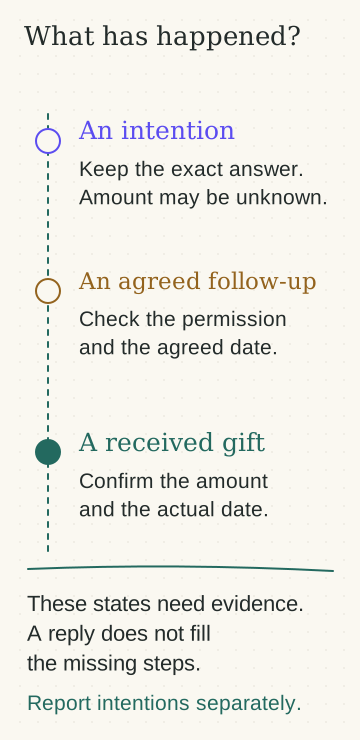
The study
- Promoting the Return of Lapsed Blood Donors: A Seven-Arm Randomized Controlled Trial of the Question–Behavior Effect
2014. Measures blood-drive registration, not money. Compares everyone assigned to each group.
Worked case
Fernwood’s check-in survey
After Femi checks duplicate identities and excludes donors whose contact preferences do not permit this survey, Fernwood Community Pantry has 1,200 eligible individual donors whose last gift was 13 to 36 months before March 1. Rhea, the development manager, wants to ask them whether they’re thinking of giving again. Femi, the operations lead, wants to know whether asking makes any difference.
On March 2, Femi randomly splits the 1,200 into two groups of 600 and saves the file. One group receives the survey on March 3. The other doesn’t. Both groups get Fernwood’s usual communications. The comparison window runs from March 3 to August 31, which is also the recheck date for every answer.
The survey
Sent March 3 to the 600 donors in the survey group.
Subject: A quick question from Fernwood Community Pantry

Hi [first name],

You’ve given to Fernwood before, and we’d like to know where things stand for you now. It’s one question, and you can skip it.

Are you thinking about giving to Fernwood again by August 31?
( ) Yes, I plan to
( ) I’m not sure yet
( ) Not right now

Would you like someone from Fernwood to get in touch?
☐ Yes, by email
☐ Yes, by phone: [number]
Leave both blank if you’d rather not hear from us about this.

Anything you’d like us to know? [optional]

Your answer isn’t a promise. We’ll only contact you about it if you tick a box above.

Rhea [surname]
Development Manager, Fernwood Community Pantry| Status | Donors | Asked for follow-up |
|---|---|---|
| Email bounced | 12 | 0 |
| Delivered, no reply | 492 | 0 |
| Replied: plan to give | 41 | 25 |
| Replied: not sure yet | 33 | 11 |
| Replied: not right now | 22 | 1 |
| All survey recipients | 600 | 37 |
96 of the 600 replied, a reply rate of 16% of everyone sent the survey. Six replies mentioned an amount in the comment box, such as “probably $50 again.” Rhea copies each comment into the donor’s record word for word and adds none of them up.
Rhea owns the follow-ups and works through the 37 by the channel each donor chose. Two donors who planned to give gave online before Rhea reached them; their follow-ups were cancelled and they received the usual receipt and thanks. Of the 35 Rhea contacted by March 31, four replied “no thanks,” and their records now say so. The 22 who said “not right now” get no personal ask; the one who asked about volunteering in their comment gets the information they requested.
Rhea’s follow-up to a donor who plans to give
Sent to donors who answered “Yes, I plan to” and ticked email.
Subject: Following up on your reply

Hi Carmen,

Thank you for answering our question in March, and for asking us to get in touch.

You said you’re planning to give to Fernwood again by August 31. There’s nothing you need to do now. In case it’s useful, here’s what has changed since your last gift: we’ve added a Saturday distribution, and the fresh produce shelf now runs all year.

When you’re ready, you can give at [link], or reply and I’ll post you a form.

If you’d rather not hear from us about this again, reply “no thanks” and I’ll make a note. You’ll keep receiving only the emails you already get from us.

Rhea
The April report
Rhea’s first draft for the April 14 finance committee counted the 41 “plan to give” answers as expected renewals at the group’s average past gift of $85: 41 × $85 = $3,485 in the spring forecast. Femi took it out. The answers did not establish 41 gifts of $85. Some comments mentioned possible amounts, but none created a commitment through Fernwood’s pledge process. The $3,485 was Fernwood’s estimate, presented as donors’ commitments.
The report gives the survey counts in full, reconciled to all 600 recipients, and leaves revenue as gifts received. Two donors made written pledges after their follow-up; finance recorded them through its usual pledge process, and the report counts them there.
The survey section of the April report
Every recipient appears in exactly one line.
SURVEY OF LAPSED DONORS, SENT MARCH 3

Sent to: 600 donors, chosen at random from 1,200 whose last gift was 13 to 36 months before March 1. The other 600 were not surveyed.

Bounced: 12
Delivered, no reply: 492
Plan to give: 41
Not sure yet: 33
Not right now: 22
Total: 600
Reply rate: 96 of 600 (16%)

Asked for follow-up: 37
Gave before we reached them: 2
Followed up by March 31: 35
Replied “no thanks”: 4

Gifts from survey recipients, March 3 to April 10: 14 donors, $1,190. Included in campaign revenue as usual.
Intentions: not included in revenue, receivables or the forecast. We didn’t ask for amounts. Six donors mentioned one in a comment; these are recorded word for word.
Pledges: 2 written pledges after follow-up, recorded by finance. See the pledges report.

Whether the survey changed giving: comparison with the 600 donors not surveyed, after August 31.
August 31: did the survey make a difference?
Femi counts, for each group of 600, the donors who made at least one gift between March 3 and August 31, from any channel, counting each donor once. Everyone stays in the group they were assigned to, including bounces and people who never replied.
| Group | Assigned | Donors who gave | Share who gave |
|---|---|---|---|
| Survey | 600 | 39 | 6.5% |
| No survey | 600 | 31 | 5.2% |
| Difference | – | 8 | 1.3 percentage points |
This comparison covers the survey and the agreed personal follow-ups it triggered. It cannot isolate the effect of asking the question. Eight more donors gave in the survey group. With 600 in each group, a gap that size could easily come from chance, so Femi reports a small difference that doesn’t settle whether the survey helped. Repeating the same design next year would add evidence.
The 39 survey-group donors who gave include 22 who said they planned to, 7 who weren’t sure, 1 who said not right now and 9 who never replied. So 22 of the 41 who planned to give did give, which is 54%. Femi doesn’t set that beside the 5.2% in the no-survey group. Those 41 chose to reply and chose that answer, and many would probably have given anyway. The 54% describes them and says nothing about what the survey did.
On August 31 every answer reached its recheck date. The 19 donors who said they planned to give and haven’t are no longer flagged, and their March answers stay in their history.
Team kit
Your survey question
Keep the follow-up question separate from the intention question, and keep the last line.
Subject: A quick question from [organization]

Hi [first name],

[One sentence on why you’re asking.] It’s one question, and you can skip it.

Are you thinking about giving to [organization] again in the next [period]?
( ) Yes, I plan to
( ) I’m not sure yet
( ) Not right now

Would you like someone from [organization] to get in touch?
☐ Yes, by email
☐ Yes, by phone: [number]
Leave both blank if you’d rather not hear from us about this.

Anything you’d like us to know? [optional]

Your answer isn’t a promise. We’ll only contact you about it if you tick a box above.

[Name]
[Role], [Organization]
Your follow-up messages
Send only to donors who asked to hear from you, by the channel they chose. Each version has a way to decline.
FOR “YES, I PLAN TO”

Hi [first name],

Thank you for answering our question in [month], and for asking us to get in touch.

You said you’re planning to give to [organization] again. There’s nothing you need to do now. In case it’s useful, here’s what has changed since your last gift: [one or two confirmed sentences].

When you’re ready, you can give at [link], or reply and I’ll send a form.

If you’d rather not hear from us about this again, reply “no thanks” and I’ll make a note.

[Name]


FOR “I’M NOT SURE YET”

Hi [first name],

Thank you for answering our question in [month], and for asking us to get in touch.

Is there anything that would help you decide, or anything you’d like to know about our work? I’m happy to [answer questions / send a short update / arrange a visit].

If you’d rather not hear from us about this again, reply “no thanks” and I’ll make a note.

[Name]


FOR “NOT RIGHT NOW”

Hi [first name],

Thank you for letting us know, and for asking us to stay in touch.

[Only if real: a way to stay involved that isn’t a gift, such as volunteering or an open day.] We won’t ask you for a donation in reply to your answer.

If you’d rather not hear from us about this again, reply “no thanks” and I’ll make a note.

[Name]
Your intention record and survey report
The record holds one donor’s answer. The report must add up to everyone sent the survey.
DONOR INTENTION RECORD

Donor ID:
Survey and date sent:
Question, word for word:
Answer, word for word:
Date answered:
Comment, word for word:
Amount, only if the donor wrote one, word for word:
Follow-up permission: ☐ email  ☐ phone  ☐ none    Date:
Staff notes (separate from the answer):
Follow-up owner:                Due by:
Follow-up done (date, channel):
Donor’s response:
Gift before follow-up? (date, gift ID):
Formal pledge? (referred to finance; pledge ID if recorded):
Recheck date:
At recheck: ☐ gave  ☐ no gift, answer moved to history  ☐ asked again, with consent


SURVEY REPORT

Assigned to survey:             Assigned to comparison group:
Assignment unit (individual donor / household):
Assignment date and method:
Contact preferences checked before assignment:
What differs between groups, including any agreed follow-up:
Bounced:
Delivered, no reply:
Plan to give:
Not sure yet:
Not right now:
Total (must equal assigned to survey):
Reply rate (replies ÷ assigned to survey):

Asked for follow-up:
Gave before follow-up:
Followed up:
Declined further contact:

Gifts received (in revenue as usual):
Intentions in revenue, receivables or forecast: none
Pledges (recorded by finance; see pledges report):

Comparison window (fixed before sending):
Survey group: donors who gave ÷ assigned =
Comparison group: donors who gave ÷ assigned =
Difference, with counts:
Read as: ☐ too small to call  ☐ worth repeating  ☐ other:
The donor intention follow-up kit
The survey, the three follow-up messages, the intention record and the reconciling report in one file.
Download the follow-up kitWho does what
Whoever processes replies records each answer word for word and opens a follow-up task only where the donor ticked a box. One named person owns each follow-up and its due date. Finance owns pledges, through whatever process your organization already uses; the survey doesn’t create a new kind of commitment. Whoever reports to leadership owns the reconciliation, the comparison and the recheck date.
Exceptions
- A donor gives before you follow up. Cancel the follow-up, send the receipt and thanks as usual and close the answer.
- A donor writes an amount. Copy it word for word into the comment field. It becomes a pledge only if the donor makes one through your usual process.
- A donor who said “not right now” gives anyway. Thank them as you would anyone. The earlier answer was true when they gave it.
- Someone answers for a household. Record the answer against the person who replied and note the household. Don’t copy it onto other people’s records.
- A donor asks not to be contacted at all. That overrides the follow-up and every other list.
Check whether it worked
- Every recipient appears in exactly one line of the report, and the lines add up to the number sent.
- Every follow-up task traces back to a ticked box.
- No intention appears in revenue, receivables or the forecast.
- Every answer has a recheck date, and the active list shrinks as those dates pass.
- If you compared groups, both giving rates use everyone assigned, over the same fixed dates.
Continue with the source
Read how the seven groups were defined and what each questionnaire asked, then the registration results at 6 and 15 months. Check which comparisons include every assigned donor, whether or not they returned the questionnaire.
Read the research ↗Record the intention and agreed follow-up
Keep the donor’s words, permission, next check and actual gift separate, with a results sheet for an optional survey test.
Download the worksheetThanks, Then Another Ask?
Decide which donors can receive an invitation to give inside your annual thank-you, and leave with a clean thank-you, an invitation paragraph and a decision for each donor group.
K. Sudhir, Hortense Fong and Subroto Roy worked with HelpAge India to vary the annual thank-you letter sent to previous donors, including a version with an explicit request for another gift.
The worked cases and templates use invented people and organizations.
The lesson
The finding in its setting
Sudhir, Fong and Roy (2019) varied HelpAge India’s annual thank-you letter to about 200,000 previous donors. Across everyone, adding an explicit request for another donation had no statistically significant effect on giving. Split by giving history, the response differed. Donors who had given recently, often or in larger amounts responded less well to the request, while lapsed, infrequent and smaller donors responded better. The authors estimate that sending the request only to the groups that responded well could raise donations by about 6–11%, a back-of-envelope calculation from their results rather than a separate test.
The letter was a once-a-year thank-you. The study shows that giving history can change how a request inside one is received. It doesn’t give you a permanent rule about whom to ask.
Four messages that all start with thank you
Most teams send several kinds of message that open with thanks. They have different triggers and owe the donor different things. This guide considers an invitation inside the annual thank-you; decisions about welcome messages belong with the welcome series.
| Message | What triggers it | What it owes the donor | Room for an invitation? |
|---|---|---|---|
| Gift receipt | A gift is processed. | An accurate record of the gift, promptly. | No. Send it on time and unchanged, and never hold it back for a test. |
| Reply to a donor’s question | The donor asked something. | The answer, or a date for it. | No. Answer first. |
| Welcome after a first gift | A donor’s first gift. | What happens next and how to reach you. | Decide this with your welcome series, separately. |
| Annual thank-you | Your calendar. | Thanks and an honest account of the year. | Possibly, for donors who pass the eligibility checks. |
Eligibility comes before assignment
Two questions get mixed together in a thank-you test. Eligibility asks whether this donor should receive an invitation at all, given everything else going on with them. Assignment asks which eligible donors get which version, and it should be random if you want to learn anything.
Decide eligibility from facts in the record: the donor’s preferences, how and when they give, whether a payment is failing or a pledge instalment is due, whether someone owes them a reply or a report, and what else is scheduled to reach them in the next few weeks. Don’t decide it from who you think will give.
Then define your comparison groups by date, with a reference date, before anyone is assigned. People who unsubscribe or ask for fewer emails after assignment leave every later send at once and stay in the analysis under the version they were assigned. Dropping them from the count would hide the reaction you most need to see.
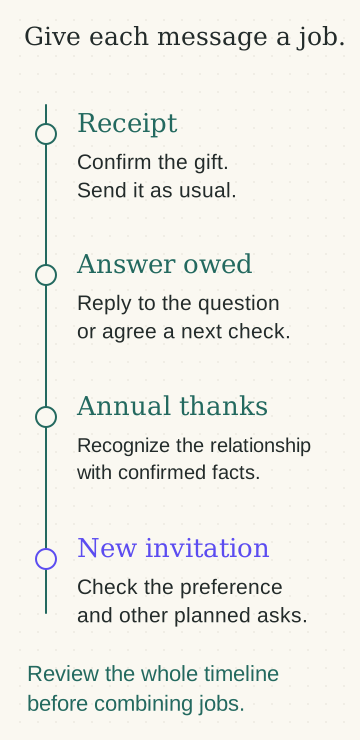
The study
- Greedy or Grateful? Asking for More when Thanking Donors
2019 working paper. Results are reported by recency, frequency and gift size. The targeting estimate is a calculation, not a separate test.
Worked case
Linden’s November letter
Linden Neighbors pairs volunteers with older people who live alone and runs a shopping minibus for them. Each November it emails donors an annual thank-you with a short account of the year. Its year-end appeal on November 24 and Giving Tuesday email on December 1 use the donor list frozen on October 31: donors who gave between November 1, 2024 and October 31, 2026.
This year Tomás, the development director, proposes adding a paragraph to the November 10 thank-you inviting a gift toward a second minibus. On November 2, before any talk of a test, Tomás asks Aisha in donor care for the contact timeline of every donor with open activity. The first one Aisha brings back belongs to Irene Kowalski.
| Date | What | Owner | Status |
|---|---|---|---|
| October 6 | Online gift of $150, with automatic receipt | Payments system | Sent October 6 |
| October 9 | Irene asks whether the gift can go to the shopping service, and asks for the annual report | Aisha, donor care | Acknowledged; answer promised by October 20 |
| October 20 | Answer to Irene’s question | Aisha, with finance | Overdue. Finance hasn’t yet confirmed how to answer. |
| November 10 | Annual thank-you, possibly with invitation | Tomás | Planned |
| November 24 | Year-end appeal | Tomás | Planned |
| December 1 | Giving Tuesday email | Communications | Planned |
Irene has three messages planned in three weeks, at least two of them requests for money, and an answer that is almost two weeks late. The proposed invitation is about the shopping service, the very thing Irene asked about. Sending it before the answer would tell Irene the organization had time to ask but not to reply.
Tomás pauses the invitation for Irene. Aisha gets the answer from finance and sends it with the annual report by November 6. Irene receives the plain thank-you on November 10. The November 24 appeal goes ahead, because Irene’s preferences allow appeal emails.
From one record to the whole list
Aisha applies the same checks to all 2,400 donors who gave between November 1, 2023 and October 31, 2026. Each donor goes into the first row that applies, so nobody is counted twice.
| Check, in order | Donors | What they receive on November 10 |
|---|---|---|
| No email consent, or asked not to be emailed | 310 | Nothing by email. Postal thanks where their preferences allow. |
| Asked not to receive fundraising requests | 140 | The plain thank-you |
| Monthly donors | 180 | The monthly donors’ own thank-you |
| Managed personally by a relationship manager | 60 | A letter from their relationship manager |
| Open issue: unanswered question, overdue promise, failed payment or pledge instalment due | 45 | The plain thank-you, once the issue is resolved |
| Last gift on or after October 11, 2026 | 165 | The plain thank-you. They had a receipt and thanks within the past month. |
| Eligible for the invitation | 1,500 | Decided by group, below |
| All donors | 2,400 | – |
A decision for each group
Tomás defines the groups before anyone is assigned. Current donors made their last gift between November 1, 2024 and October 10, 2026; lapsed donors made theirs between November 1, 2023 and October 31, 2024. Of the 1,500 eligible, 1,100 are current and 400 are lapsed.
| Group | Eligible | Decision | Reason |
|---|---|---|---|
| Current: last gift November 1, 2024 to October 10, 2026 | 1,100 | Plain thank-you for all 1,100 | All are on the November 24 appeal list, so an invitation on November 10 would put two requests 14 days apart. Tomás will reconsider with next year’s calendar. |
| Lapsed: last gift November 1, 2023 to October 31, 2024 | 400 | Test: 200 plain thank-you and 200 with the invitation, assigned at random | They aren’t on the year-end lists, so the annual thank-you is the only fundraising campaign planned for them this winter. Receipts and replies continue as usual. With 200 in each half, the result can point to something worth checking. It won’t settle it. |
Aisha assigns the lapsed donors on November 3 and saves the file read-only. Gifts from November 10 to December 8 will be matched to the version each donor was assigned, and the team will review on December 15. Tomás uses the completed appeal test linked below to show colleagues how to read the result group by group, against everyone originally assigned.
The annual thank-you
Sent November 10 to every donor receiving the plain version. Program figures confirmed by the program director on November 4.
Subject: Thank you from Linden Neighbors

Hi [first name],

Thank you for supporting Linden Neighbors.

This year, 140 volunteers made weekly visits to 210 older people who live alone in [area]. Our shopping minibus made 1,900 trips, and 37 people who hadn’t left home in a month or more joined the Thursday lunch club.

If you have a question, or you’d like to hear from us more or less often, reply to this email or call Aisha on [number].

With thanks,
Tomás [surname]
Development Director, Linden Neighbors
The invitation paragraph
Added after the program paragraph for the 200 lapsed donors assigned to it. Nothing else changes. Finance confirmed the fund wording on November 4.
Our minibus is fully booked on Tuesdays and Fridays, and 26 people are waiting for a shopping slot. We’re raising money for a second minibus. If you’d like to help, you can give at [link]. Gifts made through this email go to Linden’s general fund, which pays for the minibus along with our other services. If now isn’t the right time, there’s no need to reply.Tomás’s note to colleagues
Sent November 3, after assignment.
Subject: November 10 thank-you: who gets what

Hi all,

The annual thank-you goes out on November 10. Here’s who gets which version and what needs to happen first.

Plain thank-you: 1,100 current donors, 140 who don’t want fundraising requests, 165 who gave on or after October 11, 200 lapsed donors in the comparison half, and 45 with open issues once each issue is resolved.
Thank-you with the minibus paragraph: 200 lapsed donors, chosen at random from 400.
Not in this send: 310 without email consent (postal thanks where allowed), 180 monthly donors (their own letter) and 60 managed personally (their manager’s letter).

Aisha: please clear the 45 open issues by November 6, starting with overdue answers. Anyone still open on November 9 gets the thank-you after their issue is resolved.
Finance: receipts carry on exactly as usual. Please don’t hold any back.
Everyone: if a donor unsubscribes or asks for fewer emails after November 10, remove them from every later send straight away. Aisha keeps them in the test count under their original version.
Replies: Aisha answers within two working days, whichever version the donor received.

Window: gifts from November 10 to December 8, matched to the assignment saved on November 3. Review: December 15.

Tomás
Read a completed appeal test
- Before You Borrow the Winning Email
The worked test includes revenue, contact outcomes and the effect of a large gift, counted against the original assignment.
Team kit
Your annual thank-you
Adapt for donors who will receive the annual thank-you without an invitation. Confirm each figure with the program team.
Subject: Thank you from [organization]

Hi [first name],

Thank you for supporting [organization]. [Gift sentence, only where you’ve checked the gift record.]

[Two or three sentences on what happened this year, each confirmed by the program team.]

If you have a question, or you’d like to hear from us more or less often, reply to this email or call [name] on [number].

With thanks,
[Name]
[Role], [Organization]
Your invitation paragraph
Placed after the program paragraph, for eligible donors only. Agree the fund wording with finance.
[What’s needed, in one or two confirmed sentences.] If you’d like to help, you can give at [link]. Gifts made through this email [destination, in wording agreed with finance]. If now isn’t the right time, there’s no need to reply.Your pre-send decision sheet
Complete it before anyone is assigned. Each donor goes in the first eligibility row that applies.
ANNUAL THANK-YOU: PRE-SEND DECISION

Send date:
Owner:
Reference date for giving history:
Base list (who, and gift dates):

1. MESSAGES THAT STAY SEPARATE
Gift receipts unchanged and on usual timing: ☐ confirmed with finance
Replies owed to donors listed and assigned: ☐
Welcome series unaffected: ☐

2. ELIGIBILITY
Check | Donors | What they receive
No email consent, or asked not to be emailed |  |
No fundraising requests |  |
Monthly or recurring donors |  |
Managed personally |  |
Open issue (unanswered question, overdue promise, failed payment, pledge instalment due) |  |
Gave within [days] of the send |  |
Other: |  |
Eligible for the invitation |  |
Total (must equal the base list) |  |

3. CONTACT CALENDAR, [send date] TO [six weeks later]
Other messages planned for eligible donors (date, message, which donors):

4. GROUPS, DEFINED BEFORE ASSIGNMENT
Group 1 (definition, with dates):            Count:
Group 2 (definition, with dates):            Count:

5. DECISION FOR EACH GROUP
Group | Plain for all / invitation for all / test | Reason | Revisit on
1.
2.

6. IF TESTING
Assignment date and method:
Saved file (where, read-only):
Window for counting gifts:
Primary measure: net revenue per assigned donor, by group and version
Guardrails: unsubscribes, complaints and no-solicitation requests, by group and version
Later opt-outs removed from later sends and kept in the count under their assigned version: ☐
Review date:
Reading the result: https://gratona.com/atlas/reading?source=before-you-borrow-the-winning-email

7. SIGN-OFF
Development (name, date):
Donor care (name, date):
Finance, for receipts (name, date):
Your note to colleagues
Send after the eligibility and assignment files are checked. Give each open task one person and a date.
Subject: [Date] thank-you: who gets what

Hi all,

The annual thank-you goes out on [date]. The checked list and saved assignment are at [location].

Plain thank-you: [groups and counts].
Thank-you with the invitation: [groups and counts; assignment method if testing].
Separate arrangements: [who, their message or contact method, owner].

Open issues: [name] will answer the questions and resolve overdue promises by [date]. Anyone still awaiting an answer gets their thank-you after the issue is resolved.
Receipts: [name] confirms they continue on their usual timing, whichever version a donor receives.
Contact preferences: [name] applies new opt-outs or frequency changes to every sending queue before the next send. Keep donors in the test count under their original assignment, even if later contact stops.
Replies: [name] responds within [time], whichever version was received.

Counting window: [dates]. Review: [date and person]. Count gifts and contact outcomes against everyone originally assigned, by donor group and version.

[Name]
The thank-you decision sheet
The pre-send sheet, both message versions and the note to colleagues in one file.
Download the decision sheetExceptions
- A donor gives between assignment and the send. The receipt goes out as usual, and the donor stays in the assigned group.
- An open issue isn’t resolved by the send date. Send the thank-you later, after the answer.
- Two donors in one household fall into different groups. Decide before assignment whether you assign people or households, and send one version per unit.
- A relationship manager wants a managed donor included. Managed donors get their manager’s letter. Keep them out of the test.
- A donor in the test asks for no fundraising email. Honor it in every queue at once. The donor stays in the count under the original version.
Check before you press send
Ask a colleague who wasn’t in the planning to pick five eligible donors at random and read each one’s contact calendar for the next six weeks. If any would receive a request before an answer they’re owed, or two requests close together, fix the list before sending.
After the window, confirm that every receipt went out on its normal timing and every reply was answered within the agreed time, in both versions. Development owns the decision sheet, donor care owns open issues and replies, and finance owns receipts.
Continue with the source
Read the description of the letter versions, then the results by recency, frequency and gift size. The section on targeting shows how the 6–11% estimate was calculated and what it assumes.
Read the research ↗Finish the thank-you message decision
Review the donor’s contact timeline, settle the message’s job and define eligibility before any test assignment.
Download the worksheetOne Email Means Every Team
Write a fundraising-email promise with exact dates, apply it to every sending queue and check the delivery log to confirm it held.
Mette Trier Damgaard and Christina Gravert ran email experiments with DanChurchAid, including a version that told recipients they would hear less often.
The worked cases and templates use invented people and organizations.
The lesson
The finding in its setting
Damgaard and Gravert (2018) emailed about 43,500 people on DanChurchAid’s list. One version added a postscript promising a single email in the next three months, where the usual pattern was monthly. Over the first three days, 0.30% of that group unsubscribed against 0.49% for the usual email: 0.19 percentage points lower, or about 39% fewer in relative terms. Giving didn’t differ significantly. Donors who gave monthly by automatic payment weren’t included.
The tested promise covered email in general. A promise about fundraising email only, like the one below, is narrower and wasn’t what the study tested. The study doesn’t show that quarterly contact suits everyone or that fewer emails raise more money.
One promise, many senders
A development team can send one appeal and still break the promise, because the events team sends a ticket invitation, a relationship manager sends a personal ask and the platform sends an automated reminder. Each team sent one email. The donor received four.
Classify every message by its purpose, whatever the sending team calls it. Then check each donor’s delivery history across every system that can send. A combined contact history tells you whether the promise held; a count of templates per team doesn’t.
| Message | Usually sent by | Counts as fundraising? | Why |
|---|---|---|---|
| Appeal or appeal reminder | Development, automation | Yes | It asks for a gift. |
| Ticket invitation for a fundraising event | Events | Yes | It asks for money for the organization. |
| Personal email asking for a gift | Relationship manager | Yes | The sender’s relationship doesn’t change what it asks for. |
| Newsletter with an appeal section or donate button | Communications | Yes | The request is part of the message. |
| News-only update | Communications | No, if it has no request and no giving link | Write down what news-only means for your team. |
| Automated renewal or lapse reminder | Platform | Yes | It asks for a gift on a timer. |
| Gift receipt | Payments | No, if it holds only the receipt | Check the template for added appeal text first. |
| Reply to a donor’s message | Anyone | No, while it answers what they asked | Adding an ask makes it a solicitation. |
| Logistics for a ticket already bought | Events | No, if logistics only | Auction or pledge promotions count. |
Writing the promise
Use exact dates, name the kind of email covered and list what will still arrive. If the donor’s own words were broader, such as “just one email please,” either honor that for all email or ask what they meant before applying a narrower promise.
Keep each preference with its source and date, apply the latest one and keep the history. A preference outranks anything staff have said they’ll send. If a relationship manager offered to send a proposal and the donor has since chosen fewer fundraising emails, the proposal becomes the one email or waits until the period ends.
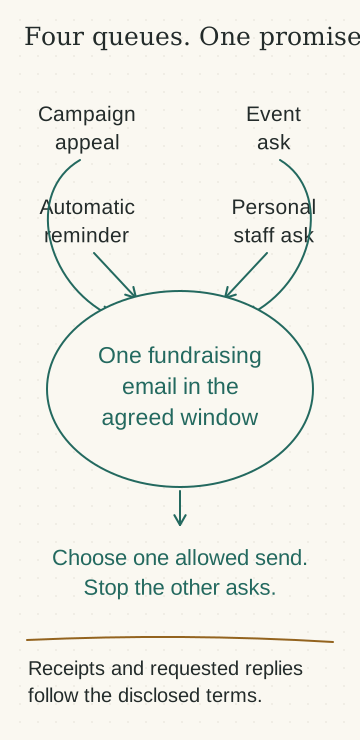
The study
- The hidden costs of nudging: Experimental evidence from reminders in fundraising
2018. The frequency comparison is one of three versions in the second experiment. Monthly automatic-payment donors were excluded.
Worked case
Ruth’s preference, and what was already scheduled
Cedar Valley Hospice’s preference page lets donors choose “One fundraising email between November 1 and January 31.” Ruth Adair, who has given every December for six years, chooses it on October 20 and receives the confirmation below. Ruth’s record also shows a September conversation in which Dan, a relationship manager, offered to send details of the family room renovation in November, and Ruth said that would be fine.
On October 23, Keisha, the operations manager, pulls every message scheduled to reach Ruth between November 1 and January 31 from every system that can send email.
The confirmation Ruth received
Sent automatically when the preference is saved. Keisha checked the wording against what each queue can honor when the preference page was set up.
Subject: Your email preference is saved

Hi Ruth,

Thanks for letting us know. Between November 1, 2026 and January 31, 2027, Cedar Valley Hospice will send you one email asking for a donation, a ticket purchase or any other gift. That includes event invitations and personal emails from our staff.

During that time you’ll still receive:
- news updates with no requests for donations
- a receipt for any gift you make
- replies to anything you write to us

If you’d prefer no news updates either, or no email from us at all, reply to this email or change your choice here: [preference page]. After January 31, you’ll hear from us as before unless you choose otherwise.

Keisha [surname]
Operations Manager, Cedar Valley Hospice| Date | Message | Queue owner | Fundraising? | Decision |
|---|---|---|---|---|
| November 12 | Winter concert ticket invitation, proceeds to the hospice | Paul, events | Yes | Suppress |
| November 18 | Family room renovation proposal, with a request | Dan | Yes | Send. This is the one fundraising email. |
| November 19 | Monthly news update | Lin, communications | No, news-only edition | Send the news-only edition |
| December 1 | Year-end appeal | Keisha, development | Yes | Suppress |
| December 14 | Automated renewal reminder, 12 months after Ruth’s last gift | Keisha, platform rule | Yes | Suppress |
| December 17 | Monthly news update, led by the year-end appeal | Lin | Yes | Suppress |
| December 29 | Automated year-end reminder | Keisha, platform rule | Yes | Suppress |
| January 21 | Monthly news update | Lin | No, news-only edition | Send the news-only edition |
| Any date | Gift receipt | Payments | No | Send as usual. The receipt template has no appeal text. |
| Any date | Replies to messages from Ruth | Whoever Ruth writes to | No, unless an ask is added | Send |
How Keisha resolved it
Dan’s proposal becomes the one fundraising email. Ruth had agreed to receive it, it’s the most specific of the six fundraising messages scheduled, and it comes from someone Ruth knows. Keisha asks Dan to keep it to one message. If Ruth replies with questions, Dan answers them, but there’s no follow-up nudge unless Ruth asks for one.
Lin’s platform can’t remove the appeal section for individual readers, so Lin sets up a news-only edition, with no appeal and no donate button, for donors with this preference. In December, when the appeal leads the newsletter, the edition is suppressed for them.
Keisha adds Ruth to the suppression list in every system that sends: the email platform, the events platform and the automation rules. Each queue owner confirms in writing that it’s applied. Dan’s calendar entry now reads “Ruth: one fundraising email agreed, November 18.”
The audit
Keisha reads delivery events every Monday during the period, and again on February 2. Drafts and scheduled sends don’t count. Keisha reads delivery logs from the email platform, the events platform and the CRM’s record of staff email, and asks relationship managers to confirm anything sent outside those systems.
| Date delivered | Message | System | Fundraising? | Within the promise? |
|---|---|---|---|---|
| November 18 | Dan’s renovation proposal | CRM staff email log | Yes | Yes, the one fundraising email |
| November 19 | News update, news-only edition | Email platform | No | Yes |
| November 24 | Dan’s answer to Ruth’s question about naming the room | CRM staff email log | No, a reply Ruth asked for | Yes |
| December 3 | “Last few concert tickets” reminder | Events platform | Yes | No |
| December 11 | Receipt for Ruth’s gift of $400 | Payments | No | Yes |
| January 21 | News update, news-only edition | Email platform | No | Yes |
The December 3 reminder came from a weekly contact import into the events platform, and the import didn’t carry suppressions. Keisha finds it on the December 7 check. Ruth received two fundraising emails instead of one. Keisha fixes the import, checks the other donors with the same preference and finds eleven more who received the reminder, and tells Paul and Dan that day.
Ruth’s preferences still allow email, so Keisha sends a short apology with no mention of the concert or the appeal and no request of any kind. For the one affected donor who had since asked for no email at all, Keisha fixes the cause and records the breach without writing.
Ruth’s December gift doesn’t restart anything. The receipt went out as usual and the promise ran to January 31. The February 2 audit found no further breaches.
Keisha’s apology
Sent December 7 to donors whose preferences allow email, after the cause was fixed.
Subject: An email we shouldn’t have sent

Hi Ruth,

In October you asked us to send you only one fundraising email between November 1 and January 31. On December 3 our events system sent you a reminder about concert tickets as well. That was our mistake, and we’ve fixed the setting that caused it.

You don’t need to do anything. If you have a question, reply here or call me on [number].

Keisha [surname]
Operations Manager, Cedar Valley Hospice
Team kit
Your promise wording
Use it on the preference page and in the confirmation. Keep only the lines every queue can honor.
Subject: Your email preference is saved

Hi [first name],

Between [start date] and [end date], [organization] will send you [one] email asking for a donation, a ticket purchase or any other gift. That includes event invitations and personal emails from our staff.

During that time you’ll still receive:
- [news updates with no requests for donations, or remove this line]
- a receipt for any gift you make
- replies to anything you write to us

If you’d prefer [no news updates either / no email from us at all], reply to this email or change your choice here: [link]. After [end date], you’ll hear from us as before unless you choose otherwise.

[Name]
[Role], [Organization]
Your queue register
One register per promise. Every queue owner confirms suppression in writing, and again after any import or list rebuild.
FUNDRAISING EMAIL PROMISE: QUEUE REGISTER

Promise, word for word:
Period:
Current preference (source, date):
Earlier preferences (source, date):
Register owner:

QUEUES THAT CAN SEND EMAIL
Queue | System | Owner | How suppression is applied | Confirmed (date)
Central appeals |  |  |  |
Event invitations and reminders |  |  |  |
Personal asks from staff |  |  |  |
Newsletters |  |  |  |
Automated reminders and renewals |  |  |  |
Receipts |  |  |  |
Other: |  |  |  |

DEFINITIONS
Counts as fundraising:
News-only means:
Receipt template checked for appeal text (date):

MESSAGES SCHEDULED IN THE PERIOD
Date | Message | Owner | Fundraising? | Send / suppress / move after period | Confirmed by
1.
2.
3.
4.
5.

STAFF COMMITMENTS AFFECTED
Who | What they told the donor | Resolution
Your delivery audit
Read delivery events, not drafts or schedules. Run it on a fixed day each week and after the period ends.
DELIVERY AUDIT

Donor or group:
Period:
Checked on (dates):
Sources read:
☐ Email platform delivery events
☐ Events platform
☐ CRM log of staff email
☐ Relationship managers asked about email sent outside these systems
☐ Automation logs

Date delivered | Message | System | Fundraising? | Reply the donor asked for? | Within the promise?
1.
2.
3.

Fundraising emails delivered:            Promised:
Breaches:
Cause:
Fixed by (name, date):
Other donors affected:
Donor told: ☐ yes, by [channel] on [date]   ☐ no, preference doesn’t allow contact
Recorded in each donor’s history: ☐
If you broke the promise
Send only if the donor’s preference allows email from you, and only after the cause is fixed. If they asked for no contact, fix it and record it without writing. Include no request.
Subject: An email we shouldn’t have sent

Hi [first name],

On [date] you asked us to send you only [the promise, in their terms]. On [date] we sent you [message] as well. That was our mistake. We’ve fixed [cause, in plain words], and the rest of the period will follow your choice.

You don’t need to do anything. If you have a question, reply here or call me on [number].

[Name]
[Role], [Organization]
The contact frequency promise kit
The promise wording, queue register, delivery audit and apology in one file, for the meeting with every team that sends email.
Download the promise kitExceptions
- The donor’s words were broad, such as “just one email.” Treat it as all email, or ask what they meant before narrowing it.
- The donor asks for no email at all. That replaces the fundraising promise at once, including news. Ask finance how receipts will reach them through a channel they allow.
- The donor gives during the period. Send the receipt as usual. The gift doesn’t reset or extend anything.
- The donor writes asking about an appeal. Answer it and record it as a conversation the donor started. Don’t follow up with asks they didn’t request.
- Two records disagree. Use the latest preference stated by that person, and keep both with their sources and dates.
- A staff member is sure the donor would welcome another ask. Don’t send it. The promise stands until the end date unless the donor changes it.
Who owns it
One person owns the register and the audit, usually in operations. Each queue owner confirms suppression in their own system, and confirms again after any import or list rebuild. Relationship managers log personal emails in the CRM or tell the register owner, because personal email often bypasses the systems the audit reads.
Check that it held
- For each donor with the preference, fundraising emails delivered in the period match the promise, counted from delivery events.
- Every breach has a cause, a fix, a date and a record of what the donor was told, or why they weren’t.
- Suppression was rechecked after every import or list rebuild in the period.
- After the end date, each donor’s messages follow their earlier preferences unless they chose something new.
Continue with the source
In the second experiment, find the version with the low-frequency postscript and compare its wording with the usual email. A footnote explains why unsubscribes were counted over three days. Note which donors were left out of the sample.
Read the research ↗Apply the contact promise to every queue
List every sender, resolve the scheduled messages and keep a delivery record and recovery plan.
Download the worksheetOriginal field notes by Gratona, with links to the books, conversations and research behind them.
More practitioner conversations
Seventeen more sources, each with a note on what it covers and when it helps.
387. How to Build the Infrastructure to Succeed in Fundraising - Mary Hackett — We Are For Good
Mary Hackett
For when the database, the reports and finance’s totals don’t agree. Covers agreeing what pledges and cash mean with finance, separate reports for the board and frontline staff, and a contact-report template.
How to Approach Donor Stewardship in Planned Giving - Veritus Group
Richard Perry / Jeff Schreifels / Bob Shafis
For stewarding legacy pledges: a written annual plan for each donor, recognition permission, and checking intent again as circumstances change.
Keep, Lift, Move: The Three Objectives of a Successful Mid-Level Program [Podcast Episode]
Lisa Robertson / Kara Ansotegui
For measuring a mid-level program: retained donors and retained value counted separately, and growth measured within the existing cohort instead of mixed with acquisition.
Personalized Communications: The Key To Donor Retention
Valerie Harris
The most operational of the stewardship sessions: where writers find preferences and history, a frontline review role and turnaround standards that include checking for errors.
[VIDEO] Using Stewardship to Keep Donors Happier Longer
Claire Axelrad
For planning a first-year welcome with useful mission material, and for respecting donors who want limited contact. Treat the statistics it cites as historical.
[VIDEO] Donor Retention Isn't Speed Dating
Lynne Wester
For separating the receipt from the thank-you, and giving new donors a welcome path before the standard appeal calendar applies.
Increase Retention for #GivingTuesday Donors
Steven Shattuck
For auditing what a campaign donor receives after giving, automated asks included. It draws on a small 2016 mystery-shopping exercise, not a representative study.
How the Donor Participation Project Builds Community
Louis Diez
For donor communities and events meant for real exchange: routine feedback, shared norms, and not reading quiet attendance as lack of interest.
Creating Magic in Every Moment: Personalizing the Recurring Donor Experience
Mallory Erickson
For monthly-giving programs: a short welcome series, anniversary recognition without an ask, and optional questions your team can act on.
Storytelling: The Secret Sauce to Fundraising Success - Thompson & Associates
Lynn Malzone Ierardi / Eddie Thompson
A short introduction to building a story around one concrete episode. Lighter than the other storytelling sources here.
How Storytelling Can Up Your Fundraising
Joan Garry
For helping board members give a two-minute account of the work, and for noticing when inconsistent descriptions point to a disagreement about strategy.
#18 - Fundraising: How Storytelling Helped Achieve a Single Gift of $27.1 Million - and More With Tammy Zonker of Fundraising Transformed — Unveild
Tammy Zonker / John Azoni
For coordinating the connector, executive and fundraiser on a major gift, and pairing a story with a costed proposal. It is one self-reported case, not evidence that the story caused the gift.
The Power of Sharing Stories — Fundraising Growth Now! Podcast — RSC Associates
Bob Swaney
For using a story to open a conversation and invite the donor’s own experience. Includes short prompts staff and board can practice with.
Episode 016 - Effective Nonprofit Storytelling - Nonprofit Fundraising
Jeremy Reis
The structural basics: one specific person, a clear before and after, and different jobs for a stewardship story and an appeal.
Four Pillars of Donor Retention: Techniques and Strategies to Retain Donors and Grow Revenue
Lynne Wester
For starting a retention effort: know your baseline, clean up names and preferences, and improve one journey before buying more tools.
356: The Trust Crisis in Major Gift Fundraising with Greg Warner — Nonprofit Lowdown (September 22, 2025)
Greg Warner with Rhea Wong
For preparing a major-gift conversation: wealth screening as incomplete context, asking what giving means to the person, and asking permission before discussing a proposal.
The Art of the Ask: Part 2 — Fundraising Growth Now! Podcast — RSC Associates
Catherine Heitz New
For the ask itself: asking permission to make a request, telling consideration from commitment and agreeing the next conversation before you leave.