
Auto Emails
Updated 3 weeks ago
Auto Emails
Use Auto Emails when you need to set up automated email notifications for donors and administrators. Each auto email set groups related email templates that share a sender address. When a trigger event happens (a new sponsorship, a payment, a profile update, or a message), Gratona sends the matching email automatically.
Find the Auto Emails Page
Open System Automations under APPS in the sidebar, then select the Auto Email tab. If you do not see it in the sidebar, your account may not have the manage email permission.
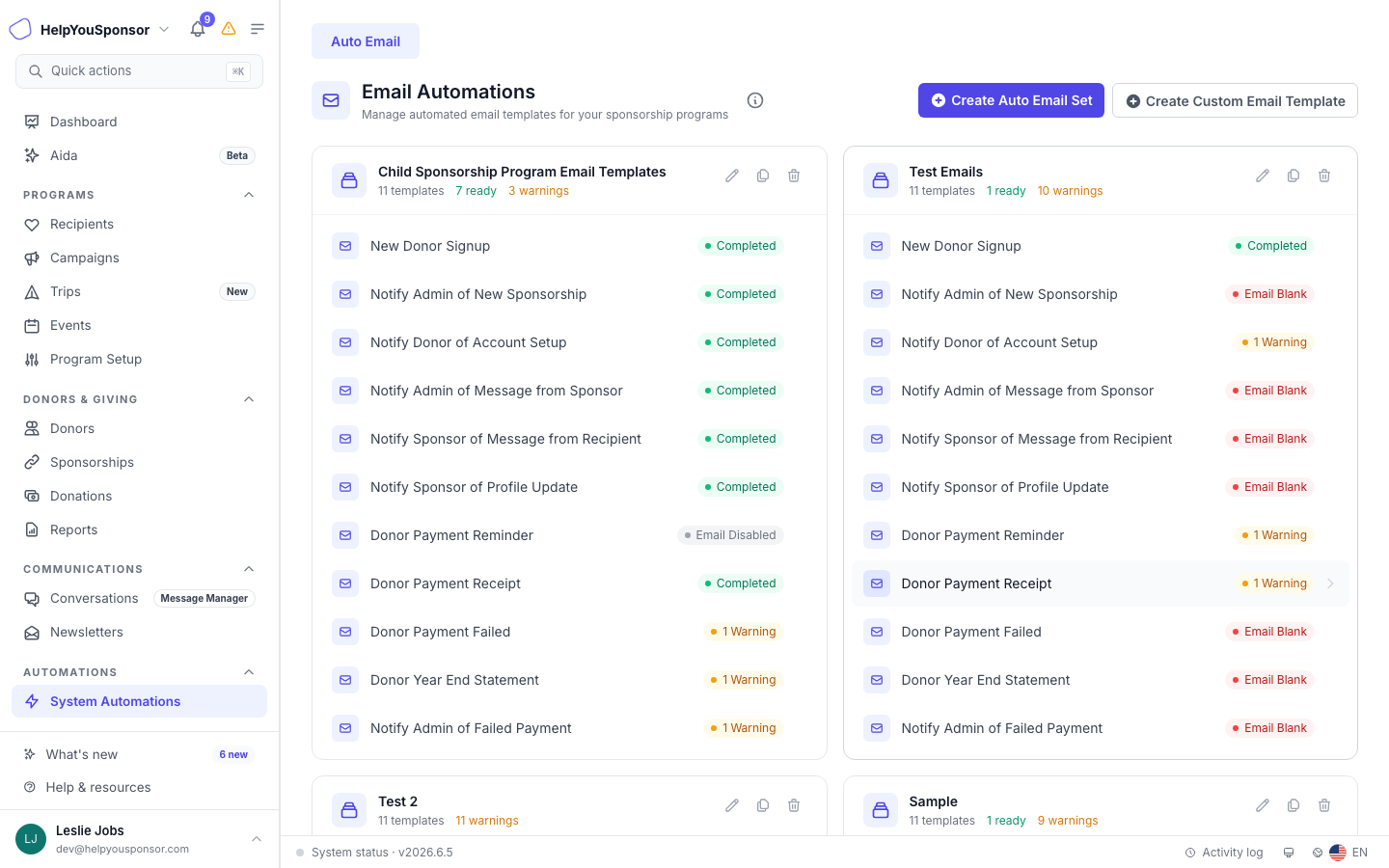
Create an Auto Email Set
An auto email set is a group of email templates that share a from-address and are connected to one or more programs.
Open System Automations and select the Auto Email tab.
Select Create Auto Email Set.
Enter an Email Set Name that helps you identify the set.
Enter the From Email Address that donors and administrators will see as the sender.
Select Submit.
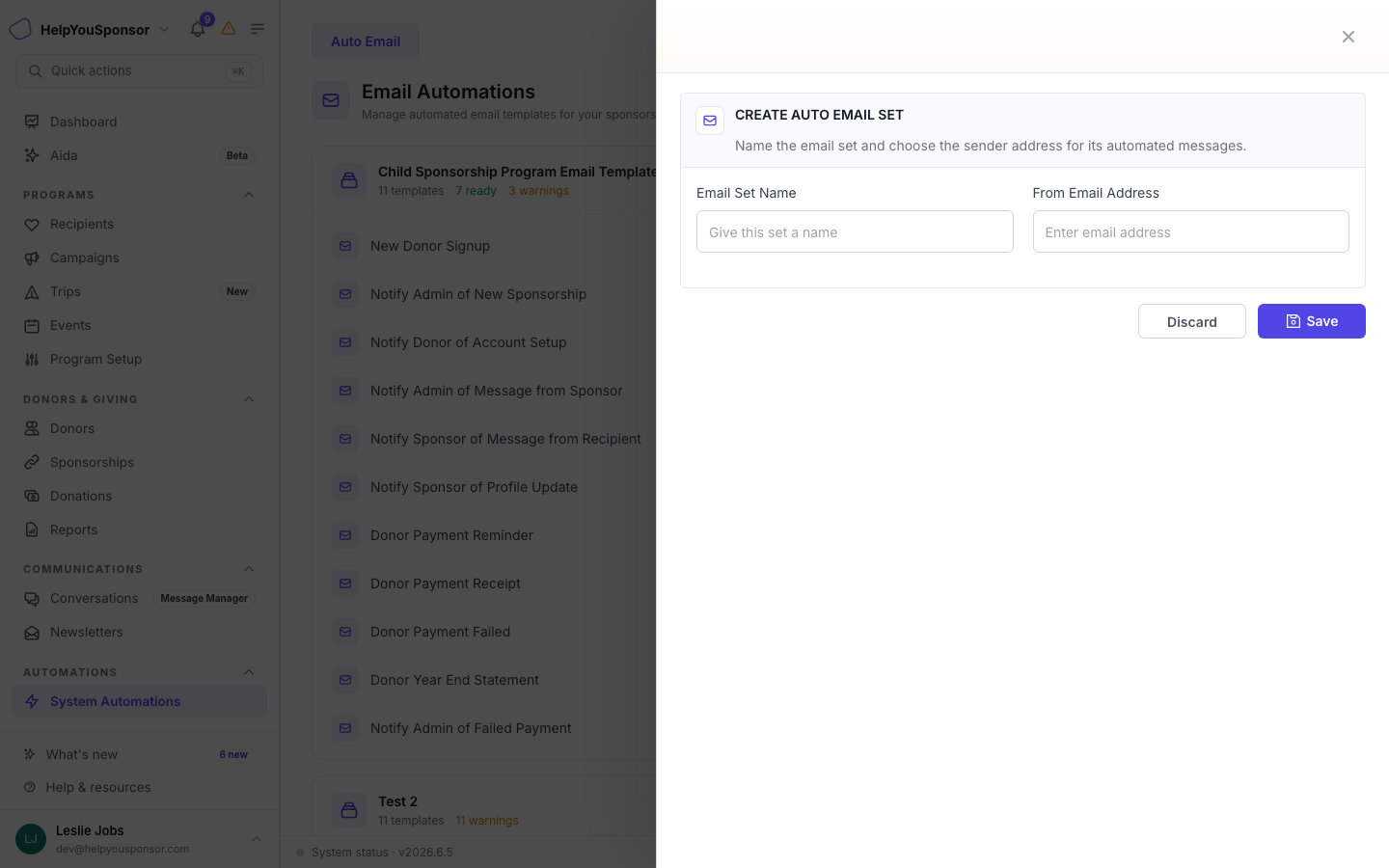
After you create the set, Gratona populates it with default email templates for the supported trigger events.
Review Email Templates in a Set
Each auto email set contains individual email templates. Select an email set card to see its templates.
Default Templates Sent to Donors
Template | When It Is Sent |
|---|---|
New Donor Signup | An admin sets up a new sponsorship, or a donor creates sponsorships on the public site. |
Notify Donor of Account Setup | An admin sets up a donor account, an admin sends it manually from All Donors or a donor profile, or a donor resets their password on the public site. |
Donor Payment Reminder | A payment method is set to credit card but no credit card is on file, or the payment method is set to anything other than credit card. |
Donor Payment Receipt | An admin records a donation, a donor donates by credit card, or Gratona automatically runs a recurring credit card payment. |
Donor Payment Failed | A recurring credit card payment fails to charge. |
Default Templates Sent to Administrators
Template | When It Is Sent |
|---|---|
Notify Admin of New Sponsorship | A donor creates sponsorships. One email is sent per sponsorship. |
Notify Admin of Email from Sponsor | A donor sends a message to their recipient or uploads a file to them. |
Notify Admin of Failed Payment | A recurring credit card payment fails to charge. |
Status Tags
Each template shows a status badge:
Completed: the template has been reviewed and saved with short codes.
Warning: some short codes are unused. The email will still be sent.
Email Disabled: the template will not be sent. Select the template and uncheck the disable option to re-enable it.
Edit an Email Template
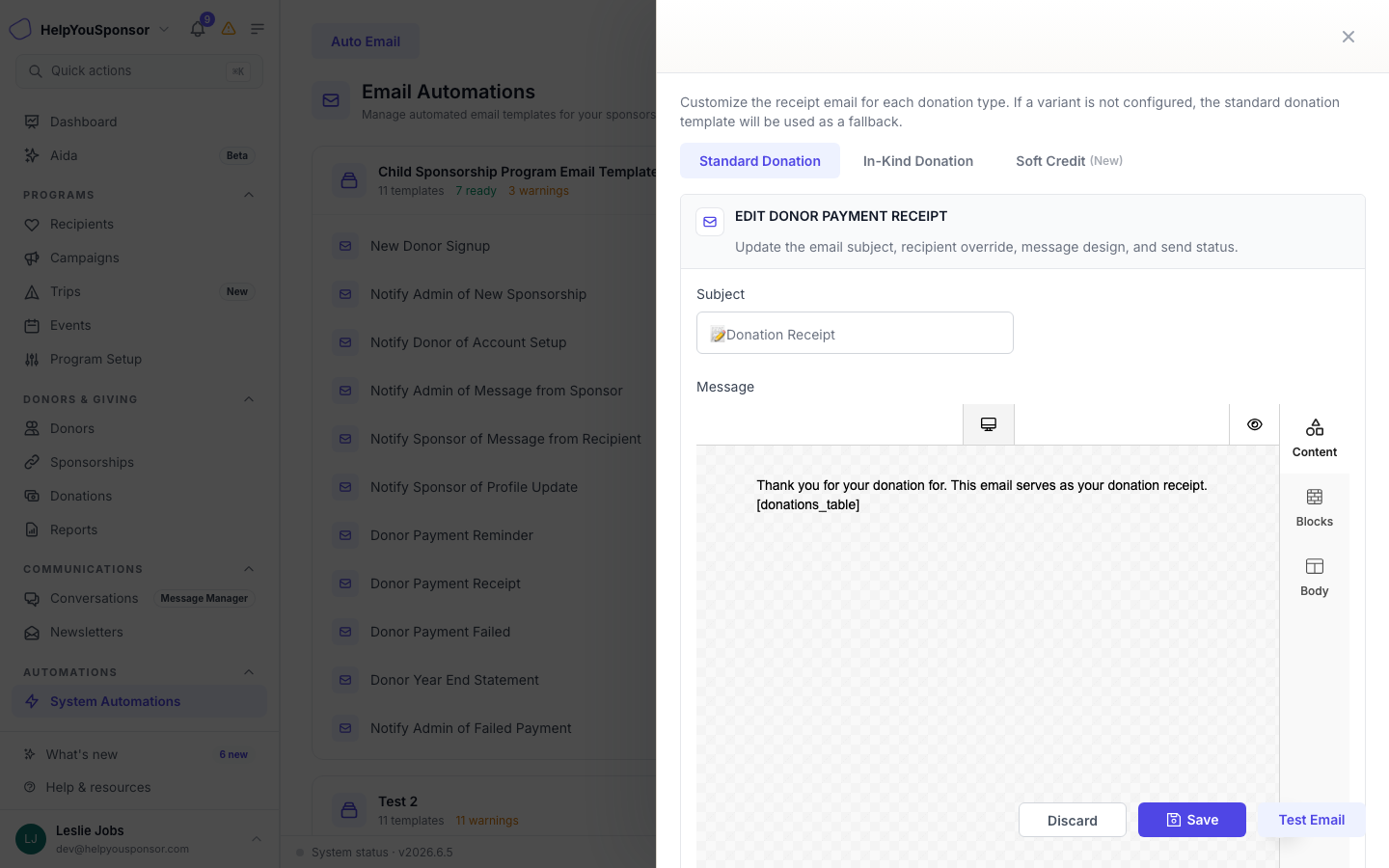
Select any template in the set to open the template editor. The editor lets you customize the message that donors or administrators receive.
Set the Subject and Message
Subject: the email subject line. Use short codes to personalize it, for example
Welcome [donor_first_name]!Message: the email body. Use the Unlayer drag-drop editor to design rich HTML emails, or switch to the code editor for plain HTML.
Disable Email: check this to stop the template from being sent. Uncheck to re-enable it.
Use Short Codes (Merge Tags)
Short codes personalize each email with data from the donor, recipient, or system. The available short codes depend on the template trigger and the program form attached to the email set.
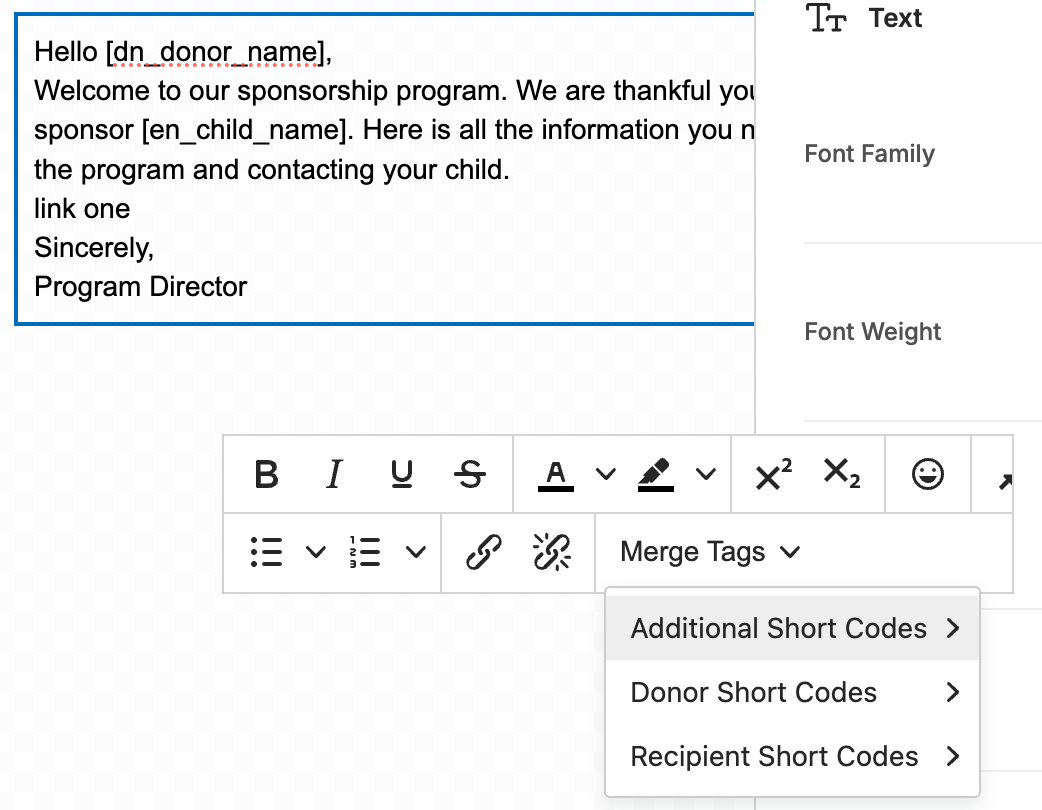
Short code groups include:
Recipient Short Codes: fields from the recipient program form attached to the email set. For example,
[en_child_name]inserts the recipient name.Donor Short Codes: fields from the donor form attached to the email set. Standard donor short codes like
[donor_first_name]and[donor_email]are always available.Custom Donor Short Codes: custom fields from the donor form.
Trip Participant Short Codes: participant fields when the program is a trip program.
In-Kind Donation Short Codes: additional short codes for in-kind donation receipt templates.
System Short Codes: provided by Gratona. These vary by trigger and can include values like the sponsorship amount, next payment date, or organization name.
Select a short code to insert it at the cursor position in the editor.
Note: Use only the short codes listed in the editor. Unrecognized short codes prevent the template from being saved.
Work with Donation-Type Variants
For payment receipt templates, you can create donation-type variants. Each variant sends a different message depending on whether the donation is a standard donation, an in-kind gift, or a soft credit.
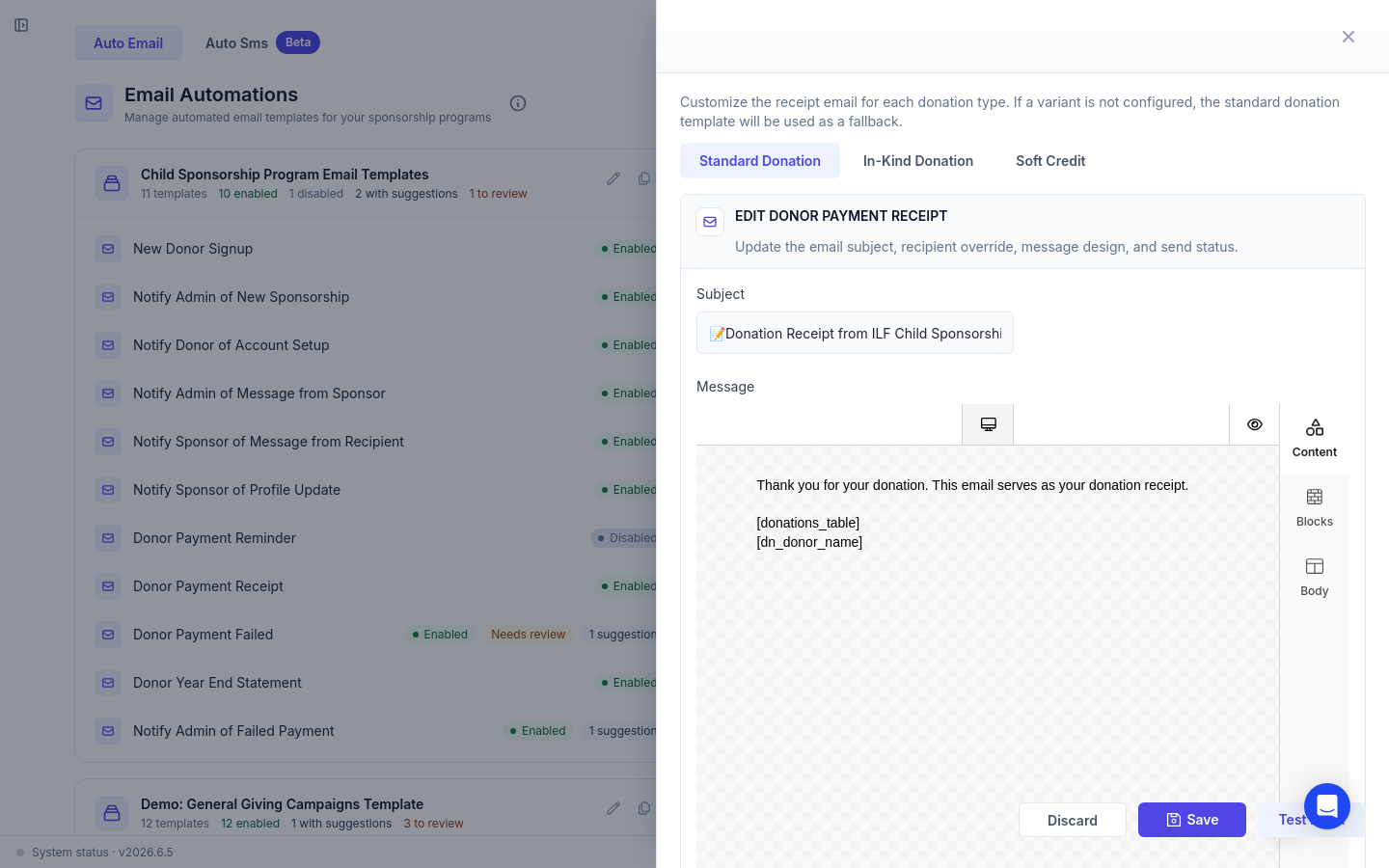
The tabs are Standard Donation, In-Kind Donation, and Soft Credit. An unconfigured tab is marked (New). At send time, a variant that is not configured or is disabled falls back to the standard donation template, so disabling a variant does not stop the receipt. No receipt is sent only when the standard donation template itself is disabled.
Open the Donor Payment Receipt template.
Select the In-Kind Donation or Soft Credit tab.
Gratona creates a copy of the default template for that donation type.
Customize the subject and message. In-kind and soft credit templates have additional short codes available.
Test an Email Template
Use Test Email to send a preview of the template to your own email address before the template goes live.
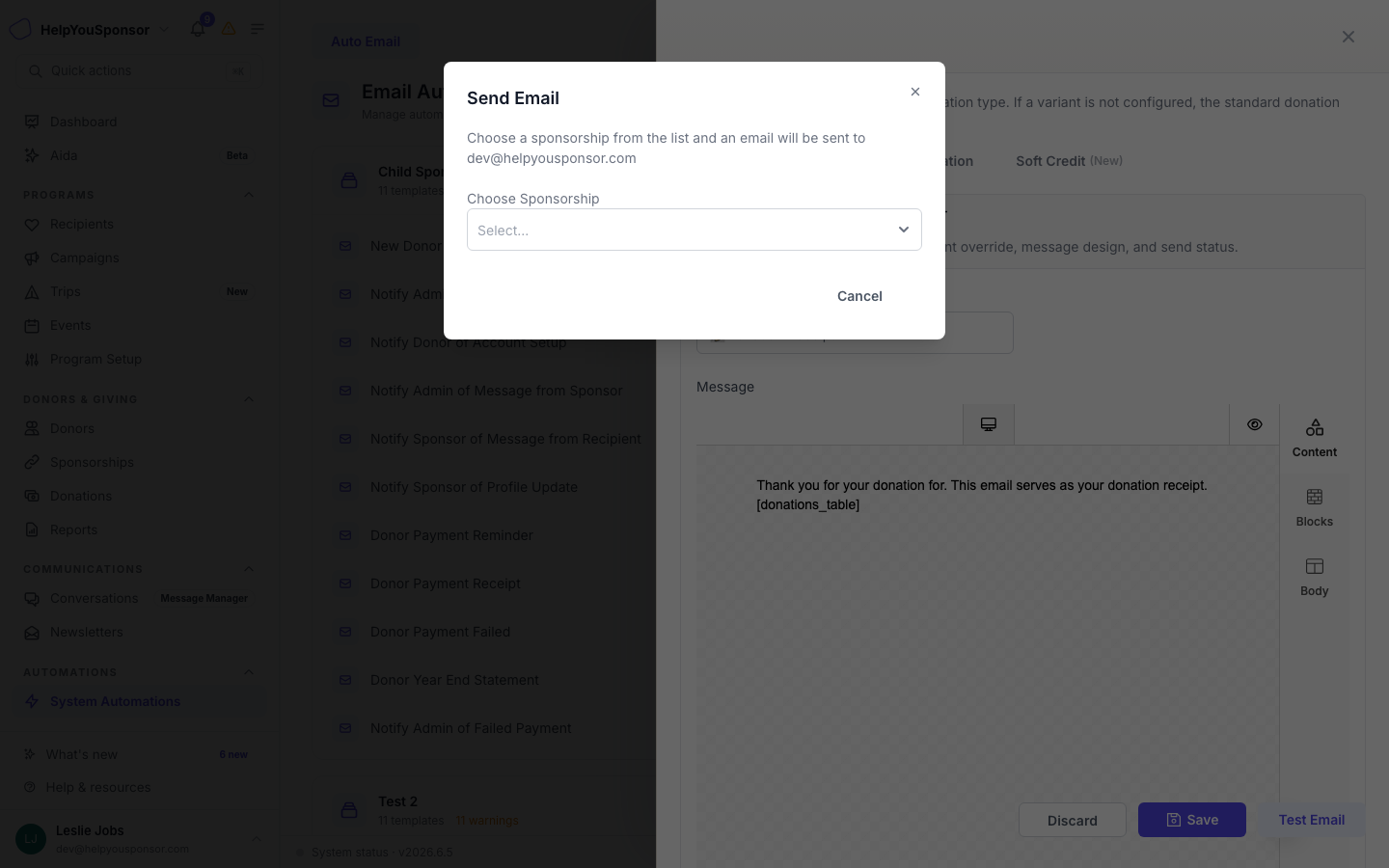
Open the template you want to test.
Select Test Email.
In Choose Sponsorship, select a sponsorship relationship. The sponsorship provides the donor and recipient data used to resolve short codes in the preview. A donor without a sponsorship cannot be used as test data, and Send appears only after a sponsorship is selected.
Select Send.
The test email is sent to your own email address, the administrator you are signed in as. Check your inbox and spam folder. Test Email is unavailable while the template is disabled or while the editor has unsaved changes, so save your edits first. After you activate verified sending, new donor-facing templates use the authenticated sending transport; email sets whose From address is on another domain are not covered by the verified domain.
Manage Email Sets
Clone an Email Set
Use Clone when you want to duplicate an existing email set and its templates. This is useful when you need a similar set for a different program.
Open System Automations and select the Auto Email tab.
Select the clone action on the email set card.
Enter a name for the cloned set.
Select Clone.
Delete an Email Set
Use Delete when an email set is no longer needed. Deleting an email set removes all templates in the set. Programs attached to the deleted set will not send auto emails.
Open System Automations and select the Auto Email tab.
Select the delete action on the email set card.
Confirm the deletion.
Create Custom Email Templates
Use Create Custom Email Template when you need an email template for a trigger that is not part of the default set.
Custom triggers currently available:
Notify donor of photo permission change: sent when a recipient file permission is changed to public.
Notify Donor Of Future Sponsorship: sent when a future sponsorship is set up for a donor.
For full instructions, see Custom Auto Emails.
Permissions
Your role controls whether you can view, create, edit, clone, or delete auto email sets and templates. If the Auto Email tab or the action buttons are missing, your account may not have the manage email permission.